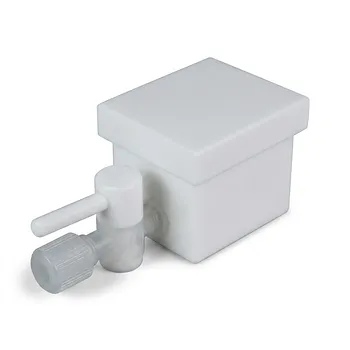
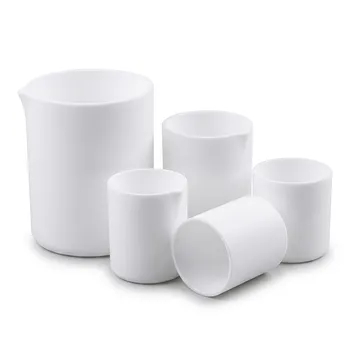
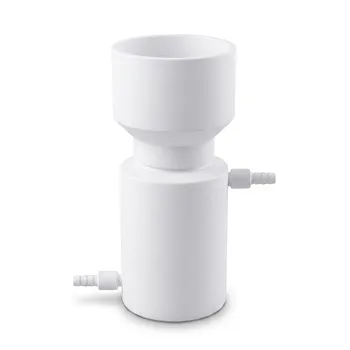
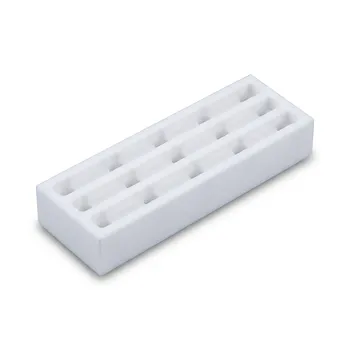
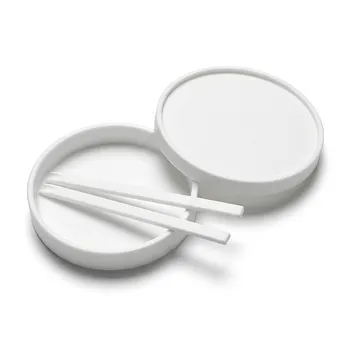
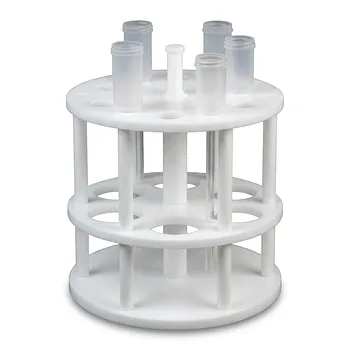
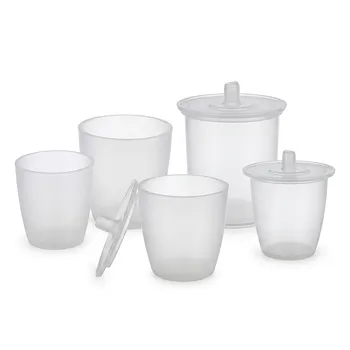
PTFE laboratory equipment is chemically inert and thermally stable because fluorine atoms form a dense protective shell around a carbon backbone, while strong C–F and C–C bonds resist chemical attack and bond cleavage. Fluorine’s very high electronegativity and the compact geometry of the C–F bond make the polymer surface difficult for acids, bases, solvents, and oxidizing agents to penetrate or react with. This structure allows PTFE vessels, tubing, beakers, and fittings to remain stable in severe chemical environments and at sustained temperatures near 260°C, although PTFE is not immune to thermal decomposition or mechanical deformation at higher temperatures.
The key is the combination of strong covalent bonding and molecular shielding: fluorine atoms protect the carbon chain both electronically and sterically, so chemical reagents have few accessible sites from which to initiate attack.
How PTFE’s Atomic Structure Creates Inertness
A carbon backbone with complete fluorine coverage
PTFE is a linear polymer built from repeating tetrafluoroethylene units:
–CF2–CF2–CF2–CF2–
Its carbon–carbon backbone provides the continuous polymer chain, while fluorine atoms surround the backbone along its length. This arrangement leaves very little of the carbon framework exposed to external reagents.
Fluorine provides electronic protection
Fluorine has the highest electronegativity on the Pauling scale, approximately 4.0. In a C–F bond, electron density is drawn strongly toward fluorine, producing a tightly bound, electron-rich outer layer around the polymer chain.
This does not make PTFE chemically reactive toward ordinary laboratory reagents. Instead, the strongly polarized bonds and fluorine-rich surface reduce the ability of other molecules to approach, replace, or abstract atoms from the carbon backbone.
The polymer adopts a helical conformation
The fluorinated chain commonly forms a helical arrangement in which fluorine atoms are closely packed around the carbon spine. Descriptions such as a 13/6 helix refer to the geometric relationship between the polymer chain and its repeating fluorine arrangement.
This geometry reinforces the shielding effect. The fluorine atoms act like a molecular barrier, restricting both physical access to the backbone and the rearrangements that could otherwise lead to chemical degradation.
Why the C–F Bond Resists Chemical Attack
High bond strength limits bond cleavage
The C–F bond is among the strongest bonds found in organic compounds. Its bond dissociation energy is often reported near 116 kcal/mol, equivalent to approximately 485 kJ/mol, although the exact value varies with molecular environment and the definition used.
That energy is substantially greater than the commonly cited values for C–H and C–O bonds. Breaking a C–F bond therefore requires unusually demanding chemical or thermal conditions.
Short bond length supports strong overlap
The C–F bond is relatively short, approximately 1.39 Å. Its short length reflects effective orbital overlap between carbon and fluorine and contributes to a strong, tightly held covalent bond.
A reagent that attacks the polymer must overcome this bond strength and reach the carbon chain through the surrounding fluorine atoms. In PTFE, both requirements are difficult under normal laboratory conditions.
Strong bonding is reinforced by steric shielding
Bond strength alone does not explain PTFE’s resistance. The fluorine atoms also create a steric barrier around the backbone, making it difficult for reactive species to access the carbon atoms or initiate chain reactions.
The result is a dual defense: the bonds are difficult to break, and the molecular structure makes them difficult to reach.
How This Produces Chemical Inertness in Laboratory Equipment
Resistance to acids and bases
PTFE generally resists concentrated acids and bases because these reagents do not readily cleave its C–F-rich structure or attack the carbon backbone. This makes PTFE useful for digestion vessels, reagent bottles, beakers, and transfer components.
Its resistance is especially valuable when the equipment must contact aggressive reagents without contributing significant extractables or corrosion products to a sample.
Resistance to organic solvents
PTFE is not readily dissolved by ordinary organic solvents because the polymer chains are held together by strong intermolecular interactions and have a chemically protected surface. Many solvents can contact PTFE without causing the swelling or dissolution seen in less fluorinated polymers.
This does not mean that every solvent has no effect. Certain extreme conditions, elevated temperatures, or specialized fluorinated solvents can produce swelling, permeation, or other changes.
Resistance to oxidation and reactive chemicals
The fluorinated surface limits access to the carbon backbone and reduces the pathways available for oxidation. Consequently, PTFE components can handle many oxidizing and reactive laboratory environments with minimal chemical degradation.
However, “chemically inert” should be interpreted as highly resistant under defined conditions, not universally unreactive. Molten or highly reactive alkali metals, certain elemental fluorinating conditions, radiation, and some specialized chemical systems can attack or damage PTFE.
Why PTFE Remains Stable at High Temperature
Strong bonds delay thermal degradation
Heating a polymer causes molecular vibrations and can eventually initiate chain scission or other decomposition reactions. PTFE’s strong C–F bonds and stable carbon backbone require substantial energy before these processes become significant.
The fluorine sheath also limits secondary reactions involving the backbone, helping PTFE retain its chemical integrity over a broad laboratory temperature range.
Chain geometry contributes to rigidity
The regular fluorinated structure and helical packing make the polymer chain less chemically accessible and more structurally constrained than a comparable hydrocarbon chain. This reduces the likelihood of internal rearrangement and helps the material retain its identity when heated.
The same structure contributes to PTFE’s low surface energy and low friction, properties that are useful in valves, seals, tubing, and fluid-handling components.
Thermal resistance has practical limits
PTFE laboratory equipment is commonly used for continuous service at temperatures up to approximately 260°C, depending on the product design, load, pressure, and manufacturer’s rating. At higher temperatures, PTFE can soften, creep, lose dimensional accuracy, and eventually decompose.
The important distinction is that chemical stability and mechanical stability are not identical. A PTFE vessel may remain chemically unreactive while becoming unsuitable because of deformation or loss of mechanical strength.
Understanding the Trade-offs
Inertness does not eliminate permeation
PTFE can resist dissolution while still allowing some chemicals or gases to permeate slowly through the polymer. This matters in long-duration storage, pressurized systems, trace analysis, and applications involving very small molecules.
Material selection should therefore consider permeability and exposure time, not only whether the material visibly degrades.
Thermal stability does not mean unlimited heat resistance
PTFE’s normal operating range is far below the temperature at which substantial decomposition occurs. Even before chemical breakdown, heating can cause expansion, creep, softening, and dimensional changes.
Laboratory equipment should be evaluated according to its actual temperature, mechanical load, pressure, and duration of exposure.
Surface contamination can come from handling
PTFE itself contributes very little chemical contamination in many applications, but its surface can retain particles, adsorbed species, or residues from previous use. Cleaning procedures, blank controls, and appropriate storage remain important in trace analysis.
Specialized reagents require separate evaluation
PTFE resists most acids, bases, solvents, and oxidizers, but no polymer is compatible with every reagent at every temperature. Compatibility data should be checked for highly reactive fluorinating systems, molten alkali metals, radiation exposure, and unusual combinations of heat and chemical stress.
How to Apply This to Your Project
PTFE’s molecular structure provides a strong basis for choosing it as laboratory equipment, but the final decision should include operating conditions and contamination requirements.
- If your primary focus is chemical compatibility: Choose PTFE when exposure involves aggressive acids, bases, solvents, or oxidizing reagents, while checking compatibility for unusually reactive chemical systems.
- If your primary focus is high-temperature service: Use PTFE within the manufacturer’s continuous-use temperature and mechanical-load limits, recognizing that softening and creep can occur before chemical decomposition.
- If your primary focus is sample purity: Use PTFE to minimize material-derived contamination, then control cleaning, residue retention, permeation, and procedural blanks.
- If your primary focus is dimensional stability: Consider whether the equipment will experience sustained heat, pressure, or mechanical stress, because chemical inertness does not prevent thermal expansion or creep.
PTFE achieves its exceptional laboratory performance because strong C–F bonding and dense fluorine shielding make its carbon backbone both difficult to reach and difficult to break.
Summary Table:
| Factor | Contribution to Inertness | Contribution to Thermal Stability |
|---|---|---|
| Carbon-Fluorine Bond Strength | ~485 kJ/mol, resists cleavage | High energy needed for decomposition |
| Fluorine Shielding | Steric and electronic barrier to reagents | Protects backbone from thermal attack |
| Helical Polymer Structure | Limits access to reactive sites | Provides structural rigidity |
| Short Bond Length | Strong orbital overlap | Enhances overall bond stability |
| Continuous Fluorine Coverage | Leaves no exposed carbon atoms | Reduces degradation pathways |
Enhance your lab's performance with KINTEK's PTFE/PFA equipment. Our products are crafted from high-performance fluoropolymers, ensuring ultimate chemical resistance and thermal stability. From beakers and tubing to custom CNC-machined parts, we provide solutions for trace analysis, aggressive chemical handling, and high-temperature processes. Contact us today to discuss your requirements and experience the KINTEK advantage!
Related Products
- Custom PTFE Laboratory Apparatus Corrosion Resistant Low Background Reaction Cells Precision CNC Fabrication
- PTFE PFA Vacuum Filtration System Corrosion Resistant Customizable Shatterproof Laboratory Device
- Heat Resistant Custom PTFE Laboratory Beaker for Hot Plate Heating and Trace Analysis
- Large Scale PTFE Beakers and Flasks for High Temperature Corrosion Resistant Laboratory Applications with Custom CNC Fabrication
- High Purity PTFE Buchner Funnel Vacuum Filtration System Corrosion Resistant Low Trace Laboratory Suction Filter Apparatus
People Also Ask
- How does PTFE's melting behavior affect custom lab apparatus? Key insights for manufacturing.
- What are the primary fabrication methods for PTFE laboratory apparatus? Expert Insights into Fluoropolymer Engineering
- What is the chemical compatibility range for PTFE laboratory apparatus? Explore Near-Universal Chemical Resistance.
- Why use PTFE or PFA for modified Cu-MOF synthesis? Ensure High Purity and Exceptional Chemical Stability
- What are the primary chemical resistance properties of PTFE laboratory apparatus? Unmatched Purity and Inertness