For high-temperature laboratory reaction apparatus, PTFE and PFA generally outperform polyphenylenesulfide (PPS) when continuous temperature, chemical purity, and thermal reliability are the primary requirements. PPS supports continuous service around 220°C and resists many industrial solvents, but its brittleness often requires glass-fiber or mineral reinforcement. Virgin PTFE and PFA support continuous use up to approximately 260°C and can provide cleaner, non-contaminating contact with aggressive chemicals.
PTFE and PFA are usually the better choices for trace-level laboratory work and aggressive-acid service. PPS can be useful where mechanical strength and solvent resistance matter, but its lower service temperature and reliance on fillers create additional purity and thermal-stability concerns.
How the Materials Compare in Continuous Service Temperature
Polyphenylenesulfide: A Lower Practical Temperature Ceiling
PPS has a continuous-use temperature of approximately 220°C, with a melting point near 285°C. That makes it a high-temperature engineering plastic, but it provides less operating margin than PTFE or PFA in heated reaction systems.
The difference matters in digestion vessels, heated cells, and reaction apparatus where temperature excursions can occur. A material operated close to its continuous-use limit has less reserve for hot spots, pressure effects, or prolonged exposure.
PTFE and PFA: Higher Continuous Ratings
Both PTFE and PFA are commonly rated for continuous service up to approximately 260°C. This makes them better suited to laboratory systems that must maintain elevated temperatures for extended periods.
Their continuous rating should not be confused with their melting points. PTFE melts around 320-342°C, while PFA melts around 302-310°C, but neither should be operated continuously near its melting range.
Service Temperature Is More Important Than Melting Point
The melting point describes when a polymer loses its solid structure. The continuous-use temperature describes a more practical long-term operating boundary under defined conditions.
For reaction apparatus, the continuous-use rating is normally the more useful design value. It better reflects sustained dimensional stability, chemical containment, and resistance to gradual thermal degradation.
Which Material Provides Better Chemical Purity?
Virgin PTFE and PFA Minimize Contamination Risks
PTFE and PFA can be used in highly pure, unfilled forms without glass fibers or mineral reinforcement. This is important when the apparatus contacts samples for trace analysis, high-purity reagents, or aggressive acids.
Eliminating reinforcing fillers reduces the potential for leaching, particulate release, and extractable contamination. That advantage is especially relevant to custom reaction vessels, electrochemical cells, and microwave digestion vessels.
PPS Often Requires Reinforcement
Raw PPS is inherently brittle and is commonly modified with substantial glass-fiber or mineral filler content to improve mechanical performance. Those additions can introduce additional chemical-contact concerns that do not arise with a fully virgin fluoropolymer design.
The issue is not that every PPS formulation will contaminate a sample. The issue is that the formulation, filler chemistry, surface exposure, and manufacturing quality must all be evaluated rather than assuming the polymer alone defines purity.
Chemical Resistance Does Not Equal Analytical Purity
PPS has high resistance to many industrial solvents, which can make it valuable in demanding mechanical or industrial components. However, solvent resistance alone does not establish suitability for trace-level laboratory contact.
For analytical apparatus, the material must also have low extractables, low particle generation, stable surfaces, and no exposed additives that can affect the sample. Virgin PTFE and PFA provide a stronger starting point for these requirements.
How Thermal Stability Differs
PPS Can Cross-Link in Hot Air
PPS may undergo oxidative cross-linking above approximately 300°C in air. Its 220°C continuous-use rating is therefore important even though its melting point is higher.
This behavior can alter the material's structure and properties during excessive thermal exposure. It reinforces the need to distinguish PPS's short-term thermal capability from its long-term stability in an oxygen-containing laboratory environment.
PTFE Has the Highest Extreme-Temperature Stability
Among the materials considered, PTFE provides the strongest resistance to thermal degradation at extreme temperatures. Its fully fluorinated, linear structure is protected by strong carbon-fluorine bonds.
At approximately 400-425°C, supplementary data indicate a PTFE weight-loss rate near 0.01% per hour, while PFA can lose roughly 1% per hour under comparable high-temperature conditions. These temperatures are beyond normal continuous laboratory service, but the difference demonstrates PTFE's greater ultimate thermal reserve.
PFA Closely Follows PTFE
PFA offers thermal performance close to PTFE and remains highly stable through the normal laboratory operating range. Reported degradation remains low below approximately 350°C, although PFA degrades faster than PTFE as temperatures approach 400°C and above.
PFA's ether-containing structure gives it somewhat lower extreme-temperature stability than PTFE. In exchange, PFA has lower melt viscosity and can be melt-processed into intricate, transparent, high-purity shapes.
Thermal Stability Supports Sample Integrity
Thermal breakdown can produce mass loss, dimensional changes, or volatile products that affect the apparatus and potentially the sample. PTFE and PFA provide a larger margin against these problems when operated within their 260°C continuous-use limit.
PPS can remain reliable when correctly specified and kept within its temperature envelope. It provides less tolerance for excessive temperature and introduces more formulation-dependent variables.
Choosing Between PTFE and PFA
When PTFE Is the Stronger Choice
PTFE is the preferred option when maximum chemical inertness and the highest possible thermal stability are required. It is especially appropriate for components expected to face severe chemical exposure or unusual short-term thermal excursions.
PTFE's limitation is processing. It generally cannot be melt-processed as easily as PFA, which can restrict the geometry or manufacturing methods available for complex laboratory parts.
When PFA Is the Stronger Choice
PFA is often preferable for intricate molded vessels, transparent components, and parts where dimensional visibility or melt processing is important. It offers the same approximate 260°C continuous-use rating as PTFE while maintaining high purity and broad chemical resistance.
PFA should not be selected solely because its processing temperature can be higher than its continuous-use temperature. Short-term processing capability does not authorize continuous operation near the processing or melting range.
When PPS May Be Appropriate
PPS can be considered when the application prioritizes structural rigidity, industrial solvent resistance, or a reinforced engineering-plastic design over ultimate chemical purity. It may also be practical where the apparatus is not exposed to aggressive acids or trace-sensitive samples.
Its formulation must be reviewed carefully. The selected grade, filler system, surface finish, sterilization or cleaning cycle, and actual operating temperature all affect suitability.
Understanding the Trade-offs
Do Not Use Melting Point as the Operating Limit
A vessel that does not melt can still lose strength, deform, cross-link, or release degradation products. Designing around the melting point rather than the continuous-use rating can produce an unreliable apparatus.
For long-duration laboratory operation, maintain a meaningful margin below the stated continuous rating and account for pressure, heating nonuniformity, and the surrounding atmosphere.
Do Not Assume “Fluoropolymer” Means Identical Performance
PTFE and PFA share a continuous-use rating near 260°C, but their extreme-temperature behavior differs. PTFE is more thermally stable above 400°C, while PFA is easier to melt-process and can provide transparent, complex geometries.
The correct choice depends on the actual thermal profile, not only the nominal temperature rating.
Do Not Ignore Fillers and Manufacturing
A reinforced PPS part may be mechanically stronger than virgin polymer, but the reinforcement can change chemical compatibility and purity. Likewise, processing aids, surface contamination, machining residues, and improper cleaning can undermine even a high-purity fluoropolymer component.
Material selection should therefore include the complete finished-part specification, not just the base resin name.
How to Apply This to Your Apparatus
The material decision should follow the sample sensitivity, temperature profile, chemistry, and required geometry.
- If your primary focus is trace-level chemical purity: Choose virgin PTFE or PFA and avoid reinforced grades or exposed fillers that could introduce leachables or particulates.
- If your primary focus is maximum thermal stability: Choose PTFE, particularly when unusual exposure above the normal 260°C service range is possible or extreme-temperature reserve is critical.
- If your primary focus is complex, transparent molded geometry: Choose PFA because its lower melt viscosity supports intricate melt-processed laboratory shapes.
- If your primary focus is reinforced mechanical performance with industrial solvent resistance: Consider PPS, provided the approximately 220°C continuous-use limit and filler-related purity risks are acceptable.
- If your primary focus is aggressive-acid or microwave digestion service: Prefer virgin PTFE or PFA and keep operating temperatures comfortably below their 260°C continuous-use limit.
For high-temperature laboratory reaction apparatus, virgin PTFE is the most thermally robust choice, PFA offers the best processing flexibility, and PPS is a more application-specific engineering alternative where purity and thermal margin are less demanding.
Summary Table:
| Property | PPS | PTFE | PFA |
|---|---|---|---|
| Continuous Service Temp | ~220°C | ~260°C | ~260°C |
| Chemical Purity | Often filled; may leach | High purity, unfilled | High purity, unfilled |
| Thermal Stability | Cross-links above 300°C | Highest extreme-temp stability | Slightly lower than PTFE |
| Best For | Mechanical strength, solvent resistance | Maximum chemical inertness, thermal stability | Intricate, transparent molded parts |
Upgrade your lab with precision PTFE/PFA components for unparalleled purity and thermal stability. At KINTEK, we specialize in high-performance fluoropolymers, offering everything from basic labware to custom CNC-machined parts for demanding applications. Our virgin PTFE and PFA solutions ensure minimal contamination and long-term reliability. Contact us today to discuss your requirements and get a tailored solution.
Related Products
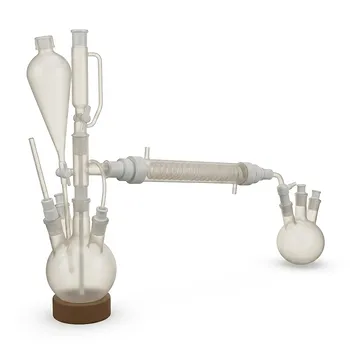
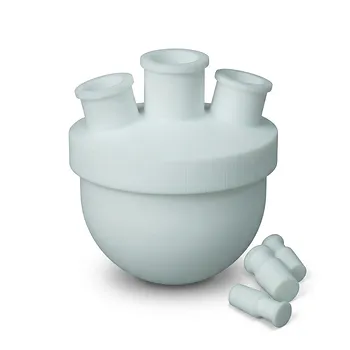
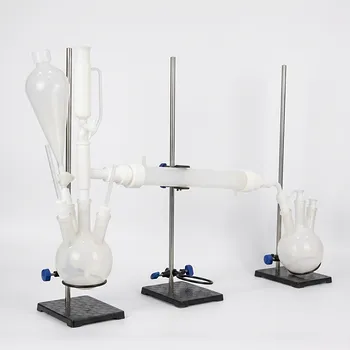
- PTFE Distillation Condensation Apparatus High Temperature Hydrofluoric Acid Resistant Fluorination Reaction Flask
- Custom PTFE Multilayer Reaction Apparatus High Temperature Corrosion Resistant Threaded Modular Sieve System
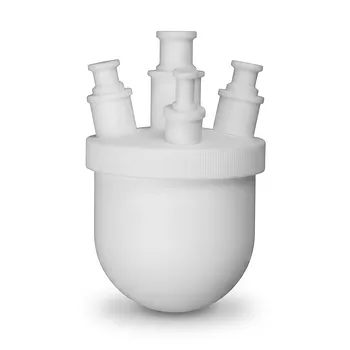
- High Temperature Corrosion Resistant PTFE Reaction Flask Custom Multi Neck Laboratory Vessel with Flat or U Bottom
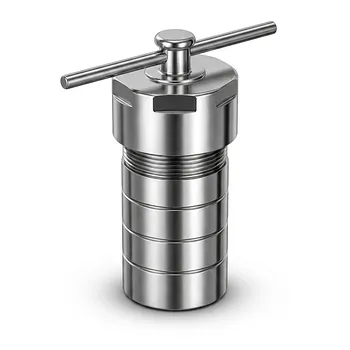
- Laboratory Hydrothermal Synthesis Autoclave Reactor PTFE PPL Lined High Temperature High Pressure Explosion Proof Reaction Vessel
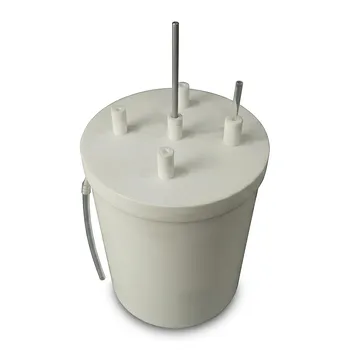
- PTFE 10L Reaction Vessel with Stirring Paddle Customizable Corrosion Resistant High Temperature Reactor for Biopharmaceutical and Chemical Processing
People Also Ask
- How does the low surface energy of PTFE benefit the condensation process? Boost Heat Transfer and Prevent Fouling
- What structural characteristics provide PTFE fluoropolymer laboratory apparatus with high thermal stability? Strong C-F bonds, dense fluorine shielding, and rigid helical conformation ensure stability during high-temperature analysis.
- What technical challenges exist in synthesizing main-chain fluorinated polymers? Discover why PTFE/PFA apparatus is ideal for these processes.
- How does resin stratification occur during the curing of fluoropolymer coatings, and why might solid fluoropolymer laboratory apparatus be preferred over surface coatings for aggressive chemical applications?
- Why is controlling the cooling rate during thermal processing critical when manufacturing high-density fluoropolymer laboratory apparatus? Optimize Strength, Clarity, and Durability