Solubility and diffusion control different parts of gas permeation. In a dense, non-porous fluoropolymer, gas molecules first dissolve into the polymer surface, then migrate through the polymer matrix, and finally desorb on the low-pressure side. The permeability coefficient combines these effects as P = D × S, so the steady-state flux through a wall of thickness ℓ is J = [D × S × (pᵢₒ − pᵢₗ)] / ℓ, assuming constant properties and a pressure-driven process.
Solubility determines how much gas enters the fluoropolymer, while diffusion determines how quickly dissolved gas moves through it. Their product governs permeability; pressure difference increases throughput, and wall thickness reduces it.
How Gas Moves Through a Dense Fluoropolymer
The Solubility-Diffusion Sequence
Gas permeation through PTFE, PFA, and similar non-porous materials is not flow through visible pores. Instead, gas molecules partition from the surrounding phase into the polymer, diffuse through the polymer chains, and leave at the opposite interface.
The process is analogous to a two-stage transport path: solubility controls entry into the material, and diffusion controls movement across it.
The Permeability Relationship
The fundamental relationship is:
[ P = D \times S ]
Here, P is the permeability coefficient, D is the diffusion coefficient, and S is the solubility coefficient.
A material can have low permeability because it dissolves little gas, because dissolved gas moves slowly, or because both effects are small. Therefore, permeability alone does not reveal which molecular mechanism controls transport.
The Flux Through a Component Wall
For a membrane or tube wall with thickness ℓ, the steady-state flux is:
[ J = \frac{D S (p_{io} - p_{il})}{\ell} ]
The pressure terms represent the gas partial pressures at the two surfaces. For a gas mixture, each species should be evaluated using its own partial-pressure difference.
This relationship shows that flux increases with permeability and pressure differential, but decreases as wall thickness increases.
What Solubility Controls
Gas Uptake at the Surface
Solubility describes the equilibrium amount of gas that the fluoropolymer can hold at a given pressure. Under Henry's-law behavior, the dissolved concentration is approximately proportional to the gas partial pressure:
[ c = S p ]
A gas with greater affinity for the polymer produces a higher concentration at the upstream surface. That higher concentration can increase the driving force for diffusion through the material.
Sorption Selectivity
Differences in solubility can separate gases even when their diffusion rates are similar. Molecular polarity, condensability, chemical structure, and interactions with the fluoropolymer influence how readily each gas dissolves.
For fluid-handling components, sorption also affects gas uptake, outgassing, and memory effects. A polymer that absorbs more of a process gas or vapor may release it later when pressure, temperature, or composition changes.
Chemical Compatibility Is Not the Same as Low Permeation
Fluoropolymers are widely valued for chemical inertness, but chemical inertness does not mean zero gas transport. A material may resist reaction with a gas while still allowing that gas to dissolve and diffuse through its wall.
Selection must therefore consider both chemical compatibility and permeation performance.
What Diffusion Controls
Molecular Movement Through the Polymer
The diffusion coefficient describes the mobility of dissolved gas within the polymer matrix. It is affected by molecular size, molecular shape, polymer-chain mobility, free volume, crystallinity, and chain packing.
Smaller molecules generally move more readily through transient gaps in a polymer. This is why small gases such as helium and hydrogen can show high transmission rates in some fluoropolymer grades.
Diffusion Selectivity
When gases differ substantially in molecular size or effective cross-section, their diffusion coefficients can differ strongly. In that case, separation is primarily diffusion-selective: smaller or more mobile molecules pass through faster.
Fluoropolymer membrane structures with restricted fractional free volume can increase size-sieving effects. However, the actual selectivity depends on the specific polymer morphology, processing history, temperature, and gas pair.
Transport Through Tubing and Seals
In tubing, containers, and gaskets, diffusion can allow external gases to enter a closed system or process gases to escape. The same mechanism can cause oxygen or moisture ingress into air-sensitive systems and vapor loss from volatile fluids.
The relevant design variable is not only the material name. Grade, crystallinity, wall construction, dimensions, temperature, and exposure history can all affect the effective diffusion coefficient.
How Operating Conditions Change Permeation
Pressure and Partial Pressure
Under the idealized steady-state relationship, increasing the partial-pressure difference increases flux proportionally. A larger pressure differential therefore drives more gas through the same material and wall thickness.
For mixtures, total pressure is not sufficient by itself. The relevant driving force is the partial-pressure difference for each permeating species.
Temperature
Temperature commonly increases diffusion because polymer-chain motion and molecular mobility increase. Gas solubility often decreases with temperature, but the increase in diffusion can dominate, causing total permeability to rise.
The magnitude and direction of the temperature effect depend on the polymer, gas, temperature range, and whether the system approaches a transition or changes morphology. Heated tubing, vessels, and seals should therefore be evaluated at their actual operating temperature rather than at room temperature alone.
Time and Transient Permeation
The steady-state flux equation does not describe the entire start-up period. Initially, gas must fill or equilibrate within the polymer, so the downstream flux may be lower or delayed before reaching a steady value.
This matters for systems that are evacuated, purged, cycled rapidly, or exposed to changing gas compositions. A component can appear to have low short-term leakage while still producing significant long-term permeation.
Why Material and Geometry Matter
Polymer Structure
Permeation generally decreases when polymer chains are more rigid and closely packed. Higher crystallinity and stronger interchain interactions can reduce free volume and restrict diffusion.
These structural factors influence D directly and may also alter S by changing the available environments in which gas molecules can dissolve.
Wall Thickness
For a homogeneous wall under steady-state conditions, flux is inversely proportional to thickness. Doubling the wall thickness approximately halves the flux if the material properties and pressure conditions remain unchanged.
In real components, the benefit may not appear perfectly linear because surface layers, orientation, defects, crystallinity gradients, and changing transient times influence the measured result. Thickness is still one of the most direct design tools for reducing permeation.
Component Geometry
Total gas throughput depends on more than flux. For a tube or container, the total permeation rate also depends on the available surface area.
A thin-walled component with a large exposed area can transmit more gas overall than a thicker component with a small area, even when its local flux is similar. System calculations should therefore distinguish between flux per unit area and total permeation rate.
Understanding the Trade-offs
Barrier Performance Versus Flexibility
Increasing thickness can reduce steady-state flux, but it may make tubing less flexible, increase bending forces, and complicate assembly. A thicker wall is not automatically the best choice if it creates mechanical or operational problems elsewhere.
Material structure can also create trade-offs. A morphology that restricts diffusion may improve barrier performance while reducing processability or changing mechanical behavior.
Inertness Versus Gas Barrier Efficiency
Fluoropolymers offer strong chemical resistance, but different fluoropolymers and grades can have substantially different permeability values. Choosing a fluoropolymer solely because it is chemically inert can leave an unacceptable gas-transport pathway.
The correct comparison is between candidate materials under the relevant gas, temperature, pressure, wall thickness, and exposure duration.
Low Short-Term Loss Versus Long-Term Integrity
Short experiments may underestimate the importance of permeation because the component has not reached steady state. Long-term storage, continuous gas delivery, and repeated pressure cycling can expose behavior that is not visible in an initial screening test.
For trace analysis and air-sensitive work, evaluate both the initial transient and the eventual steady-state contribution.
Reported Permeability Values Require Care
Published values may use different units, temperatures, film thicknesses, conditioning procedures, and test methods. They should not be compared without checking those conditions.
A value measured for a flat film may also require adjustment before it is applied to an extruded tube, molded seal, or storage vessel with different morphology and geometry.
Temperature Claims Need Qualification
It is incorrect to assume that every temperature increase raises both solubility and diffusion. For gases, solubility frequently decreases as temperature rises, while diffusion increases; the net permeability reflects the balance between those effects.
Design decisions should rely on measured or validated temperature-dependent permeability data whenever the operating range is important.
Making the Right Choice for Your Goal
Use the solubility-diffusion model to separate material selection from geometry and operating-condition decisions.
- If your primary focus is gas separation: Compare both permeability and selectivity, then determine whether the gas pair is separated mainly by diffusion differences, solubility differences, or both.
- If your primary focus is minimizing gas loss: Select a low-permeability material and use sufficient wall thickness, while accounting for component surface area and the actual partial-pressure difference.
- If your primary focus is protecting air-sensitive reagents: Evaluate oxygen, moisture, and process-vapor ingress over the full storage period, including transient uptake and long-term permeation.
- If your primary focus is heated fluid handling: Measure or obtain temperature-dependent permeability data because increased diffusion can outweigh reduced gas solubility.
- If your primary focus is trace analysis: Consider sorption, outgassing, conditioning history, and cross-contamination in addition to steady-state transmission.
Solubility determines gas loading, diffusion determines molecular mobility, and their product provides the permeability basis for designing reliable fluoropolymer membranes and fluid-handling components.
Summary Table:
| Parameter | Definition | Role in Permeation | Key Factors |
|---|---|---|---|
| Solubility (S) | Equilibrium gas concentration in polymer per unit pressure | Determines gas uptake at surface | Gas condensability, polymer affinity, temperature |
| Diffusion (D) | Mobility of dissolved gas molecules in polymer | Controls transport rate through material | Molecular size, polymer free volume, crystallinity |
| Permeability (P) | Product of D and S | Overall barrier efficiency | Polymer type, temperature |
| Flux (J) | Gas flow rate per unit area | Impacts total gas transmission | Pressure gradient, wall thickness |
Optimize your gas barrier performance with high-purity PTFE and PFA solutions. At KINTEK, we specialize in advanced fluoropolymer components designed to control permeation precisely. Whether you need low-permeability tubing, custom membranes, or specialized fluid handling parts for trace analysis or high-temperature processes, our expert team can help you select the right material and design. [Contact us today] (#ContactForm) to discuss your requirements and ensure reliable, long-term performance in your most demanding applications.
Related Products
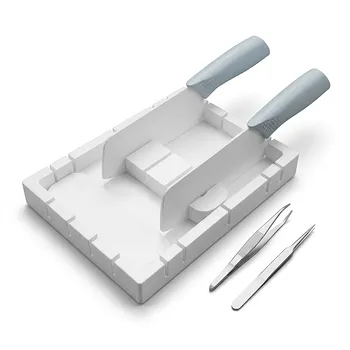
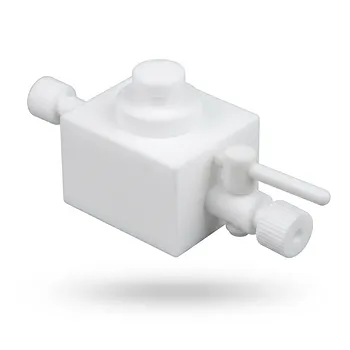
- High Purity PTFE Square Membrane Cutter and Filter Aliquot Device for Trace Analysis and Cleanroom Laboratory Applications
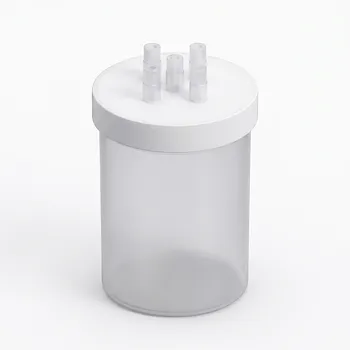
- High Purity 4L PFA Reaction Tank for Proton Exchange Membrane Electrolysis Water Oxygen Separation Systems
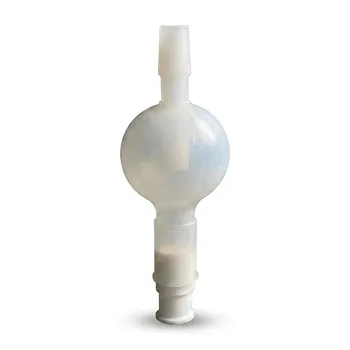
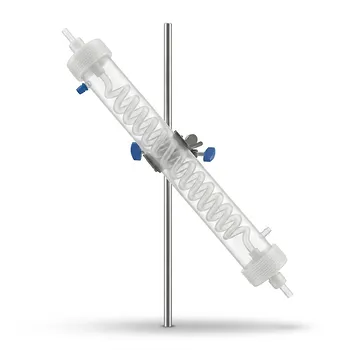
- High Purity PFA Chromatography Column with Collection Bottle Corrosion Resistant Fluoropolymer Filtration System for Trace Analysis
- Custom PFA Tubing 1/4 Inch High Purity Corrosion Resistant Fluoropolymer Tube with Welding and Machining Services
- Custom PTFE Insulating Gaskets and Corrosion Resistant Fluoropolymer Seals for Industrial Electrical Applications
People Also Ask
- What are the structural characteristics and manufacturing principles of Polytetrafluoroethylene (PTFE) filter membranes?
- What is the chemical composition and temperature resistance of PTFE filter membranes? Essential Specs for Labs
- How does the inherent hydrophobicity of PTFE filter membranes affect liquid and gas separation? Optimize Performance
- What are the performance advantages of PTFE filter membranes vs depth filters? Boosting Lab Purity and Efficiency
- What is the thermal stability range for PTFE filter membranes? Master Extremes from -200°C to +260°C