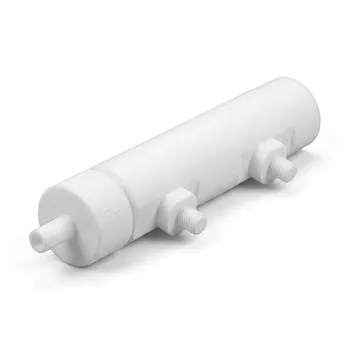
PTFE microchannel reactors fundamentally redefine process efficiency by utilizing microscale geometry to maximize the surface-area-to-volume ratio. This design allows for heat and mass transfer rates that are orders of magnitude higher than those found in traditional batch reactors, enabling precise control over reaction conditions.
PTFE microchannel reactors replace the inefficient bulk mixing of batch vessels with high-intensity, continuous-flow environments. This shift eliminates thermal gradients and diffusion bottlenecks, allowing for safer, faster, and more selective chemical transformations.
The Engineering of Superior Heat Transfer
Maximizing Surface-Area-to-Volume Ratios
The primary driver of heat transfer efficiency in microchannels is the exceptionally high surface-area-to-volume ratio. In a traditional 1-liter batch flask, the ratio is relatively low, whereas microchannels provide a massive surface area relative to the small volume of fluid they contain.
Achieving Near-Isothermal Operation
Because the fluid is in constant, close contact with the channel walls, heat can be added or removed almost instantaneously. This leads to heat transfer coefficients reaching 1 to 500 MW m⁻³ K⁻¹, compared to a mere 10 kW m⁻³ K⁻¹ in standard batch vessels.
Eliminating Thermal Runaway Risks
The ability to remove heat rapidly through thin PTFE walls ensures near-isothermal operation. This level of control effectively eliminates the risk of local "hot spots" and thermal runaway, even during highly exothermic chemical reactions.
Accelerating Mass Transfer through Flow Dynamics
Rapid Mixing and Diffusion
In a batch vessel, mixing relies on mechanical stirring, which often leaves diffusion-limited zones. Microchannel reactors utilize rapid mixing driven by the small physical dimensions, where the distance molecules must travel to react is drastically reduced.
Specialized Flow Regimes
These reactors often operate using slug or annular flow regimes, which create internal circulation within the fluid segments. This localized turbulence significantly enhances the contact between different phases, accelerating the overall reaction rate.
Impact on Selectivity and Yield
By optimizing mass transfer, microchannel reactors ensure that reagents are brought together under ideal conditions. This precision reduces the formation of unwanted byproducts, leading to significantly improved selectivity and higher product yields.
Understanding the Trade-offs
Temperature and Pressure Constraints
While PTFE (Polytetrafluoroethylene) offers unparalleled chemical resistance, it has physical limitations. It is softer than metals, meaning PTFE reactors generally operate at lower pressures and temperatures compared to stainless steel or Hastelloy microreactors.
The Challenge of Solids and Fouling
Microchannels are highly susceptible to clogging or fouling if the reaction produces solids or precipitates. Unlike a batch vessel that can often stir through a slurry, a microchannel requires careful management of particle size to prevent catastrophic blockages.
Complexity of System Integration
Transitioning from a simple stirred tank to a microfluidic system increases operational complexity. It requires precise pumping systems, sophisticated sensors, and a deeper understanding of fluid dynamics to maintain a steady state.
How to Apply This to Your Project
When deciding between a traditional batch vessel and a PTFE microchannel reactor, your choice should be dictated by the specific requirements of your chemical process.
- If your primary focus is safety in highly exothermic reactions: Use microchannel reactors to leverage their high heat-transfer coefficients and prevent thermal runaway.
- If your primary focus is working with highly corrosive reagents: Choose PTFE microchannels for their superior chemical inertness, which protects the equipment from degradation.
- If your primary focus is maximizing yield for fast, competitive reactions: Implement microfluidic flow to take advantage of rapid mixing and eliminate mass-transfer limitations.
- If your primary focus is processing high-solids slurries: Stick with traditional batch vessels or specialized large-bore flow reactors to avoid the risk of channel clogging.
By matching the reactor geometry to the kinetic and thermal profile of your reaction, you can achieve levels of process intensification that are impossible in bulk containers.
Summary Table:
| Feature | PTFE Microchannel Reactor | Traditional Batch Vessel |
|---|---|---|
| Heat Transfer Coeff. | 1 to 500 MW m⁻³ K⁻¹ | ~10 kW m⁻³ K⁻¹ |
| Mixing Mechanism | Rapid diffusion/internal circulation | Mechanical stirring |
| Temperature Control | Near-isothermal (eliminates hotspots) | Prone to thermal gradients |
| Selectivity/Yield | High (controlled reaction environment) | Variable (diffusion-limited) |
| Chemical Resistance | Exceptional (Fluoropolymer) | Varies by material |
| Solids Handling | High risk of clogging | Suitable for slurries |
Elevate Your Process with KINTEK’s Fluoropolymer Engineering
Maximize your laboratory’s efficiency and safety with KINTEK’s high-performance PTFE and PFA solutions. From everyday basic labware like beakers, crucibles, and reagent bottles to advanced reaction apparatus such as custom PTFE microchannel reactors, we provide the precision tools necessary for superior heat and mass transfer.
Our expertise extends across a comprehensive range:
- Fluid Transfer: Tubing, fittings, and valves.
- Sample Prep: Separatory funnels, filters, and high-purity trace analysis tools.
- Advanced Apparatus: Electrochemical cells, battery testing fixtures, and microwave digestion vessels.
Backed by end-to-end custom CNC fabrication, KINTEK is equipped to deliver everything from complex non-standard machined parts to high-volume orders. Whether you are managing highly exothermic reactions or require bespoke laboratory setups, we offer an absolute focus on high-performance fluoropolymers to ensure your success.
Ready to optimize your chemical transformations? Contact us today to discuss your project!
Related Products
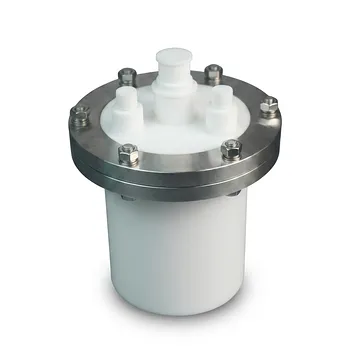
- Customizable Polytetrafluoroethylene PTFE Reactor and Corrosion Resistant Teflon Flask
- PTFE 10L Reaction Vessel with Stirring Paddle Customizable Corrosion Resistant High Temperature Reactor for Biopharmaceutical and Chemical Processing
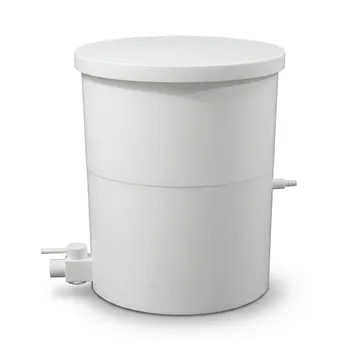
- Custom PTFE Multilayer Reaction Apparatus High Temperature Corrosion Resistant Threaded Modular Sieve System
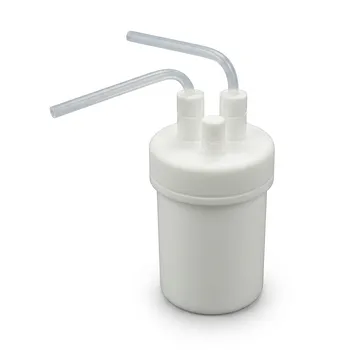
- Custom PTFE Volatile Matter Condensation Reflux Reaction Device Corrosion Resistant Pressure Resistant
- High Performance Customizable PTFE Reaction Vessel and Corrosion Resistant Polytetrafluoroethylene Flask for Chemical Laboratory Use
People Also Ask
- What functional advantages do PTFE reactors provide over glass? Achieve Superior Purity and Safety in Synthesis
- What are the primary fabrication methods for capillary-based and monolithic PTFE reactors? Expert Production Insights
- Why are PTFE or PFA reaction vessels required for the selective etching process of MXene using hydrofluoric acid (HF)?
- Why is a Teflon-lined (PTFE) reactor vessel required for the hydrothermal synthesis of V2O5 and SnO2 nanomaterials?
- What is the role of high chemical inertness reaction vessels in the organic synthesis of acylhydrazone ligands? | Guide