PFA and PTFE provide essentially equivalent high-temperature service performance, but PFA is much easier to process into complex high-purity components. Both materials can support continuous operating temperatures up to approximately 260°C and resist strong acids, bases, and organic solvents. PTFE remains the stronger choice when maximum non-stick behavior, low friction, or custom machining is decisive, while PFA is generally preferable for seamless molded tubing, vessels, valves, and fittings.
The central distinction is processability, not continuous-use temperature: PTFE and PFA offer comparable thermal and chemical performance, but PFA can be conventionally melt-processed, whereas PTFE requires specialized forming or machining.
How Their Thermal Performance Compares
Continuous operating temperature
Both PTFE and PFA have a commonly cited maximum continuous service temperature of approximately 260°C. This makes either material suitable for demanding laboratory environments involving elevated temperatures and aggressive chemicals.
The service-temperature rating describes long-term operating capability. It should not be confused with the material's melting point or the temperature used during fabrication.
Melting behavior
PTFE has a melting point near 327°C, but it does not behave like a conventional thermoplastic above that temperature. Its melt viscosity is extremely high, so it forms a stiff, non-flowing gel rather than flowing into a mold.
PFA melts at approximately 305°C to 310°C and has substantially lower melt viscosity. This allows it to flow during extrusion or molding while retaining the thermal stability expected from a perfluorinated fluoropolymer.
High-temperature chemical service
Both materials retain exceptional resistance to strong acids, bases, and organic solvents at elevated temperatures. Their fluorinated molecular structures provide a highly stable protective environment around the carbon backbone.
For high-purity fluid handling, the practical result is low risk of chemical attack, material degradation, or contamination from the component itself when the application remains within the resin's qualified operating limits.
Why Processability Changes Component Design
PTFE requires specialized fabrication
PTFE is typically produced through compression molding, sintering, paste extrusion, or machining from stock shapes. Precision CNC machining is often used to produce custom reaction vessels, electrochemical cell bodies, digestion components, and other non-standard parts.
This approach can produce highly precise components, but it adds manufacturing steps and may make complex internal geometries, thin sections, or seamless fluid paths more difficult or expensive to produce.
PFA supports conventional molding and extrusion
PFA's copolymer structure reduces melt viscosity and enables conventional melt processing. Manufacturers can mold or extrude it into tubing, bottles, valves, fittings, and complex laboratory vessels.
This is particularly valuable when the design requires seamless geometries, integrated fluid paths, thin walls, or repeatable production of intricate components.
PFA enables translucent and inspectable labware
PFA is commonly available in translucent or transparent forms, allowing users to inspect fluid levels, particulates, bubbles, and some process conditions visually. This can be useful in trace analysis, reagent handling, and contamination-sensitive workflows.
PTFE is generally opaque, so inspection often depends on external measurement or opening the apparatus.
How to Choose for High-Purity Laboratory Applications
Choose PTFE for maximum non-stick performance
PTFE has the lowest coefficient of friction among the two materials. It is therefore well suited to applications where sliding behavior, release performance, or minimal adhesion matters.
Examples include stir-bar components, sliding seals, custom-machined parts, and apparatus where a highly non-stick surface is the primary requirement.
Choose PFA for molded fluid handling
PFA is usually the more practical choice for high-purity tubing, molded fittings, valves, bottles, and seamless vessels. Melt processing supports smooth, non-porous surfaces and reduces the need to assemble multiple machined pieces.
This can simplify fluid paths and reduce potential contamination sites associated with joints, seams, or mechanically assembled sections.
Consider PTFE for cryogenic service
PTFE can maintain structural integrity at extremely low temperatures, including cryogenic conditions approaching approximately -267°C. That makes it the stronger candidate when the component must tolerate both severe chemical exposure and very low temperatures.
PFA selection for cryogenic use should be based on the specific grade, geometry, thermal cycling, and mechanical requirements rather than on its high-temperature rating alone.
Evaluate electrical requirements separately
Both PTFE and PFA offer very low dielectric constants and dissipation factors. Either can be appropriate for insulation, electrochemical cells, and analytical instrumentation where electrical signal interference must be minimized.
The choice between them should therefore be driven primarily by geometry, fabrication method, mechanical behavior, and temperature range when electrical performance is otherwise comparable.
Understanding the Trade-offs
PTFE's fabrication burden
PTFE's non-melt-processable nature can increase tooling, machining, and production costs. Complex shapes may require several operations, and design changes can be less economical when each part must be machined from a stock shape.
However, machining also provides considerable design control for prototypes, custom apparatus, and low-volume components.
PFA's processing advantage is not universal
PFA is easier to mold and extrude, but that does not automatically make it the best material for every component. PTFE can still be preferable when very low friction, maximum release behavior, a specific machined geometry, or cryogenic performance is more important than molded production.
The correct decision depends on the full operating envelope rather than on processability alone.
Do not use melting point as the operating limit
A material's melting point is not a safe continuous-use temperature. Long-term performance also depends on load, pressure, wall thickness, thermal cycling, chemical exposure, and the design of the component.
For critical laboratory apparatus, validate the selected grade and geometry against the manufacturer's continuous-use, pressure, and chemical compatibility data.
Manufacturing can affect purity
Both materials are capable of high-purity service, but cleanliness depends on the resin grade, processing environment, post-processing, packaging, and installation practices. A high-purity resin does not eliminate contamination introduced during fabrication or assembly.
For trace analysis and sensitive fluid handling, specify the required purity level and qualification documentation alongside the polymer choice.
Making the Right Choice for Your Goal
Select the material according to the dominant design and operating requirement:
- If your primary focus is maximum non-stick behavior and low friction: Choose PTFE, particularly for stir bars, sliding seals, and precision-machined components.
- If your primary focus is complex molded geometry: Choose PFA for seamless vessels, valves, fittings, tubing, and intricate fluid paths.
- If your primary focus is high-purity fluid visibility: Choose translucent PFA when visual inspection of the contents or flow is valuable.
- If your primary focus is cryogenic containment: Favor PTFE after confirming the component's mechanical and thermal-cycling requirements.
- If your primary focus is repeatable production: Favor PFA because conventional melt molding and extrusion can simplify manufacturing and reduce assembly points.
For high-purity laboratory apparatus, PTFE is the machining and low-friction specialist, while PFA is the molding and fluid-handling specialist; both provide comparable continuous high-temperature and chemical resistance.
Summary Table:
| Property | PTFE | PFA |
|---|---|---|
| Maximum Continuous Service Temperature | ~260°C | ~260°C |
| Melting Point | ~327°C (non-flowing gel) | ~305-310°C (flows) |
| Processability | Requires compression molding, sintering, or CNC machining | Can be melt-processed via injection molding or extrusion |
| Fabrication Complexity | High (machining from stock shapes) | Low (conventional melt processing) |
| Non-stick/Friction | Excellent (lowest friction) | Good (slightly higher friction) |
| Optical Clarity | Opaque | Translucent/transparent |
| Cryogenic Suitability | Excellent (down to ~-267°C) | Limited (depends on grade) |
| Typical Applications | Custom machined parts, stir bars, seals | Molded tubing, vessels, fittings, valves |
Expert Guidance for High-Purity Fluoropolymer Components
Need help deciding between PTFE and PFA for your laboratory? At KINTEK, we specialize in high-performance fluoropolymers, offering a complete range of PTFE and PFA labware, from standard beakers and tubing to custom CNC-machined parts and electrochemical cells. Our team provides end-to-end support, ensuring you select the optimal material for your specific application, whether you require maximum non-stick properties, complex molded geometries, or high-volume production. Leverage our expertise to enhance your lab's efficiency and reliability. Get in touch with our specialists today!
Related Products
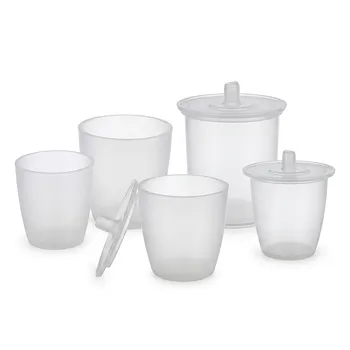
- High Purity PFA Crucible and Corrosion Resistant PTFE Beaker for Trace Analysis and Custom Laboratory Applications
- High Purity PTFE PFA Plastic Crucible for Corrosion Resistant Acid Digestion and Trace Analysis
- High Temperature Resistant PTFE Thermal Insulation Board Corrosion Resistant Metal Free Fluoropolymer Stand for Ultra Clean Laboratories
- High Purity PFA Coiled Tubing Custom PTFE Machining PFA Welding and Precision Bending Solutions
- Customizable PTFE Heat Insulation Plate High Temperature Corrosion Resistant Laboratory Support Layered Multi Tier Stand
People Also Ask
- Why are high-purity vessels critical for BiFeO3 synthesis? Ensuring Phase Purity
- Why is the use of high-purity PFA or PTFE labware critical during TiO2 nanoparticle purification? Protect Sample Purity
- Why is high-purity PFA trace analysis labware used for MXene? Ensure Superior Material Integrity in Research
- Why is high-purity PFA labware necessary for Znx@LS-2 zeolite ICP-OES analysis? Ensure Trace-Level Precision
- Why is high-purity PFA trace analysis labware used for sample processing when preparing Mo2CTx@MoS2? Ensure Material Purity