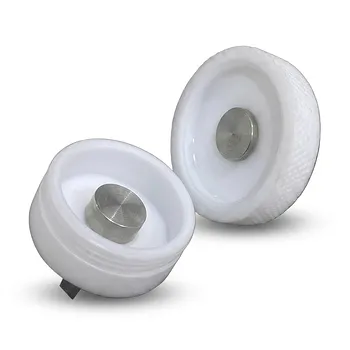
Meshed CR2032-type coin cell cases are the essential bridge between standard electrochemical testing and the dynamic gas-diffusion requirements of lithium-oxygen batteries. These specialized housings feature a sieve-like structure on the cathode side that allows ambient oxygen to diffuse directly into the cell. This design is critical because it enables the catalyst to engage in the Oxygen Reduction Reaction (ORR) and Oxygen Evolution Reaction (OER), simulating the real-world environment needed to evaluate battery performance.
The core advantage of meshed coin cell cases is their ability to transform a sealed electrochemical environment into an open-diffusion reactor. This allows researchers to measure high specific capacity and cycling stability while maintaining the mechanical pressure required for stable electrical contact.
Facilitating Gas-Phase Electrochemistry
Overcoming the Barrier of Sealed Cases
Standard coin cells are hermetically sealed to prevent environmental contamination, which would normally block the entry of oxygen. Meshed cases bypass this limitation by using a perforated cathode housing that acts as a gateway for gas molecules. This physical architecture is what allows lithium-oxygen (Li-O2) chemistry to function within the compact CR2032 form factor.
Enabling ORR and OER Processes
For a lithium-oxygen battery to operate, oxygen must interact with the solid-state catalyst at the cathode. The sieve-like structure ensures that oxygen is readily available for the Oxygen Reduction Reaction (ORR) during discharge and the Oxygen Evolution Reaction (OER) during charge. Without this constant supply of gas, the catalytic evaluation would be impossible.
Simulating Real-World Gas Diffusion
These cases provide a controlled environment to study how catalysts perform under real gas-diffusion conditions. By mimicking the way oxygen moves through carbon paper or gas diffusion layers, researchers can more accurately predict how a material will behave in a full-scale breathing battery system.
Mechanical Stability and Precise Testing
Maintaining Consistent Contact Pressure
Despite the holes in the mesh, the housing is designed to maintain stable electrical contact pressure across the entire internal stack. This pressure is vital for keeping the lithium anode, separator, and catalyst-loaded carbon paper in close proximity. Uniform pressure prevents internal resistance spikes that could skew experimental data.
Ensuring Uniform Oxygen Distribution
High-quality meshed housings are engineered to promote uniform oxygen flow across the cathode surface. If oxygen distribution is uneven, certain areas of the catalyst will be overworked while others remain idle, leading to inaccurate capacity measurements. A well-designed mesh ensures the entire active area participates equally in the reaction.
Protecting Internal Components
While the mesh allows gas exchange, the overall fixture still provides a precise mechanical seal for the rest of the battery stack. This ensures that the liquid electrolyte remains contained and the lithium anode is protected from rapid degradation. This balance of openness and encapsulation is necessary for achieving long-term cycling stability.
Understanding the Trade-offs
Electrolyte Evaporation and Volatility
One of the primary challenges of using meshed cases is the potential for electrolyte evaporation. Because the system is "open" to the environment, volatile solvents used in the electrolyte can escape through the mesh over time. This can lead to cell "dry-out," which prematurely ends cycling tests and may be mistaken for catalyst failure.
Sensitivity to Environmental Contaminants
While the mesh lets oxygen in, it can also allow moisture and carbon dioxide to enter the cell if the testing environment is not strictly controlled. Water vapor can react violently with the lithium anode or lead to the formation of irreversible byproducts like lithium hydroxide. Testing must usually occur in a specialized chamber or "oxygen box" to maintain gas purity.
How to Apply This to Your Research
When selecting or using meshed coin cell cases for lithium-oxygen battery testing, your choice should be dictated by your specific experimental goals and the sensitivity of your materials.
- If your primary focus is catalyst efficiency: Use high-mesh-count housings to ensure maximum oxygen flux and to prevent gas-diffusion limitations from bottlenecking the reaction.
- If your primary focus is long-term cycling stability: Prioritize housings that offer the tightest mechanical seals around the edges to minimize electrolyte loss over hundreds of hours of testing.
- If your primary focus is high-rate performance: Ensure your cathode current collector and mesh design provide low contact resistance to handle higher current densities without excessive heat generation.
By aligning the physical architecture of the meshed case with the specific requirements of the lithium-oxygen reaction, researchers can generate highly accurate and reproducible performance data.
Summary Table:
| Key Feature | Function in Li-O2 Testing | Research Benefit |
|---|---|---|
| Perforated Cathode | Allows direct ambient oxygen diffusion | Enables ORR and OER catalytic processes |
| Sieve-like Structure | Mimics gas-diffusion layer mechanics | Simulates real-world breathing battery environments |
| Mechanical Housing | Maintains stable stack contact pressure | Prevents internal resistance spikes and data skew |
| Compact CR2032 Form | Provides a standardized open-diffusion reactor | Ensures reproducible results in standard lab setups |
Optimize Your Electrochemical Research with KINTEK Precision
Achieving accurate results in lithium-oxygen battery testing requires hardware that balances gas permeability with mechanical integrity. At KINTEK, we specialize in providing high-performance laboratory supplies designed for the most demanding environments.
Our expertise extends from everyday basic labware (beakers, measuring cylinders, crucibles) to specialized battery testing fixtures and advanced derivative apparatus like standard or custom electrochemical cells. We manufacture virtually all imaginable laboratory supplies crafted from high-performance PTFE and PFA, ensuring chemical inertness and durability.
Why choose KINTEK?
- Custom Fabrication: End-to-end custom CNC fabrication for complex, non-standard machined parts and bespoke laboratory setups.
- Comprehensive Range: From fluid transfer components (tubing, valves) to sample prep tools (filters, pipettes) and general consumables (O-rings, gaskets).
- Precision Focused: Maintaining an absolute focus on high-performance fluoropolymer materials to support your high-purity trace analysis and advanced reactions.
Ready to enhance your lab's efficiency with specialized battery testing components or custom fluoropolymer parts?
Contact us today to discuss your project or high-volume orders!
References
- Shadeepa Karunarathne, Amr M. Abdelkader. Triphase Heterogeneous Electrocatalysts of Ni and Co for High‐Performing Li‐O<sub>2</sub> Batteries. DOI: 10.1002/eom2.70002
This article is also based on technical information from Kintek Knowledge Base .
Related Products
People Also Ask
- What is the thermal operating range for PTFE battery clamps in electrochemical research? Stability from -200°C to +260°C
- What are the primary functions and material compositions of PTFE battery clamps? Ensure Precision & Chemical Resistance
- How do coin cell testing fixtures evaluate ZIF-derived LCO cycling stability? Ensure Battery Research Precision
- What are the electrical insulation and signal integrity advantages of using PTFE battery clamps? Ensure Data Accuracy
- How does the chemical inertness of PTFE benefit laboratory-scale battery testing? Ensure high-purity research results.