Fully fluorinated polymers prioritize temperature capability and flexibility, while hydrogen-containing fluoroplastics prioritize strength and stiffness. PTFE and PFA can operate continuously at temperatures approaching 260°C and commonly provide elongation values of roughly 300%–400%. PVDF, ETFE, and ECTFE are typically about 1.5 times stronger and twice as stiff, but their continuous-use temperatures and elongation are generally lower.
The selection depends on which failure mode matters most: choose fully fluorinated materials for extreme heat, chemical inertness, and flexibility; choose hydrogen-containing fluoroplastics when rigidity, tensile strength, abrasion resistance, and dimensional stability are more important at moderate temperatures.
How the Two Polymer Families Differ
Fully fluorinated polymers: PTFE, PFA, and FEP
Fully fluorinated polymers have polymer backbones shielded by fluorine atoms. This structure provides exceptional resistance to chemical attack and thermal degradation.
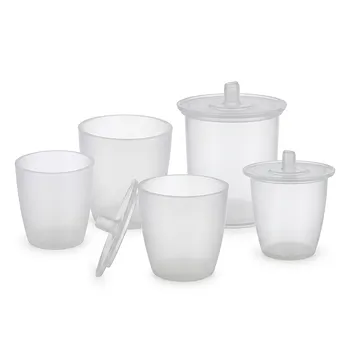
PTFE and PFA are especially well suited to digestion vessels, crucibles, tubing, reagent bottles, and high-purity laboratory components exposed to aggressive chemicals or elevated temperatures.
FEP offers similar chemical inertness but generally has a lower continuous service temperature than PTFE or PFA. A representative limit is approximately 204°C for FEP, compared with about 260°C for PFA.
Hydrogen-containing fluoroplastics: PVDF, ETFE, and ECTFE
Hydrogen-containing fluoroplastics retain hydrogen or other non-fluorine atoms in the polymer structure. These atoms increase intermolecular attraction, which improves mechanical strength and rigidity.
The trade-off is reduced thermal and chemical stability compared with fully fluorinated materials. Depending on the specific grade and exposure conditions, continuous-use limits may range from roughly 120°C–150°C for some materials to around 200°C–215°C for higher-temperature grades.
Mechanical Strength and Stiffness
Hydrogen-containing materials provide the structural advantage
PVDF, ETFE, and ECTFE generally offer approximately 1.5 times the mechanical strength and about twice the stiffness of fully fluorinated polymers.
Typical tensile-strength comparisons illustrate the difference:
- PTFE: approximately 20–35 MPa
- PFA: approximately 31 MPa
- PVDF: commonly around 30–70 MPa, depending on grade
- ETFE: commonly around 38–42 MPa
These values are representative rather than universal. Filler content, processing method, temperature, specimen geometry, and loading direction can significantly change actual performance.
Fully fluorinated materials are softer and more prone to deformation
PTFE and related materials are comparatively soft and can deform under sustained load, particularly at elevated temperatures. This behavior, often described as creep, matters for clamps, threaded connections, seals, supports, and thin-walled components.
PFA generally provides better mechanical performance than PTFE among fully fluorinated options, while retaining high chemical and thermal resistance. It is often the stronger choice when a melt-processable, high-purity fluoropolymer must also tolerate mechanical stress.
Rigidity can determine equipment life
For rigid housings, structural supports, valve bodies, pump components, or abrasion-exposed parts, hydrogen-containing fluoroplastics may maintain shape more effectively.
However, greater stiffness is not automatically better. A rigid material can be less forgiving under impact, thermal cycling, or differential expansion, while a more flexible material may better accommodate movement and vibration.
Temperature Resistance
Fully fluorinated polymers lead at high temperature
The absence of hydrogen in the polymer backbone reduces susceptibility to dehydrofluorination and related degradation mechanisms. As a result, PTFE and PFA can provide continuous service temperatures of approximately 260°C, with melting points near or above 300°C.
This makes them appropriate for:
- High-temperature chemical digestion
- Hot aggressive acids and solvents
- Hot alkali handling
- Thermal cycling
- High-purity equipment where degradation or contamination is unacceptable
Hydrogen-containing materials have narrower thermal limits
Hydrogen-containing fluoroplastics can degrade more readily at elevated temperatures, particularly in the presence of strong bases such as sodium hydroxide, potassium hydroxide, or organic amines.
Their actual limit depends on the polymer and grade. ETFE and PVDF should not be assigned a single universal temperature rating; the equipment supplier’s continuous-use, short-term, chemical-exposure, and pressure ratings should be checked separately.
Temperature affects strength in both families
A room-temperature strength comparison can be misleading. All thermoplastics generally lose stiffness as temperature rises, and fluoroplastics are no exception.
A hydrogen-containing polymer may be stronger at moderate temperature but become unsuitable once the environment approaches its thermal or chemical limit. Conversely, PTFE or PFA may be mechanically weaker but remain functional where the alternative polymer would chemically degrade.
Elongation and Flexibility
Fully fluorinated polymers offer much higher elongation
PTFE, PFA, and FEP can exhibit elongation at break values around 300%–400%, although the exact value depends on grade and test method.
This high elongation allows tubing, liners, films, and flexible connections to tolerate movement, bending, assembly strain, and thermal expansion without immediate fracture.
For example, representative values for melt-processable materials include approximately 300% elongation for PFA and 290% for FEP.
Hydrogen-containing polymers are less extensible
PVDF, ETFE, and ECTFE generally provide lower elongation than fully fluorinated materials. Their greater stiffness and strength improve dimensional stability, but reduce their ability to stretch or conform.
This makes them better suited to rigid or semi-rigid components than to applications requiring extreme flexibility or repeated deformation.
Elongation is not the same as fatigue resistance
A high elongation value indicates how far a specimen can stretch before breaking in a tensile test. It does not, by itself, establish resistance to repeated flexing, cyclic pressure, abrasion, or long-term creep.
For tubing and moving connections, evaluate the complete design, including bend radius, pressure, temperature, wall thickness, and cycle frequency.
Matching the Material to Laboratory Equipment
Choose PTFE or PFA for extreme chemical and thermal exposure
Fully fluorinated polymers are generally the safer choice when the equipment will experience:
- Continuous temperatures approaching 260°C
- Aggressive acids, bases, or organic solvents
- High-temperature digestion
- Strong chemical cleaning
- High-purity or low-contamination requirements
- Flexible tubing or liners
- Repeated thermal cycling
PFA is often preferred over PTFE when better tensile strength, lower permeability, or melt-processable fabrication is valuable. PTFE remains attractive for maximum chemical inertness, low friction, and broad availability.
Choose PVDF, ETFE, or ECTFE for rigidity and abrasion resistance
Hydrogen-containing fluoroplastics are preferable when the application requires:
- Higher tensile strength
- Greater stiffness
- Better dimensional stability
- Improved abrasion resistance
- More rigid piping, housings, or support components
- Moderate operating temperatures
ETFE is useful where toughness and abrasion resistance are important. PVDF is frequently considered when a balance of chemical resistance, strength, and processability is needed.
Consider the entire load and exposure profile
The correct selection depends on more than the maximum temperature. Evaluate temperature, chemical concentration, exposure time, pressure, mechanical load, flexing, abrasion, and cleaning conditions together.
A material that performs well in a static room-temperature test may fail under sustained load at elevated temperature or during exposure to a chemically aggressive reagent.
Understanding the Trade-offs
Strength versus thermal and chemical stability
Hydrogen-containing fluoroplastics generally provide the better mechanical envelope at moderate temperatures. Fully fluorinated polymers provide the better thermal and chemical envelope.
Selecting the stronger polymer is not beneficial if it cannot tolerate the actual reagent or operating temperature.
Flexibility versus dimensional stability
Fully fluorinated materials offer high elongation and flexibility, but they may deform under load and require support. Hydrogen-containing materials hold shape more effectively but may be less forgiving of bending, impact, or thermal movement.
For tubing, a flexible PTFE or PFA tube may be appropriate. For a rigid manifold or support structure, ETFE, PVDF, or ECTFE may be more suitable if chemical and temperature limits permit.
Chemical compatibility must be verified at operating temperature
General labels such as “chemically resistant” are insufficient for demanding laboratory use. Chemical resistance can change with concentration, temperature, pressure, exposure duration, and mechanical stress.
Particular caution is required with hot alkaline solutions and amines, which can accelerate degradation in hydrogen-containing fluoropolymers.
Avoid comparing datasheet values without context
Tensile strength and elongation values are normally measured under specified laboratory conditions. They should not be treated as direct predictions of service life.
Compare values using the same test standard and account for the intended temperature, geometry, loading mode, and safety margin.
Making the Right Choice for Your Goal
Use the following priorities to narrow the selection before checking the supplier’s detailed compatibility and design data.
- If your primary focus is maximum temperature and chemical inertness: Choose PTFE or PFA, particularly for hot digestion, aggressive reagents, high-purity handling, and thermal cycling.
- If your primary focus is mechanical strength and rigidity: Choose PVDF, ETFE, or ECTFE when the operating temperature and chemical exposure remain within the material’s limits.
- If your primary focus is flexible high-purity fluid handling: Choose PTFE or PFA tubing, with PFA favored when better strength, lower permeability, or melt-processable construction is needed.
- If your primary focus is abrasion and dimensional stability at moderate temperatures: Consider ETFE or PVDF, provided the chemical compatibility assessment supports their use.
- If your primary focus is a balanced high-temperature melt-processable material: Evaluate PFA before FEP because PFA generally provides the higher continuous-use temperature and tensile strength.
The best laboratory material is not the strongest one in isolation, but the one whose thermal, chemical, mechanical, and elongation limits remain comfortably within the full service environment.
Summary Table:
| Property | Fully Fluorinated (PTFE, PFA) | Hydrogen-Containing (PVDF, ETFE, ECTFE) |
|---|---|---|
| Mechanical Strength | Lower (e.g., PTFE ~20-35 MPa) | Higher (~1.5x stronger) |
| Stiffness | Lower | Higher (~2x stiffer) |
| Continuous Temperature | Up to ~260°C (PFA) | Lower (~120-215°C depending on grade) |
| Elongation at Break | High (~300-400%) | Lower |
| Chemical Resistance | Superior | Good but less resistant to hot bases |
| Flexibility | High | Lower |
| Best For | Extreme heat, chemical inertness, flexible tubing | Rigid components, abrasion resistance, dimensional stability |
Choose the Right Fluoropolymer for Your Lab
At KINTEK, we specialize in high-performance PTFE and PFA labware designed for extreme temperatures, aggressive chemicals, and high-purity applications. Whether you need flexible tubing, digestion vessels, or custom-machined components, our expertise ensures optimal performance. Contact us today to discuss your requirements and get a tailored solution.
Related Products
- High Purity PFA Crucible and Corrosion Resistant PTFE Beaker for Trace Analysis and Custom Laboratory Applications
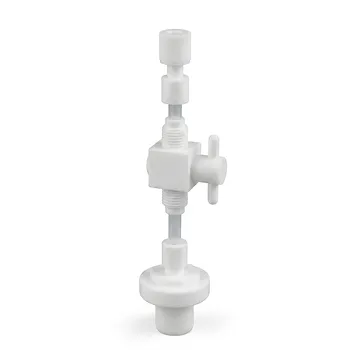
- High Purity PFA PTFE Flare Stop Valves Customizable 2-Way 3-Way Reducing Fluoropolymer Fluid Control Solutions
- PTFE PFA Vacuum Filtration System Corrosion Resistant Customizable Shatterproof Laboratory Device
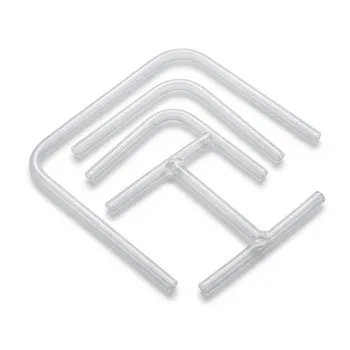
- High Purity PFA Coiled Tubing Custom PTFE Machining PFA Welding and Precision Bending Solutions
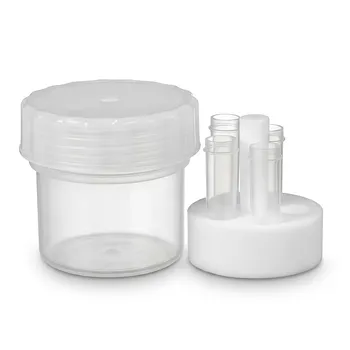
- Corrosion Resistant PTFE Support with PFA Transparent Reaction Tank and High Purity PFA Sampling Tube for Trace Analysis
People Also Ask
- Why are high-purity vessels critical for BiFeO3 synthesis? Ensuring Phase Purity
- Why is the use of high-purity PFA or PTFE labware critical during TiO2 nanoparticle purification? Protect Sample Purity
- Why is high-purity PFA trace analysis labware recommended for trace element detection? Achieve Gold Standard PPT Accuracy
- Why is high-purity PFA trace analysis labware used for MXene? Ensure Superior Material Integrity in Research
- Why is high-purity PFA labware necessary for Znx@LS-2 zeolite ICP-OES analysis? Ensure Trace-Level Precision