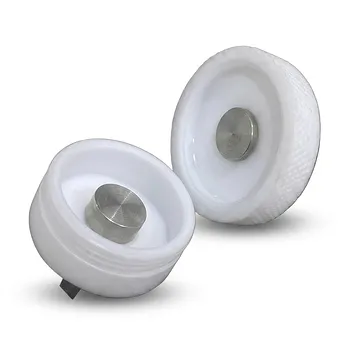
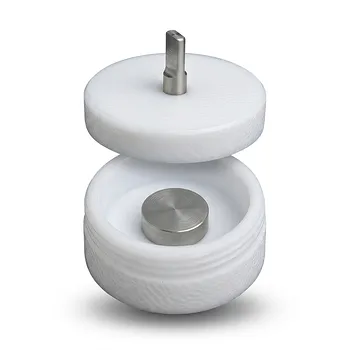
Compression-type battery test fixtures are critical for evaluating KMnVOH electrochemical performance because they provide a stable, hermetically sealed environment that ensures uniform physical contact between the cathode, separator, and zinc anode. By applying precisely controlled mechanical pressure, these fixtures minimize interface resistance and ensure uniform current distribution, which is essential for obtaining accurate data during cyclic voltammetry (CV) and galvanostatic charge-discharge (GCD) testing.
The central takeaway is that compression-type fixtures isolate the intrinsic electrochemical properties of KMnVOH by eliminating variables related to unstable physical connections and environmental interference. This technical stability is mandatory for ensuring that measured performance data—such as rate capability and cycle life—is both repeatable and scientifically valid.
Ensuring Interfacial Integrity and Electrical Stability
Minimizing Ohmic Polarization
Compression fixtures apply constant external pressure that forces the KMnVOH cathode into tight contact with the separator and electrolyte. This minimizes contact resistance, which significantly reduces ohmic polarization and prevents artificial voltage drops during high-rate testing.
Ensuring Uniform Current Distribution
Precise mechanical loading ensures that the active material is pressed evenly against the current collector. This prevents localized current crowding, ensuring the electrochemical reactions occur uniformly across the entire electrode surface rather than at isolated points of contact.
Compensating for Volume Changes
During long-term cycling, KMnVOH may experience subtle volume fluctuations. A pressurized fixture provides continuous mechanical support that maintains contact integrity even as the material expands or contracts, preventing the loss of electrical connectivity.
Managing the Testing Environment
Withstanding Internal Pressure Fluctuations
Aqueous electrolytes used with KMnVOH can generate internal pressure changes due to thermal expansion or gas evolution. The hermetic seal of a compression fixture maintains a stable environment, preventing electrolyte evaporation or leakage that would otherwise skew long-term results.
Chemical and Corrosion Resistance
Evaluation of KMnVOH often involves corrosive aqueous electrolytes that can react with standard testing components. High-quality fixtures utilize corrosion-resistant materials like PTFE to ensure that the collected data reflects the material's energy storage characteristics rather than chemical interference from the fixture itself.
Thermal and Mechanical Consistency
Specialized designs can compensate for material contraction during sub-zero temperature testing. By maintaining constant contact pressure across varying temperatures, the fixture ensures that the resulting data reflects the electrolyte's intrinsic performance rather than setup-induced resistance increases.
Understanding the Trade-offs
The Risk of Excessive Pressure
While pressure is necessary for contact, excessive force can damage the porous structure of the KMnVOH cathode or cause the separator to fail. It is critical to calibrate the compression to a level that optimizes contact without compromising the physical integrity of the cell components.
Assembly Complexity vs. Repeatability
Compression fixtures are more complex to assemble and maintain than standard coin cells. However, they eliminate the manual setup fluctuations common in simpler designs, making them the superior choice for high-precision research where data repeatability is paramount.
How to Apply This to Your Research
Selecting the appropriate testing strategy depends on your specific evaluation goals for KMnVOH:
- If your primary focus is intrinsic material kinetics: Use a high-precision compression fixture with PTFE components to isolate the electrochemical signal from contact resistance and chemical noise.
- If your primary focus is long-term cycle life: Ensure the fixture provides constant mechanical pressure (e.g., 10 MPa) to maintain electrical contact despite potential volume changes in the KMnVOH structure.
- If your primary focus is low-temperature performance: Utilize a fixture with thermal compensation features to ensure that increased resistance readings are due to electrolyte behavior rather than physical contraction at the interface.
By standardizing the mechanical environment through compression-type fixtures, researchers can confidently attribute electrochemical findings to the intrinsic properties of the KMnVOH material.
Summary Table:
| Key Feature | Impact on KMnVOH Evaluation | Critical Benefit |
|---|---|---|
| Controlled Pressure | Minimizes contact resistance & ohmic polarization | Ensures accurate CV/GCD data |
| Uniform Loading | Prevents localized current crowding | Guarantees even electrochemical reactions |
| Hermetic Sealing | Prevents electrolyte evaporation | Maintains stability for long-term cycling |
| Corrosion Resistance | Uses high-purity PTFE/PFA materials | Eliminates chemical noise & interference |
| Mechanical Support | Compensates for volume fluctuations | Maintains connectivity during expansion |
Elevate Your Battery Research with KINTEK Precision
Is your KMnVOH research being held back by inconsistent data? At KINTEK, we specialize in providing the high-performance environment your materials deserve. From custom-engineered compression-type battery testing fixtures to a comprehensive range of high-purity laboratory supplies, we ensure your results are repeatable and scientifically valid.
Our Expertise Includes:
- Advanced Battery Solutions: Specialized battery testing fixtures, electrode accessories, and custom electrochemical cells.
- High-Purity Labware: PTFE and PFA beakers, crucibles, reagent bottles, and digestion tubes designed for corrosive aqueous electrolytes.
- Fluid Transfer & Prep: Tubing, fittings, filters, and separatory funnels to maintain sample integrity.
- Custom Fabrication: End-to-end CNC machining for non-standard parts and bespoke laboratory setups.
Whether you need everyday basic labware or complex, high-volume fluoropolymer components, KINTEK’s absolute focus on high-performance materials guarantees durability and chemical purity.
Contact us today to optimize your laboratory setup!
References
- Selin Sarıyer, Rezan Demir‐Cakan. Microwave‐Assisted Rapid Hydrothermal Synthesis of Vanadium‐Based Cathode: Unravelling Charge Storage Mechanisms in Aqueous Zinc‐Ion Batteries. DOI: 10.1002/cssc.202402445
This article is also based on technical information from Kintek Knowledge Base .
Related Products
- Corrosion Resistant PTFE Coin Cell Battery Testing Clamps and Acid Proof Custom Fluoropolymer Battery Fixtures
- Acid Resistant PTFE Button Cell Battery Test Fixture Customizable Machining High Purity Electrochemical Testing Clamp
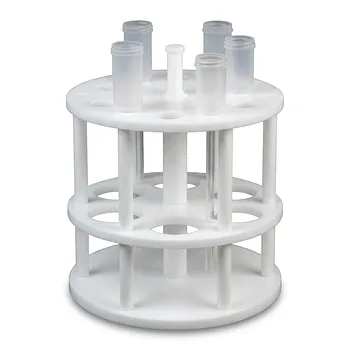
- Custom PFA Microcolumn Racks and PTFE Machined Low Background Corrosion Resistant Laboratory Fixtures
People Also Ask
- What is the thermal operating range for PTFE battery clamps in electrochemical research? Stability from -200°C to +260°C
- What are the primary functions and material compositions of PTFE battery clamps? Ensure Precision & Chemical Resistance
- How do coin cell testing fixtures evaluate ZIF-derived LCO cycling stability? Ensure Battery Research Precision
- What are the electrical insulation and signal integrity advantages of using PTFE battery clamps? Ensure Data Accuracy
- How does the chemical inertness of PTFE benefit laboratory-scale battery testing? Ensure high-purity research results.