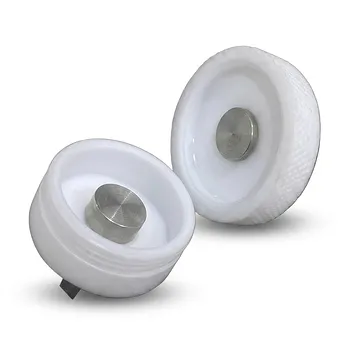
Coin cell components and battery testing fixtures are the mechanical foundation required to isolate and measure the electrochemical properties of VS2/MoS2@S composite cathodes. These fixtures provide the controlled environment necessary to ensure that the data collected reflects the material's intrinsic catalytic activity rather than external variables like poor electrical contact or electrolyte leakage.
Core Takeaway: By providing consistent mechanical pressure and a hermetic seal, coin cell components minimize ohmic polarization and interfacial resistance. This stabilization is essential for accurately verifying the ability of VS2/MoS2@S catalysts to inhibit the polysulfide shuttle effect during long-term cycling.
The Role of Mechanical Integrity in Data Accuracy
Reducing Ohmic Polarization through Contact Pressure
Coin cell components, specifically the stainless steel spacers and wave springs, provide the constant mechanical pressure required to maintain tight contact between the cathode, electrolyte, and anode. This physical constraint is vital for reducing ohmic polarization, ensuring that the electrical path remains efficient throughout the testing process.
Optimizing Interfacial Charge Transfer
Stable physical contact ensures a uniform interface between the VS2/MoS2@S active material and the electrolyte. This allows researchers to accurately measure the interfacial charge transfer resistance, which is a critical metric for evaluating how efficiently the catalyst facilitates the conversion of polysulfides.
Managing Volume Expansion during Cycling
Composite materials often undergo physical expansion and contraction during the intercalation of ions. High-precision fixtures provide the necessary structural constraint to monitor these changes without losing electrical connectivity, which is necessary for obtaining reliable rate-performance data.
Quantifying Catalytic Performance and Long-Term Stability
Verifying Polysulfide Shuttle Inhibition
A primary goal of evaluating VS2/MoS2@S is determining its ability to suppress the polysulfide shuttle effect. Testing fixtures enable the long-term monitoring of charge-discharge cycles, allowing for the precise calculation of capacity decay rates that prove the catalyst's effectiveness.
Standardizing the Electrochemical Environment
Using standardized modules, such as 2032 coin cells, creates a reproducible platform for measuring specific capacity and cycle life. The hermetic seal provided by the casing prevents the ingress of moisture or oxygen, which would otherwise contaminate the results and mask the material's true performance.
Accuracy in High-Rate Performance Testing
To evaluate the material at various rates (from 0.1 C to 2 C), the testing fixture must maintain a uniform current distribution across the electrode surface. Precision components ensure that the recorded capacity changes are a result of the material's kinetics rather than localized resistance "hot spots."
Understanding the Trade-offs and Limitations
The Risks of Improper Pressure
While high pressure is necessary for contact, excessive mechanical stress can damage the separator or lead to internal short circuits. Conversely, insufficient pressure increases internal resistance, leading to an underestimation of the material's actual electrochemical potential.
Sealing and Internal Pressure Fluctuations
Standard coin cell housings must be expertly sealed using a precision crimping machine to withstand internal pressure fluctuations. If the seal is compromised, electrolyte evaporation can occur, which artificially accelerates capacity decay and renders long-term stability data invalid.
How to Apply This to Your Electrochemical Evaluation
Recommendations for Material Assessment
- If your primary focus is evaluating catalytic kinetics: Use high-tension wave springs and gold-plated spacers to minimize contact resistance and ensure the measured overpotential is intrinsic to the VS2/MoS2@S material.
- If your primary focus is long-term cycle stability: Prioritize the use of high-quality 2032 casings with robust gaskets to maintain a hermetic seal over hundreds of cycles, preventing electrolyte dry-out.
- If your primary focus is rate performance (0.1C to 2C): Ensure uniform thickness of the cathode slurry and use precision-aligned testing fixtures to guarantee a homogenous current distribution.
The careful selection and assembly of coin cell fixtures transform a raw composite material into a functional electrochemical system, providing the clarity needed to validate advanced energy storage solutions.
Summary Table:
| Component/Feature | Role in VS2/MoS2@S Evaluation | Impact on Data Accuracy |
|---|---|---|
| Spacers & Wave Springs | Maintains constant contact pressure | Reduces ohmic polarization and interfacial resistance |
| Hermetic Seal (2032 Casing) | Prevents electrolyte leakage/moisture ingress | Ensures reliable long-term cycle stability data |
| Structural Constraint | Manages cathode volume expansion | Maintains electrical connectivity during ion intercalation |
| Precision Alignment | Ensures uniform current distribution | Validates intrinsic kinetics during high-rate testing |
Elevate Your Battery Research with KINTEK Precision Solutions
To achieve definitive results in the evaluation of VS2/MoS2@S composite cathodes and other advanced energy materials, mechanical precision is non-negotiable. KINTEK provides the high-performance laboratory supplies you need to eliminate external variables and focus on material performance.
From essential coin cell components and battery testing fixtures to specialized high-purity trace analysis labware (beakers, crucibles, digestion tubes) and fluid transfer components (tubing, valves, fittings), we cover your entire experimental workflow. Our expertise extends to advanced reaction apparatus, including custom electrochemical cells, hydrothermal synthesis liners, and microwave digestion vessels—all crafted from superior PTFE and PFA materials.
Why choose KINTEK?
- End-to-End Customization: We offer full custom CNC fabrication for non-standard machined parts tailored to your unique laboratory setup.
- Material Excellence: An exclusive focus on high-performance fluoropolymers ensures chemical inertness and thermal stability.
- Comprehensive Range: We supply everything from basic consumables (O-rings, seal tapes, spatulas) to complex, bespoke reactor assemblies.
Ensure your data reflects the true potential of your catalysts. Contact KINTEK today to discuss your custom fabrication needs or to place a high-volume order for premium laboratory supplies.
References
- Thilini Boteju, Venkataraman Thangadurai. Synergistic Effect of VS<sub><b>2</b></sub>/MoS<sub><b>2</b></sub> as an Electrocatalyst for Accelerating Polysulfide Conversion in Lithium–Sulfur Batteries. DOI: 10.1021/acsami.5c12948
This article is also based on technical information from Kintek Knowledge Base .
Related Products
People Also Ask
- What is the thermal operating range for PTFE battery clamps in electrochemical research? Stability from -200°C to +260°C
- What are the primary functions and material compositions of PTFE battery clamps? Ensure Precision & Chemical Resistance
- How do coin cell testing fixtures evaluate ZIF-derived LCO cycling stability? Ensure Battery Research Precision
- What are the electrical insulation and signal integrity advantages of using PTFE battery clamps? Ensure Data Accuracy
- How does the chemical inertness of PTFE benefit laboratory-scale battery testing? Ensure high-purity research results.