Use a fluorinated mobile phase and fluoropolymer-compatible sample handling. When a highly fluorinated polymer does not dissolve in THF or chloroform, conventional SEC can produce aggregation, distorted elution, or column plugging rather than a reliable molecular weight distribution. Effective analysis requires an eluent that keeps the polymer molecularly dissolved throughout separation, such as an HCFC/HFIP mixture or, for suitable polymer systems, a pentafluorophenol/chloroform mixture.
The central challenge is not simply finding a solvent that dissolves the polymer once; it is maintaining complete solubility during filtration, injection, and passage through the SEC column. Fluorinated eluents, chemically resistant fluid-path components, and independent confirmation of the result are the basis of trustworthy molecular weight data.
Why Conventional SEC Fails
Insolubility Changes the Measurement
SEC separates molecules according to their hydrodynamic volume in solution. If a fluorinated polymer is only partially dissolved, the measured size no longer represents the individual polymer chains.
Undissolved material can form aggregates that elute as apparently larger species. It can also remain trapped in the column, causing pressure increases, peak distortion, and progressive loss of column performance.
Fluorine Alters Solvent Compatibility
Polymers with substantial fluorine content often have low affinity for common SEC eluents such as THF and pure chloroform. Their strong fluorinated segments can require a more specialized solvent environment to remain dispersed.
A solvent that appears adequate during initial sample preparation may still allow precipitation after dilution, filtration, or mixing with the mobile phase. Solubility must therefore be assessed under the actual chromatographic conditions.
Detector Response Can Be Weak
Some highly fluorinated polymers can show weak refractive-index detector response when their refractive index is close to that of the eluent. This is sometimes described as isorefractive behavior.
A weak or absent signal does not necessarily indicate that the polymer is absent. It may indicate that the detector and mobile-phase combination are poorly matched to the sample.
Selecting an Appropriate Fluorinated Eluent
HCFC/HFIP Mixtures
An HCFC mixed with 1,1,1,3,3,3-hexafluoro-2-propanol (HFIP) can provide the solvent environment needed to maintain fluorinated polymers in solution during SEC. The specific composition should be selected based on the polymer’s chemistry and verified experimentally.
The important criterion is continuous solubility from sample preparation through column separation. A compatible mixture should produce a stable chromatogram without visible precipitation, abnormal pressure behavior, or evidence of sample loss.
Pentafluorophenol and Chloroform
A pentafluorophenol/chloroform mixture, such as a 1/3 volume ratio reported for suitable systems, can be another option when HCFC/HFIP conditions are not appropriate or available. Its usefulness depends on the polymer structure and should not be assumed for every fluorinated material.
Comparative solubility testing can establish whether this mixture provides better dissolution and chromatographic behavior than the primary fluorinated eluent.
Match the Eluent to the Detector
The mobile phase must be compatible with both the polymer and the detector. An eluent that dissolves the sample but produces poor refractive-index contrast may still yield an unusable chromatogram.
Where available, consider a detector configuration that provides stronger contrast for the polymer, while remembering that detector selection does not correct incomplete dissolution.
Preparing the Sample Without Introducing Artifacts
Dissolve Completely Before Injection
Use an appropriate concentration and sufficient mixing time to obtain a genuinely molecular solution. Do not rely on visual clarity alone if the polymer may form small, slowly settling aggregates.
The solution should remain stable after dilution to the injection concentration and during the time required for filtration and analysis. Any cloudiness, sediment, or time-dependent change is a warning that the conditions are unsuitable.
Use Fluoropolymer Sample Vessels
HFIP and related fluorinated alcohol mixtures can attack ordinary plastics, elastomers, and other materials used in sample preparation. Extracted additives or swollen components can contaminate the sample and increase chromatographic background.
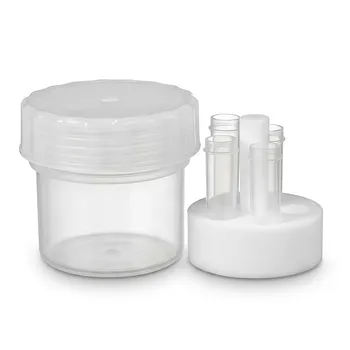
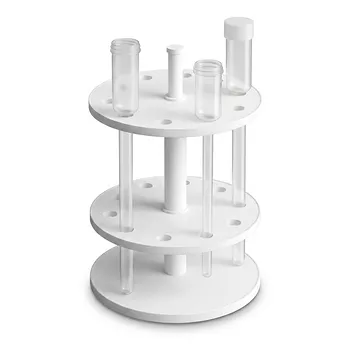
PFA sample vials and other high-purity fluoropolymer vessels minimize solvent-induced extractables and help preserve baseline stability.
Filter With PTFE Membranes
Filtering removes residual particulates and undissolved material before injection, reducing the risk of column plugging. Use PTFE membrane filters that are compatible with the selected fluorinated solvent.
Filtration does not make an incompletely dissolved polymer suitable for SEC. It can instead remove the high-molecular-weight or aggregated fraction and bias the reported distribution, so dissolution should be verified before filtering.
Protecting the SEC Fluid Path
Use PTFE and PFA Components
HFIP-containing eluents can swell or extract material from conventional tubing, seals, fittings, and vials. Use high-purity PTFE or PFA tubing, fittings, transfer lines, and sample-contact components wherever they are exposed to the mobile phase or sample.
This reduces contamination, solvent degradation, and changes in flow-path dimensions that can affect system performance.
Check the Complete System
Compatibility must be evaluated for the entire solvent path, including reservoirs, degassers, pump seals, injector components, columns, detectors, waste lines, and connections. A fluoropolymer sample vial alone does not protect a system containing incompatible internal materials.
Consult the instrument and column manufacturer’s chemical-resistance data before introducing HFIP or an HCFC-based solvent. Confirm that the selected column hardware and stationary phase are rated for the operating solvent.
Establish a Clean Baseline
Flush and equilibrate the system thoroughly with the selected mobile phase before analyzing samples. Monitor baseline stability, pressure, and detector response during equilibration and between injections.
A rising baseline or unexplained peaks may result from extractables rather than the polymer. Running solvent blanks helps distinguish system contamination from genuine sample signals.
Validating Molecular Weight Results
Calibrate for the Polymer System
SEC normally reports molecular weights through a calibration relationship based on standards or an established detector method. The resulting values depend on hydrodynamic volume, solvent quality, column chemistry, and the calibration standard.
When the fluorinated polymer differs substantially in chain conformation from the calibration standards, the reported molecular weights should be treated as method-dependent estimates unless an appropriate absolute measurement is available.
Check Reproducibility
Repeat injections should produce consistent retention times, peak shapes, and calculated molecular weight averages. Changes between injections can indicate precipitation, adsorption, degradation, or progressive column fouling.
Record sample stability, filtration conditions, injection concentration, solvent composition, temperature, pressure, and detector settings. These variables are part of the measurement, not merely operational details.
Use an Independent Technique When Necessary
If detector response is weak or complete dissolution cannot be demonstrated, support the SEC result with another method. ¹H NMR end-group analysis can provide a reliable number-average molecular weight when distinct initiator end-group proton signals can be resolved against polymer backbone signals.
NMR does not replace SEC for determining the full molecular weight distribution, but it can test whether the SEC-derived number-average molecular weight is plausible.
Understanding the Trade-offs
Specialized Solvents Increase Operational Complexity
Fluorinated eluents can improve solubility but require compatible equipment, careful waste handling, and more stringent solvent-management procedures. They may also be more expensive or less convenient than THF or chloroform.
The analytical benefit is justified when conventional solvents produce incomplete dissolution or unreliable data, but the method should be designed around documented chemical compatibility.
Filtration Can Bias the Distribution
Filtering is valuable for protecting the column, but it can remove insoluble polymer fractions. If the polymer is not fully dissolved before filtration, the result may appear artificially shifted toward lower molecular weight.
Compare filtered and unfiltered dissolution behavior where appropriate, while protecting the column with a validated filtration strategy.
SEC Does Not Eliminate Calibration Limitations
A fluorinated eluent can solve the solubility problem without making the molecular weight measurement absolute. Differences in polymer architecture, branching, stiffness, and solvent-dependent conformation can still affect the relationship between elution volume and molar mass.
Interpret SEC data together with the calibration method and, when the result is consequential, an independent measurement such as NMR end-group analysis.
Materials Compatibility Can Limit Method Transfer
A method that works on one SEC instrument may not transfer directly to another if the systems use different seals, tubing, injector materials, or detector flow cells. Chemical compatibility and baseline behavior must be rechecked after transfer.
How to Apply This to Your Project
Start with a small-scale solubility and system-compatibility study before committing valuable sample or exposing the SEC column to an unproven solvent.
- If your primary focus is complete dissolution: Screen HCFC/HFIP first, then evaluate a pentafluorophenol/chloroform mixture when chemically appropriate, confirming that the solution remains stable through filtration and injection.
- If your primary focus is column protection: Use PTFE filters and PFA or PTFE sample-contact components, and monitor pressure and solvent blanks for signs of particulates or extractables.
- If your primary focus is accurate molecular weight distribution: Use a validated fluorinated mobile phase, document calibration limitations, and confirm repeatability across replicate injections.
- If your primary focus is reliable number-average molecular weight: Supplement SEC with ¹H NMR end-group analysis when resolvable end-group signals are available.
- If your primary focus is detector sensitivity: Check for isorefractive behavior and select a detector and mobile-phase combination that provides sufficient polymer-to-eluent contrast.
A fluorinated polymer can be characterized effectively by SEC when solubility, materials compatibility, detector response, and calibration are treated as one integrated method-development problem.
Summary Table:
| Key Step | Action | Critical Consideration |
|---|---|---|
| Eluent Selection | Use HCFC/HFIP mixture or pentafluorophenol/chloroform. | Ensure complete solubility throughout the run; match detector contrast. |
| Sample Prep | Dissolve fully in fluorinated solvent; use PFA vials and PTFE filters. | Avoid artifacts from inadequate dissolution; filtration can remove aggregates and bias results. |
| Fluid Path | Use PTFE/PFA tubing, fittings, and components. | Prevent contamination and swelling from HFIP; check entire system compatibility. |
| Validation | Calibrate with appropriate standards; check reproducibility; use NMR end-group analysis for additional verification. | SEC results are method-dependent; confirm with an independent technique if necessary. |
Need reliable SEC analysis for your fluorinated polymers? KINTEK's PTFE and PFA components, including tubing, fittings, and vials, ensure solvent compatibility and sample integrity. Our custom machining capabilities support your specific setup. Contact us today to optimize your polymer characterization and achieve accurate molecular weight data — Get in touch today!
Related Products
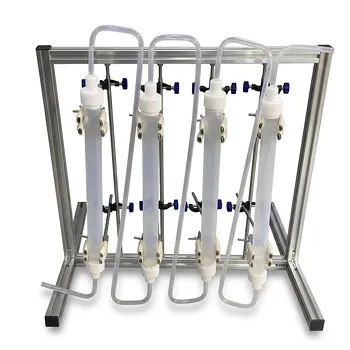
- High Purity PFA Chromatography Columns and Collection Bottles Corrosion Resistant Fluoropolymer Filtration Systems for Trace Analysis
- High Purity PFA Chromatography Column with Collection Bottle Corrosion Resistant Fluoropolymer Filtration System for Trace Analysis
- High Purity PFA Chromatography Column Double Layer Constant Pressure Filter Column with Sieve Plate Acid Resistant Fluoropolymer Filtration System
- Custom PTFE Filtration System Acid Resistant Chemical Semiconductor Fluoropolymer Filter Assembly
- High Purity PFA Chromatography Microcolumn Corrosion Resistant Resin Column with Sieve Plate for Trace Analysis
People Also Ask
- Why use high-purity PFA bottles for Carbon Quantum Dots? Ensure Ink Stability and Prevent Fluorescence Quenching
- Why is PFA often selected over traditional PTFE for manufacturing complex fluoropolymer fluid components, custom fittings, and sealed laboratory digestion vessels? Discover the key advantages for your lab.
- What are the primary functional and temperature differences between PFA and FEP when selecting melt-processible fluoropolymers for custom laboratory apparatus?
- Why is the chemical stability of polymer endgroups critical when selecting melt-processible fluoropolymers like PFA for high-purity laboratory apparatus? Choose Stable Endgroups for Reliable Performance
- What are the characteristics of PFA material? A Guide to Its High-Performance Balance