The Frustration of the "Perfect" Setup That Fails
Imagine this: You have a top-tier potentiostat, high-purity electrolytes, and a meticulously calibrated DC power source. You begin your electrolysis process, expecting a clean, non-spontaneous redox reaction. But as the hours pass, the data begins to drift. The current fluctuates, the yield drops, or worse—trace impurities appear in your analysis that shouldn't be there.
In many high-stakes research environments, from battery testing to semiconductor development, researchers find themselves fighting "ghost variables" in their data. They spend weeks troubleshooting the electronics or the chemical concentrations, yet the inconsistency remains.
The Cost of the "Good Enough" Vessel
The common struggle often lies in treating the electrochemical cell as a simple container—a "passive box" where the reaction happens. When results fail, researchers typically try to compensate by over-volting the system or refining the electrolyte recipe.
However, ignoring the physical architecture of the cell leads to significant business and scientific consequences. In the semiconductor industry, a single part-per-billion of leached impurity from a vessel can ruin a wafer batch. In new energy research, a poorly sealed or slightly reactive cell body can lead to false positives in efficiency tests, causing months of wasted R&D budget on a "breakthrough" that cannot be replicated.
The Science: Why Electrolysis is a "Hostile" Process
To understand why these failures happen, we must look at the fundamental physics of an electrolytic cell. Unlike a galvanic cell (like a standard battery) which releases energy through a natural, spontaneous flow, an electrolytic cell is an exercise in forced chemistry.
As defined by the laws of thermodynamics, these reactions have a positive Gibbs free energy change ($\Delta G > 0$). This means you are using an external DC source to literally "tear apart" stable chemical bonds. To achieve this, you must exceed the decomposition potential of the system.
Here is the hidden catch: the high-energy environment required to force these non-spontaneous reactions doesn't just affect your target chemicals. It also attacks the container itself. Standard glass can leach ions in alkaline conditions, and lower-grade plastics can degrade under the intense local pH shifts at the electrode-electrolyte interface. When the vessel itself begins to interact with the process, your "controlled" experiment becomes a chaotic, multi-variable mess.
Solving the Root Cause with Material Integrity
To achieve repeatable, high-purity results, the cell must be more than a container; it must be a perfectly inert stage. If you are driving a reaction that is chemically aggressive, your hardware must be chemically invisible.
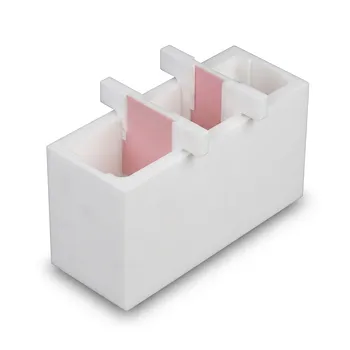
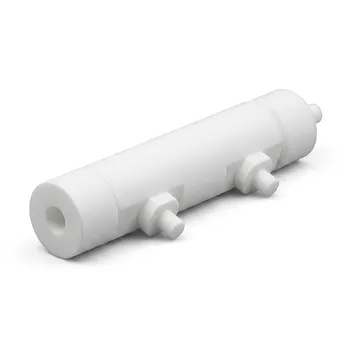
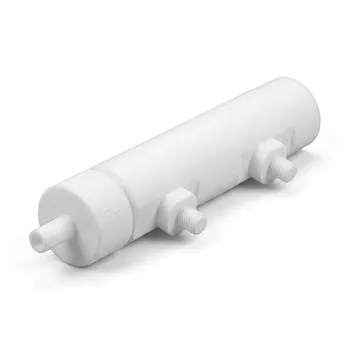
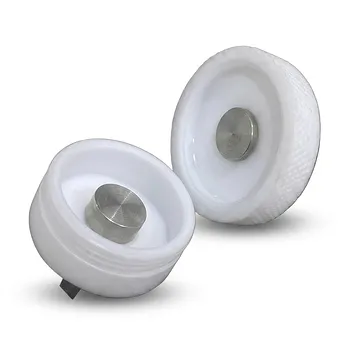
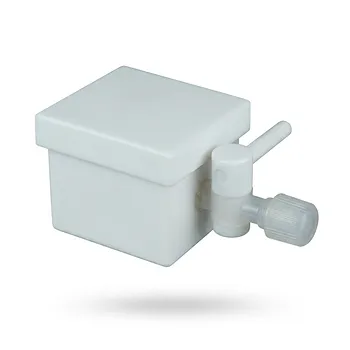
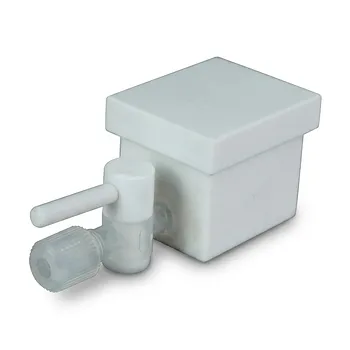
This is why we focus on high-precision PTFE and PFA fabrication. These materials are chosen not just for their heat resistance, but for their near-total chemical universal inertness. A KINTEK electrochemical cell is engineered to ensure that 100% of the electrical energy provided by your DC source goes into the intended redox reaction, rather than reacting with the cell walls or leaching contaminants into the electrolyte.
By utilizing custom CNC-machined PTFE bodies and PFA trace-analysis labware, you eliminate the vessel as a variable. Our battery testing fixtures and microwave digestion vessels are designed specifically to withstand the extreme pressures and "non-spontaneous" demands of modern electrolysis, ensuring that the decomposition potential you apply is used only for the chemistry you intended to study.
Beyond the Fix: Unlocking New Research Horizons
When you stop worrying about the integrity of your cell environment, the focus shifts from "troubleshooting hardware" to "pioneering science."
With a truly inert and precision-engineered cell, you can explore higher voltage windows that were previously impossible due to vessel degradation. You can achieve the ultra-low detection limits required for semiconductor-grade trace analysis and accelerate the development of next-generation solid-state batteries. By solving the fundamental problem of the cell environment, you don't just get better data—you get a faster path to market and the confidence that your results will stand up to the most rigorous peer review.
The complexity of electrolysis shouldn't be compounded by the limitations of your hardware. Whether you are scaling a chemical process or refining a specialized prototype, the right environment is the foundation of accuracy. To discuss how our high-purity PTFE and PFA solutions can stabilize your specific electrochemical challenges, Contact Our Experts.
Related Products
- Corrosion Resistant PTFE Electrochemical Cell for New Energy Research Inert Insulating Customizable Lab Reaction Vessel
- Square PTFE Electrochemical Cell for Silicon Wafer Processing and Hydrofluoric Acid Resistance in Semiconductor and New Energy Research
- White PTFE Electrolytic Cell with Movable Slider and Insulated Lid for Fluorine Corrosion Resistance
- Custom PTFE Reaction Box Opaque White Square Electrochemical Cell Tank
- Custom PTFE Electrolytic Cell Corrosion Resistant Low Background Reaction Vessel with Inlet Outlet Ports
Related Articles
- Why Your Electronic Components Keep Failing: The Insulation Problem You're Overlooking
- Why Your Results Drift in Harsh Electrolytes—and the Atomic Armor That Fixes It
- Is Your Electrode Housing Corrupting Your Data? Why PTFE Jackets Are Crucial for Precise Electrochemistry
- Beyond the Textbook: Why Your Electrolytic Cell Needs More Voltage Than You Calculated
- Beyond the Circuit: Why Material Choice is the Hidden Variable in Your Electrolytic Cell’s Performance