The Frustrating "Click" of a Failed Experiment
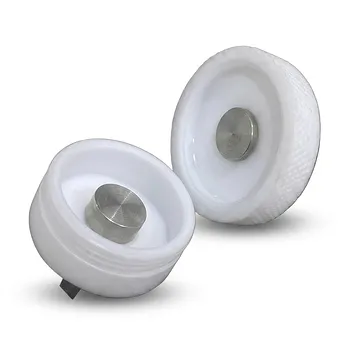
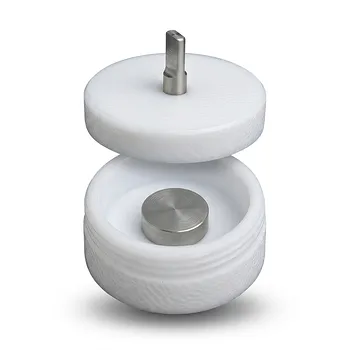
You are mid-way through a critical battery characterization cycle. To ensure the electrical signal is as clean as possible, you give the PTFE-threaded battery clamp one final, firm twist. Then, you feel it—a sickening "click" or a sudden loss of resistance. The threads have stripped, or worse, the clamp body has visibly deformed.
In the world of electrochemical research, this is a common but costly mishap. What began as an attempt to secure a stable connection ends with a ruined fixture and a discarded experiment. Why does a material as specialized as Polytetrafluoroethylene (PTFE) seem so fragile when it comes to mechanical assembly?
The Common Struggle: Chasing Signal at the Expense of Hardware
When researchers encounter "noisy" data or inconsistent contact resistance, the instinctual response is a mechanical one: tighten the connection. We are conditioned by our experience with stainless steel or brass fittings, where "tighter is better."
However, applying this logic to PTFE battery setups often leads to a cycle of diminishing returns:
- The Over-Torque Trap: Using pliers or excessive hand force to "lock" a battery electrode in place.
- The Resulting Damage: Threads become flattened, or the material "creeps"—slowly deforming over time even under a constant load.
- The Business Impact: This isn't just a technical annoyance. It results in frequent replacement of expensive labware, project delays while waiting for custom prototypes, and—most dangerously—unreliable data that can lead your R&D team down the wrong path.
The Root Cause: Why PTFE Behaves More Like a Liquid Than a Metal
To solve this, we have to look at the material science. Unlike the metals used in traditional fasteners, PTFE is a relatively soft polymer with a Shore D hardness of approximately 50–65.
The fundamental problem is a phenomenon known as mechanical creep or "cold flow." Because of its unique molecular structure, PTFE can permanently deform under a load that is well below its breaking point. When you over-tighten a threaded clamp:
- Dimensional Inaccuracy: The clamping pressure compresses the material, changing the internal geometry of the fixture.
- Thread Distortion: Because the material is soft, the peaks of the threads can "flow" into the valleys, effectively smoothing them out until they can no longer hold a load.
- The Paradox: Increasing pressure does not necessarily improve electrical contact; in fact, if the material deforms enough to misalign the electrode, your signal noise may actually increase.
The Solution: Engineering for Precision, Not Power
True stability in battery testing doesn't come from brute force—it comes from the intelligent integration of material properties. At KINTEK, we design our PTFE and PFA fixtures with the understanding that the fixture should facilitate contact, not force it.
Our high-precision battery clamps are built to leverage PTFE’s strengths—specifically its exceptional electrical insulation (dielectric strength of 60 MV/m) and its chemical inertness—while neutralizing its mechanical limitations.
By utilizing custom CNC fabrication, we ensure that thread tolerances are exact. More importantly, our fixtures are designed to work in tandem with high-purity gold-plated contacts. Because these contacts are engineered for high conductivity, we can achieve an ultra-low contact resistance of less than 0.5 Ω with only moderate tightening.
You no longer need to "crank" the fixture down because the electrical path is already optimized. The goal is "secure mechanical fixation," which requires significantly less torque than most researchers realize.
Beyond the Fix: Unlocking New Research Potential
When you stop fighting the material and start working with its properties, your lab’s capabilities shift. Transitioning from "brute force" assembly to "precision fixation" opens up several new possibilities:
- Long-Term Thermal Stability: Because the material isn't being stressed to its limit, you can perform hydrothermal synthesis or long-term battery cycling without worrying about the fixture deforming as temperatures fluctuate.
- Preservation of Trace Analysis: By maintaining the structural integrity of your PFA or PTFE labware, you prevent micro-cracks where contaminants could hide, ensuring higher purity in trace analysis.
- Faster Throughput: Technicians can assemble cells confidently and quickly, knowing that "finger-tight" is the scientific standard, not a compromise.
Ultimately, the most valuable asset in your lab is your data. By understanding the mechanical boundaries of your PTFE fixtures, you ensure that every milli-ohm measured is a reflection of your electrode’s performance, not a symptom of a deformed fixture.
If you are facing challenges with fixture durability, inconsistent measurements, or require custom-engineered components for a niche electrochemical application, our team is ready to help. From specialized prototypes to high-volume industrial orders, we bring precision CNC fabrication to your most demanding research problems. Contact Our Experts today to discuss how we can optimize your battery testing hardware.
Related Products
- Corrosion Resistant PTFE Coin Cell Battery Testing Clamps and Acid Proof Custom Fluoropolymer Battery Fixtures
- Acid Resistant PTFE Button Cell Battery Test Fixture Customizable Machining High Purity Electrochemical Testing Clamp
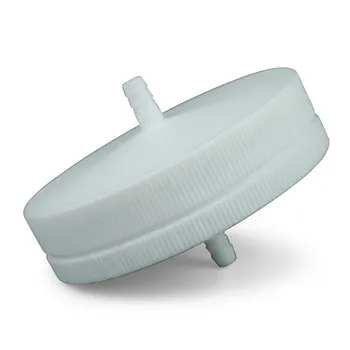
- PTFE Filter Membrane Holder for Hydrogen Chloride and Water Filtration 90mm Environmental Sampling Clamp Customizable
- Custom PTFE Reaction Lid with Integrated Valve and Fitting Corrosion Resistant No Leaching PFA FEP Bottle Cap System
- White PTFE Electrolytic Cell with Movable Slider and Insulated Lid for Fluorine Corrosion Resistance
Related Articles
- Why Inconsistent Battery Test Results Start at the Clamp—And How to Fix It
- Why Electrode Polarities Flip—And How to Ensure Your Battery Tests Never Fail
- Why Your Results Drift in Harsh Electrolytes—and the Atomic Armor That Fixes It
- Why Your Electrolysis Results Are Drifting: The Hidden Impact of Cell Environment on Non-Spontaneous Reactions
- Beyond the Textbook: Why Your Electrolytic Cell Needs More Voltage Than You Calculated