Is Your Battery Underperforming, or is Your Test Fixture the Culprit?
Imagine you’ve spent weeks perfecting a new electrode chemistry. You assemble the cell, start the characterization, and the data looks… wrong. There is an unexpected voltage drop, the polarization curves are jagged, and the capacity seems lower than your theoretical calculations.
Before you blame the chemistry or the electrolyte, look at the physical interface. In high-precision battery research, the most common source of "phantom" data errors isn't the battery itself—it’s the contact resistance at the point where your testing equipment meets your sample.
The "Tighter is Better" Trap
When researchers encounter unstable readings, the instinctual response is often to grab a wrench. If the electrical signal is weak or noisy, the common logic suggests that tightening the battery clamp will force a better connection.
However, in many labs, this leads to a frustrating cycle:
- Over-tightening leads to the deformation of the testing fixture.
- Material "creep" occurs, where the plastic parts slowly shift under pressure, causing the contact to loosen again over time.
- Inconsistent Data forces the team to repeat experiments, wasting expensive materials and delaying project milestones.
This isn't just a technical annoyance; it’s a business drain. Every failed test represents wasted man-hours and delayed time-to-market for new energy solutions.
The Hidden Science of Contact Resistance
To solve this, we have to look at the physics of the interface. In battery characterization, we aim to measure the electrochemical properties of the electrode material. However, if the resistance at the contact point (where the clamp touches the current collector) is high, it introduces polarization losses.
Essentially, the energy is being "wasted" trying to overcome the resistance of the clamp before it even reaches your sample. If your contact resistance is high or fluctuating, your data reflects the limitations of your hardware, not the performance of your chemistry.
Furthermore, most high-performance lab fixtures use PTFE (Polytetrafluoroethylene) because of its incredible chemical resistance. But PTFE has a specific physical profile—it has a Shore D hardness of approximately 50–65. It is relatively soft. If you apply excessive torque to PTFE threads, the material will flow or deform. The key to a perfect measurement isn't force; it’s conductivity and precision.
The Solution: Precision Engineering over Raw Force
To achieve laboratory-grade accuracy, you need a tool designed to solve the resistance problem through material science rather than mechanical pressure.
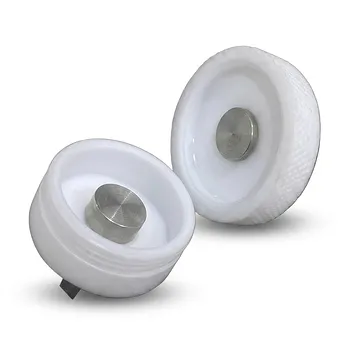
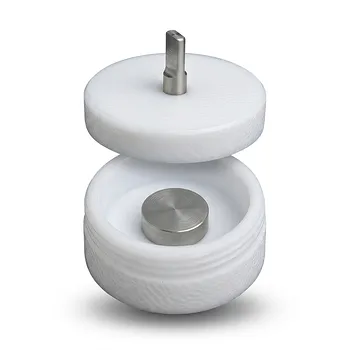
At KINTEK, we design our PTFE battery clamps with high-purity gold-plated contacts. This specific combination addresses the root causes of testing failure:
- Ultra-Low Resistance: By using high-purity gold, our clamps consistently achieve a contact resistance of less than 0.5 Ω. This ensures that polarization losses are minimized and your data remains a "clean" reflection of the electrode.
- Chemical and Physical Balance: The PTFE body provides the necessary inertness for harsh chemical environments, while our CNC-machined threads are designed for a "just-right" fit.
- Stability Without Damage: Because the gold plating ensures excellent electrical flow even at moderate pressures, you no longer need to over-tighten the fixture. This prevents material creep and extends the lifespan of your labware.
Beyond the Fix: Accelerating Discovery
When you eliminate the "noise" of poor contact resistance, the focus of your lab shifts. You stop troubleshooting your equipment and start optimizing your science.
With a stable, low-resistance connection, you can achieve:
- Higher Throughput: Get the right data on the first run, eliminating the need for "trial and error" tightening.
- Precision Characterization: Observe subtle electrochemical transitions that were previously masked by system resistance.
- Scalable Reliability: Ensure that tests conducted today are perfectly comparable to tests conducted six months from now.
Reliable battery data is the foundation of the energy transition. By understanding the physical limits of your fixtures and choosing tools designed for the task, you turn your laboratory from a place of "searching for errors" into a place of "finding solutions."
Whether you are developing the next generation of solid-state batteries or optimizing semiconductor-grade chemicals, your results are only as good as your weakest connection. At KINTEK, we specialize in making sure that connection is the strongest part of your process. If you are facing inconsistent data or need custom-engineered fixtures for your unique research parameters, our technical team is ready to help you bridge the gap between "good enough" and "world-class."
Related Products
- Corrosion Resistant PTFE Coin Cell Battery Testing Clamps and Acid Proof Custom Fluoropolymer Battery Fixtures
- Acid Resistant PTFE Button Cell Battery Test Fixture Customizable Machining High Purity Electrochemical Testing Clamp
Related Articles
- The Invisible Creep: Why Your PTFE Battery Clamps Fail and How to Achieve Perfect Contact
- Why Electrode Polarities Flip—And How to Ensure Your Battery Tests Never Fail
- Why Your Results Drift in Harsh Electrolytes—and the Atomic Armor That Fixes It
- Why Your Electrolysis Results Are Drifting: The Hidden Impact of Cell Environment on Non-Spontaneous Reactions
- Beyond the Textbook: Why Your Electrolytic Cell Needs More Voltage Than You Calculated