The Frustration of "Perfect" Physics and Failing Experiments
Imagine this: you have meticulously calculated the decomposition potential for your latest electrochemical experiment. Your DC power source is calibrated, your electrolyte concentration is exact, and the theory says the reaction should proceed perfectly. Yet, three hours into the run, the voltage starts drifting. By the end of the day, your "high-purity" deposit is contaminated, and your electrodes show signs of unexpected degradation.
You’ve followed the fundamental principles of an electrolytic cell to the letter. So, why is the data lying to you?
The Common Struggle: Fighting a Losing Battle Against Contamination
When electrolysis experiments fail or produce "noisy" data, researchers often look first at their power supply or the purity of their reagents. They spend weeks troubleshooting the electrical circuit or re-ordering expensive catalysts.
However, the real culprit is often the "silent partner" in the experiment: the cell housing and its components. Many labs rely on standard glassware or generic plastic fixtures that aren't designed for the aggressive environment of high-voltage, non-spontaneous reactions. This leads to a series of costly business and research consequences:
- Project Delays: Weeks lost chasing "phantom peaks" in data caused by leached impurities.
- Wasted Resources: Expensive electrolytes and rare-metal electrodes are ruined by a vessel that cannot withstand the chemical stress.
- Non-Reproducible Results: Slight variations in how a container reacts with the chemistry make it impossible to standardize a process for industrial scaling.
The Root Cause: When Energy Meets Matter

To understand why these failures happen, we have to look at the fundamental operating principle of an electrolytic cell. Unlike a battery (galvanic cell) that releases energy, an electrolytic cell consumes energy to force a non-spontaneous reaction (where the Gibbs free energy change, ΔG, is greater than zero).
You are essentially "pumping" electrical energy into a chemical system to break stable molecular bonds. But here is the catch: that energy doesn't just act on your target ions. It creates a highly aggressive environment where:
- Chemical Aggression is Magnified: The electrolyte (often a concentrated acid or molten salt) is already corrosive. Adding an external current accelerates the rate at which that electrolyte attacks the walls of your container.
- Trace Leaching: Standard materials that seem "inert" at room temperature often begin to shed ions when subjected to the potential of an electrolytic run. These ions migrate to the cathode, contaminating your results.
- Seal Failure: The heat generated by the resistance of the electrolyte can cause standard seals to expand and leak, introducing oxygen or moisture that poisons the reaction.
If your cell housing isn't as chemically resilient as your theory is sound, the environment will eventually become part of the reaction.
The Solution: Engineering the Ultimate Chemical Fortress
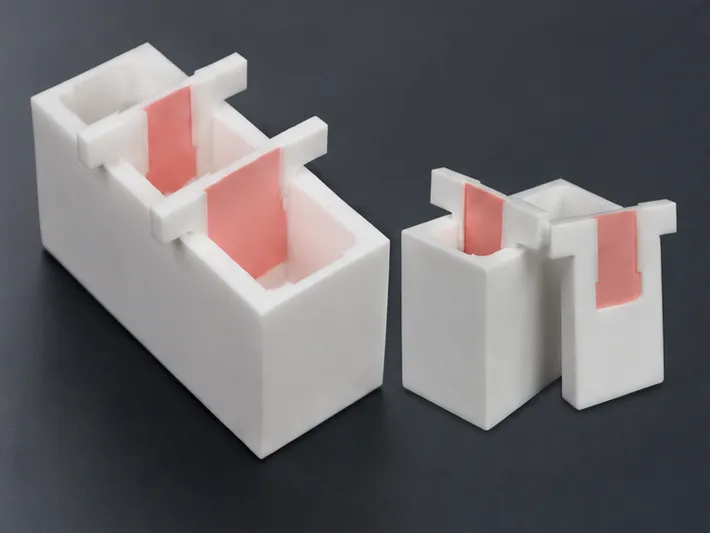
To solve the root cause—environmental interference—you need a cell designed with the same precision as your electrical components. This is where the choice of material becomes a performance-critical decision.
At KINTEK, we believe that an electrolytic cell shouldn't just hold a reaction; it should protect it. We specialize in high-precision PTFE (Teflon) and PFA (Perfluoroalkoxy) laboratory products because these materials are uniquely suited to the physics of electrolysis:
- Absolute Inertness: PTFE and PFA are virtually immune to chemical attack, ensuring that even under high voltage, the container remains a neutral observer, not a participant.
- High-Purity Trace Analysis: Our PFA labware is designed for the semiconductor and chemical research sectors where even parts-per-billion contamination is unacceptable.
- Custom CNC Precision: Every electrochemical cell and battery fixture we produce is custom-machined. This ensures airtight seals and perfect electrode alignment, eliminating the "human error" of improvised setups.
Our products are not just containers; they are the physical embodiment of the stability required to drive non-spontaneous reactions safely and accurately.
Opening New Doors in Electrochemical Research

When you eliminate the "noise" caused by material failure, the focus shifts back to discovery. By moving from "standard" labware to precision-engineered PTFE and PFA cells, researchers can unlock potentials that were previously out of reach:
- New Energy Frontiers: Conduct long-term cycling tests on next-generation battery chemistries without worrying about fixture degradation.
- Accelerated Development: Get "clean" data on the first run, slashing the time it takes to move from a laboratory prototype to an industrial-scale electrolytic process.
- Extreme Chemistry: Safely explore the electrolysis of molten salts or ultra-corrosive fluorine-based electrolytes.
The fundamental principle of electrolysis is about using energy to create change. By choosing the right material foundation, you ensure that the only change occurring is the one you intended.
Whether you are refining high-purity metals, testing new battery architectures, or performing complex trace analysis, your setup shouldn't be the bottleneck of your innovation. Our team at KINTEK specializes in turning complex chemical requirements into high-performance, custom-fabricated hardware. Let’s work together to ensure your next experiment is defined by its results, not its failures. Contact Our Experts.
Related Products
- White PTFE Electrolytic Cell with Movable Slider and Insulated Lid for Fluorine Corrosion Resistance
- Custom PTFE Electrolytic Cell Corrosion Resistant Low Background Reaction Vessel with Inlet Outlet Ports
- High Purity Custom PTFE Reaction Cell Electrolytic Tank for Semiconductor and Polysilicon Industrial Applications
- Square PTFE Electrochemical Cell for Silicon Wafer Processing and Hydrofluoric Acid Resistance in Semiconductor and New Energy Research
- Customizable PFA Square Tray Corrosion Resistant High Temperature Large Petri Dish Electrolytic Cell
Related Articles
- Beyond the Textbook: Why Your Electrolytic Cell Needs More Voltage Than You Calculated
- Why Your Electrolysis Results Are Drifting: The Hidden Impact of Cell Environment on Non-Spontaneous Reactions
- Why Your Electronic Components Keep Failing: The Insulation Problem You're Overlooking
- Is Your Electrode Housing Corrupting Your Data? Why PTFE Jackets Are Crucial for Precise Electrochemistry
- The Invisible Creep: Why Your PTFE Battery Clamps Fail and How to Achieve Perfect Contact