The Mystery of the Stalled Reaction
You’ve done the math. You’ve consulted the standard reduction potential tables, calculated your $E^\circ_{cell}$, and dialed in the precise voltage on your power supply. But as you watch your electrolytic cell, nothing happens. Or perhaps the reaction crawls at a glacial pace, far below the efficiency your model predicted.
In the world of electrochemistry, there is a frustrating gap between "theoretically possible" and "practically functional." For researchers in semiconductor development or new energy storage, this gap isn't just a curiosity—it’s a source of inconsistent data, wasted energy, and delayed project timelines.
The Common Struggle: Cranking the Dial
When a reaction fails to initiate at the theoretical voltage, the most common response is simply to "turn up the heat"—to increase the applied voltage until something happens.
While this might kickstart the reaction, it creates a cascade of new problems. Excessive voltage often leads to side reactions, such as the decomposition of the solvent or the degradation of expensive electrodes. It generates unwanted heat that can warp standard labware and introduce thermal noise into your data.
Ultimately, "brute-forcing" the voltage is an admission that we don't fully control the environment. This lack of control leads to poor repeatability; a setup that works today might fail tomorrow because of a slight change in electrode spacing or a microscopic trace of contamination.
The "Energy Tax": Why Theoretical Voltage Isn't Enough
The reason your textbook calculations fail in the real world is that they describe an idealized state of equilibrium that doesn’t account for "friction." To move from theory to a productive electrolytic cell, you must pay a series of "energy taxes."
1. The Ohmic Drop ($IR$ Drop)
Electricity must flow through the electrolyte and the circuit itself. Every millimeter of distance between electrodes and every bit of resistance in the solution acts like a break on the system. This is the Ohmic drop ($V = I \times R$). If your cell geometry is inconsistent or your connectors are poor, a significant portion of your applied voltage is wasted just overcoming the internal resistance of the setup.
2. Kinetic Overpotential ($\eta$)
Chemical reactions don't like to be rushed. At the surface of the anode and cathode, there are kinetic barriers—think of them as "activation energy" hurdles. To force the redox reaction to happen at a meaningful rate, you must apply an extra "push" known as overpotential.
When you combine these factors, the formula for operation isn't just $V = E^\circ$. It is: $V_{applied} = |E^\circ| + \eta_{anode} + \eta_{cathode} + IR$
If your hardware isn't designed to minimize that $\eta$ and $IR$, you are fighting an uphill battle against physics.
Precision Geometry: The Tool That Defeats Inefficiency
To minimize these losses, you cannot rely on "off-the-shelf" generic containers. You need an environment designed to reduce the "energy tax" to its absolute minimum. This is where the marriage of high-performance materials and precision engineering becomes critical.
At KINTEK, we don't just manufacture labware; we engineer the physical architecture of your electrochemical experiments.
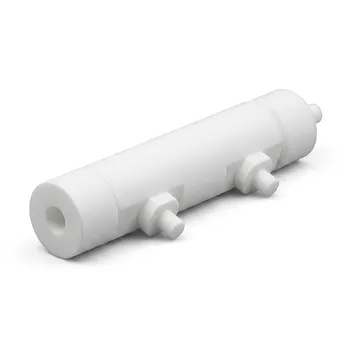
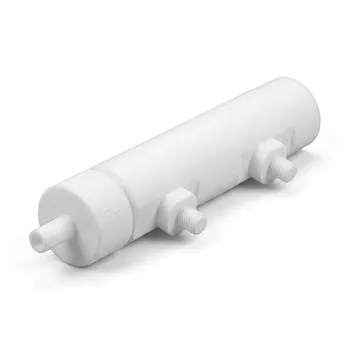
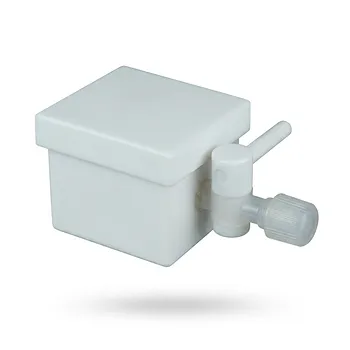
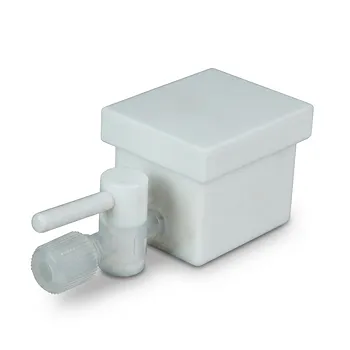
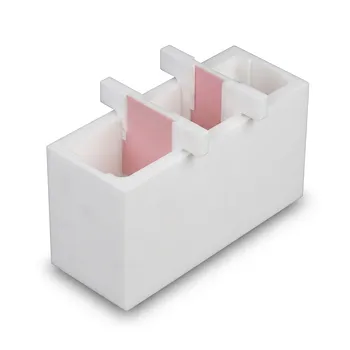
- Minimizing the Ohmic Drop: Through custom CNC fabrication, we produce electrochemical cells with exacting tolerances. By ensuring perfectly parallel electrode placement and optimized spacing, we drastically reduce the $IR$ drop, allowing more of your energy to go toward the reaction rather than heating the electrolyte.
- Eliminating Chemical "Noise": Experimental "friction" is often caused by leachable contaminants from low-grade plastics. Our use of high-purity PTFE and PFA ensures that the only chemistry happening in the cell is the chemistry you intended. These materials are chemically inert and thermally stable, maintaining their structural integrity (and thus your cell geometry) even under rigorous conditions.
- Application-Specific Design: From battery testing fixtures to hydrothermal synthesis liners, our components are designed to handle the specific kinetic pressures of your specialty.
Opening the Door to High-Stakes Research
When you solve the problem of operational voltage at the hardware level, the focus shifts from "trying to make it work" to "analyzing how it works."
By reducing the overpotential and ohmic losses, you gain the ability to perform high-precision trace analysis without interference. In the semiconductor and new energy sectors, this means you can measure the "true" performance of a new battery chemistry or a catalytic coating without the results being masked by the inefficiencies of a poorly designed cell.
With a stabilized, low-resistance environment, you can accelerate your R&D cycles, confident that the data you see on the screen is a result of your science, not a flaw in your equipment.
Whether you are scaling a specialized prototype or optimizing high-volume industrial orders, the right hardware transforms the "energy tax" into an "efficiency dividend." To discuss how our custom PTFE/PFA components and CNC-fabricated electrochemical cells can streamline your specific research challenges, Contact Our Experts.
Related Products
- White PTFE Electrolytic Cell with Movable Slider and Insulated Lid for Fluorine Corrosion Resistance
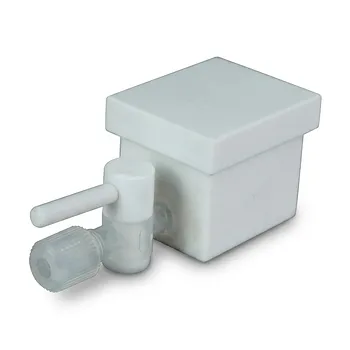
- Custom PTFE Electrolytic Cell Corrosion Resistant Low Background Reaction Vessel with Inlet Outlet Ports
- High Purity Custom PTFE Reaction Cell Electrolytic Tank for Semiconductor and Polysilicon Industrial Applications
- Square PTFE Electrochemical Cell for Silicon Wafer Processing and Hydrofluoric Acid Resistance in Semiconductor and New Energy Research
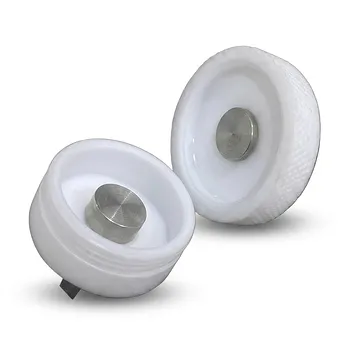
- Customizable PFA Square Tray Corrosion Resistant High Temperature Large Petri Dish Electrolytic Cell
Related Articles
- Beyond the Circuit: Why Material Choice is the Hidden Variable in Your Electrolytic Cell’s Performance
- Why Your Electrolysis Results Are Drifting: The Hidden Impact of Cell Environment on Non-Spontaneous Reactions
- Why Your Electronic Components Keep Failing: The Insulation Problem You're Overlooking
- Is Your Electrode Housing Corrupting Your Data? Why PTFE Jackets Are Crucial for Precise Electrochemistry
- The Invisible Creep: Why Your PTFE Battery Clamps Fail and How to Achieve Perfect Contact