The Invisible Flaw in Your Electrochemical Setup
You have spent weeks perfecting your electrolyte composition and selecting the ideal catalyst for your working electrode. The cell is sealed, the potentiostat is calibrated, and the experiment begins. But an hour later, the baseline starts to drift. "Ghost" peaks appear in your voltammetry, or your impedance data looks like a tangled mess of noise.
Before you blame your chemistry or your software, look at the housing. In many laboratories, the electrode jacket—the humble sleeve that holds the active core—is the overlooked weak link. Whether you are developing the next generation of solid-state batteries or performing trace analysis for semiconductor-grade chemicals, a subpar housing isn't just a part; it's a source of experimental error.
The Cost of "Making Do" With Generic Sleeves
When precision is the goal, "good enough" materials often lead to costly failures. Many researchers attempt to solve stability issues by adjusting the electronics or using excessive shielding, ignoring the fact that their electrode housing is physically failing.
Common, off-the-shelf sleeves often suffer from:
- Electrolyte Wicking: Subtle leaks between the core and the jacket that create unintended "parallel" electrodes.
- Chemical Degradation: Harsh acids or organic solvents swelling the housing, causing the electrode to shift mid-test.
- Signal Contamination: Trace impurities leaching from low-grade plastics into your high-purity cell.
The business consequence is clear: wasted man-hours, reproducible results that aren't actually reproducible, and the potential for a product launch or a research breakthrough to be delayed because of "mystery" data variability.
The Root Cause: Why Material Science Dictates Signal Integrity
To understand why an electrode fails, we have to look at the physics of the interface. An electrode jacket must do more than just "hold" a wire; it must serve as an absolute barrier to every electrical and chemical force in the cell.
The primary reason generic housings fail is inadequate Volume Resistivity. If your housing material has any level of conductivity or porosity, you will experience "leakage currents." These are tiny, parasitic flows of electrons that bypass your active sensing element. When this happens, the current you measure no longer represents the faradaic processes occurring at your electrode surface—it represents the failure of your insulation.
Furthermore, thermal instability is a silent killer. Most plastics expand and contract significantly with temperature changes. In a reactor varying between room temperature and 150°C, a poorly matched housing will "creep" or pull away from the electrode core, creating a microscopic gap where electrolyte can hide, leading to erratic signal spikes and potential short circuits.
The Solution: Precision-Engineered PTFE Architecture
To solve these fundamental issues, the industry has turned to Polytetrafluoroethylene (PTFE) as the gold standard for electrode jackets. But it is not just the material itself; it is the precision fabrication that makes the difference.
A KINTEK PTFE electrode jacket serves as a near-perfect insulating fortress for your sensor. Here is why:
- Absolute Electrical Isolation: With a volume resistivity exceeding 10¹⁸ Ω·cm and a dielectric strength of 60 MV/m, PTFE ensures that every electron measured is an electron you actually intended to capture. It effectively eliminates stray capacitance and ohmic drops along the shaft.
- Extreme Thermal Resilience: Capable of maintaining structural integrity from –200 °C to +250 °C, these jackets prevent the "thermal creep" that causes seals to fail during high-temperature synthesis or aging tests.
- Custom CNC Geometry: Because PTFE is a viscoelastic material, a "one size fits all" approach leads to leaks. We use high-precision CNC fabrication to create thin-walled sleeves, porous plugs, or multi-ring junctions with tolerances tight enough to prevent electrolyte wicking even under pressure.
- Total Chemical Immunity: PTFE is virtually inert. Whether you are working with concentrated hydrofluoric acid or aggressive organic solvents in battery research, the jacket will not degrade, swell, or leach contaminants.
Beyond the Fix: Unlocking New Research Horizons
When you eliminate the "noise" caused by inferior housing, the potential of your laboratory changes. You transition from troubleshooting your equipment to truly understanding your chemistry.
With precision-machined PTFE electrode jackets, you can move into more demanding sectors with confidence. In semiconductor trace analysis, you can ensure that your results are free from plasticizer contamination. In new energy research, you can run long-term battery cycling tests for months without worrying about the housing deforming or failing.
By addressing the root cause of signal instability—the mechanical and electrical failure of the electrode housing—you don't just fix a problem; you create a foundation for accelerated, high-confidence R&D.
At KINTEK, we understand that in high-stakes research, there is no such thing as a "simple" plastic part. Our team specializes in transforming PTFE, PFA, and other high-performance fluoropolymers into the precision tools your lab requires to achieve the impossible. Whether you need a specialized prototype for a unique electrochemical cell or high-volume industrial components, we provide the CNC expertise to ensure your data stays clean and your projects stay on schedule. Contact Our Experts today to discuss your custom fabrication needs and solve your most persistent technical challenges.
Related Products
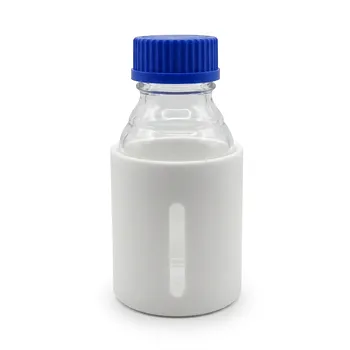
- Custom PTFE Thermal Insulation Sleeves Laboratory Vessel Condensation Jackets Virgin Fluoropolymer Machined Components
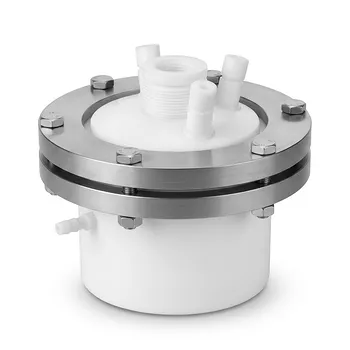
- Custom PTFE Reaction Apparatus Flange Sealed Corrosion Resistant Jacketed Vessel with Stirring Bar and Thermometer Ports
- Custom PTFE Insulating Gaskets and Corrosion Resistant Fluoropolymer Seals for Industrial Electrical Applications
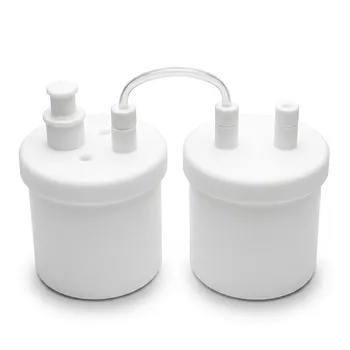
- Custom PTFE Absorption Bottle with Condensation Jacket Corrosion Resistant Low Background High Purity
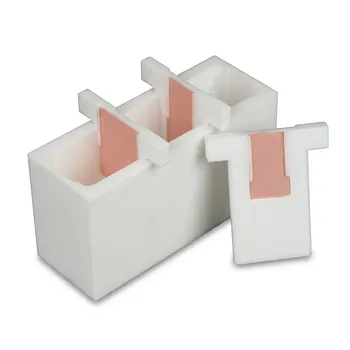
- White PTFE Electrolytic Cell with Movable Slider and Insulated Lid for Fluorine Corrosion Resistance