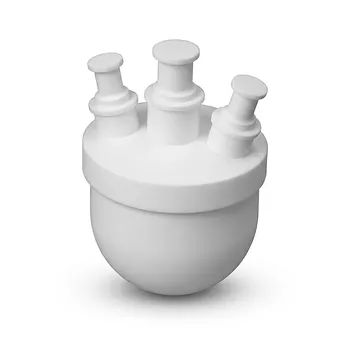
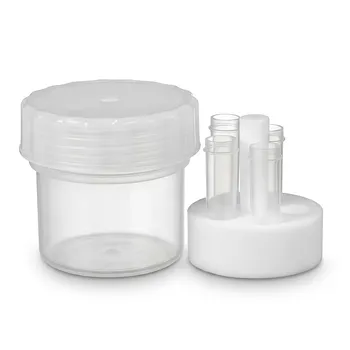
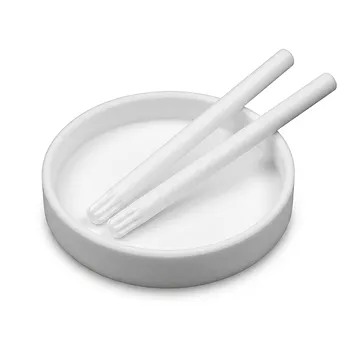
PTFE is difficult to melt-process because its molecules are exceptionally long, stiff, and strongly entangled. Standard PTFE has a molecular weight of roughly (10^6)–(5 \times 10^6) g/mol, producing a melt viscosity near (10^{11})–(10^{12}) Pa·s—approximately a million times higher than that of common melt-processable thermoplastics. Above its melting transition, PTFE becomes a stiff, gel-like material rather than a freely flowing liquid, so fluoropolymer labware is typically compression-molded and sintered or machined from solid stock. This same molecular structure supports continuous service temperatures approaching 260°C (500°F).
PTFE’s high melt viscosity comes from ultra-high molecular weight, rigid fluorocarbon chains, and persistent entanglements that preserve a fibrillar structure above the melting point. The result is outstanding high-temperature and chemical performance, but processing must rely on powder-based forming, sintering, and machining rather than conventional injection molding.
Why PTFE Has Such Extreme Melt Viscosity
Ultra-high molecular weight restricts chain movement
PTFE chains are much longer than those in ordinary thermoplastics. At molecular weights commonly reaching several million grams per mole, the chains contain extensive entanglements that resist sliding past one another.
When heated, these chains do not readily separate and flow. Their enormous length causes the melt to retain substantial resistance to deformation even above the crystalline melting transition.
Fluorocarbon chains are unusually stiff
The carbon–fluorine structure gives PTFE a relatively rigid molecular backbone. Compared with more flexible hydrocarbon polymers, the chains have fewer conformations that allow them to coil and rearrange freely.
This stiffness limits the rapid random-coil motion normally associated with a conventional polymer melt. PTFE therefore behaves more like a highly resistant, structured gel than a low-resistance liquid.
The fibrillar structure persists above melting
PTFE does not immediately lose all molecular organization when its crystalline regions melt. Its straightened, fibrillar macromolecular packing and persistent entanglements remain important in the amorphous regions.
That retained structure is a central reason its melt viscosity can remain around (10^{11})–(10^{12}) Pa·s, rather than falling to the flowable range expected for ordinary thermoplastics.
How High Viscosity Changes PTFE Processing
Conventional injection molding is generally impractical
In common thermoplastics, heating above the melting point produces a melt that can be driven through a screw, runner, and mold cavity. PTFE does not develop that type of practical flow under normal processing conditions.
Heating it above approximately 340°C produces a clear, stiff, highly viscous gel. The material may deform under pressure, but it does not readily fill complex cavities like a conventional injection-molding resin.
Powder compression and sintering are used instead
PTFE components are commonly formed by compressing PTFE powder or granular material, followed by heating near or above the crystalline melting range to sinter the particles into a coherent part.
This approach creates laboratory vessels, tubing, fittings, digestion components, and other shapes without requiring the polymer to flow through a mold as a conventional melt.
Precision machining completes the component
After sintering, PTFE can be machined using precision CNC techniques. Machining is particularly valuable for custom labware, non-standard fluidic fittings, threaded parts, and components with tight dimensional requirements.
For high-purity applications, the fabrication process must also be controlled to avoid contamination, dimensional distortion, and defects in the finished surface.
Sintering quality affects laboratory reliability
Because PTFE does not readily flow during heating, poorly controlled forming or sintering can leave microscopic voids or incompletely consolidated regions within the part.
Those defects can reduce mechanical stress-crack resistance, increase the risk of permeation, and create locations where samples or aggressive chemicals may become trapped. Proper powder preparation, compaction, heating, and cooling are therefore essential.
How the Molecular Structure Supports High Service Temperature
PTFE remains stable far below its processing temperature
PTFE’s continuous-use temperature is commonly specified near 260°C (500°F), even though its crystalline melting transition occurs at approximately 327–342°C, depending on material condition and measurement method.
The gap between service temperature and melting temperature provides a practical operating range in which the labware can retain its shape and function without approaching melt transition conditions.
Chain integrity supports dimensional stability
The same long, strongly entangled chains that resist melt flow also resist deformation during elevated-temperature service. PTFE labware can therefore maintain useful structural integrity in hot chemical environments where many conventional plastics soften, creep, or lose strength.
This does not mean PTFE is mechanically unchanged at high temperature. Its stiffness and load-bearing capability still decline as temperature rises, especially under sustained pressure or load.
Chemical inertness complements thermal performance
PTFE’s high-temperature usefulness is especially important because it is also highly resistant to chemical attack. This combination makes it suitable for applications such as:
- Microwave digestion vessels
- Trace-analysis containers
- Chemical storage components
- High-purity fluid fittings
- Reaction and sample-handling apparatus
The material’s performance is therefore not based on melt viscosity alone. It results from the broader combination of molecular structure, chemical inertness, low surface energy, and thermal stability.
What This Means for Fluoropolymer Labware
PTFE is suited to demanding chemical service
PTFE is a strong choice when the primary requirements are chemical compatibility, low contamination risk, and high-temperature resistance. Its non-melt-processible nature is usually acceptable for standard shapes, machined parts, and specialized vessels.
It is particularly valuable where contact with aggressive acids, bases, solvents, or reactive digestion mixtures is expected.
Complex shapes may require alternative fluoropolymers
If a component requires intricate channels, thin uniform walls, seamless molded geometry, or high-volume production, a melt-processible fluoropolymer such as PFA may be more practical.
PFA and similar materials can be processed using more conventional melt techniques while retaining much of the chemical resistance associated with fluoropolymers. The choice is therefore a balance between PTFE’s performance advantages and the required geometry and manufacturing route.
Temperature ratings must match the actual load
A stated service temperature is not a guarantee that a component can support any pressure or mechanical load at that temperature. PTFE can creep under sustained stress, and this effect becomes more significant as temperature increases.
Labware selection should consider temperature, pressure, duration, wall thickness, applied load, thermal cycling, and chemical exposure together.
Understanding the Trade-offs
High viscosity improves service performance but limits fabrication
PTFE’s molecular structure gives it excellent resistance to thermal deformation and chemical attack. The same structure prevents economical conventional melt molding and makes fabrication more specialized.
This often increases manufacturing time, tooling requirements, and cost, particularly for custom components.
Sintering can introduce dimensional and structural variation
PTFE undergoes dimensional changes during compression and sintering. Parts may require allowance for shrinkage, careful thermal control, and post-sintering machining to achieve final tolerances.
Inadequate consolidation can also produce microvoids that compromise pressure performance, chemical containment, or analytical cleanliness.
PTFE is not automatically the best choice for every hot application
Although PTFE can operate continuously near 260°C, performance depends on the design and mechanical conditions. At elevated temperature, creep, deformation, and reduced stiffness may limit use before chemical compatibility does.
For a highly loaded or pressure-containing component, a lower-temperature material with greater mechanical strength may outperform PTFE despite having less chemical resistance.
Dispersion processing is a separate behavior
PTFE dispersions used in coatings or deposition processes should not be treated like ordinary polymer melts. Their viscosity can change unusually with temperature because of the suspending medium and surfactant system.
This makes temperature control important during coating, transfer, and deposition, where unexpected thickening can cause clogging or non-uniform coverage.
Making the Right Choice for Your Goal
The correct decision depends on whether chemical and thermal performance or manufacturing flexibility is the dominant requirement.
- If your primary focus is maximum chemical resistance and high-temperature service: Choose PTFE labware when operation may approach 260°C and the geometry can be produced by sintering, machining, or both.
- If your primary focus is complex molded geometry or high-volume production: Consider a melt-processible fluoropolymer such as PFA, provided its temperature, mechanical, and chemical limits meet the application.
- If your primary focus is pressure or sustained mechanical loading: Evaluate creep, wall thickness, temperature, and pressure together rather than relying on PTFE’s nominal service-temperature rating.
- If your primary focus is analytical purity and containment reliability: Specify well-consolidated material and tightly controlled sintering to minimize microvoids, permeation, and sample entrapment.
PTFE’s extreme melt viscosity is the processing penalty for a molecular structure that delivers exceptional chemical resistance and high-temperature service.
Summary Table:
| Aspect | Impact |
|---|---|
| Molecular weight (10^6–5x10^6 g/mol) | Extreme chain entanglement, high viscosity (10^11–10^12 Pa·s) |
| Chain stiffness | Resists flow, behaves as gel above melting point |
| Processing method | Compression molding + sintering, CNC machining |
| Service temperature | Continuous up to 260°C (500°F) |
| Labware suitability | Ideal for high-purity, chemical resistance, high-temp applications |
| Limitations | Cannot injection mold; complex shapes require PFA |
Elevate your lab with KINTEK's high-performance PTFE and PFA labware. Our precision-machined and sintered components ensure purity and durability for demanding applications like microwave digestion and trace analysis. Need custom solutions? Our CNC capabilities deliver bespoke parts from simple to complex. Contact us today to discuss your requirements and experience the KINTEK advantage!
Related Products
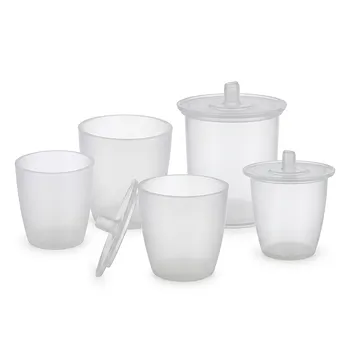
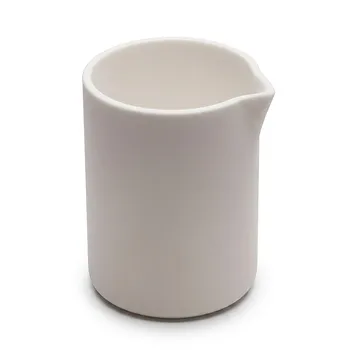
- High Purity PFA Crucible and Corrosion Resistant PTFE Beaker for Trace Analysis and Custom Laboratory Applications
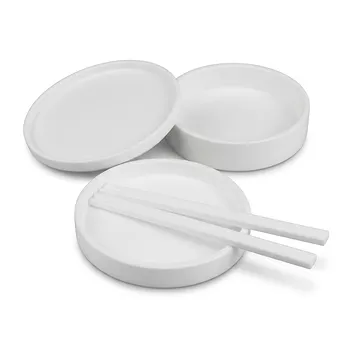
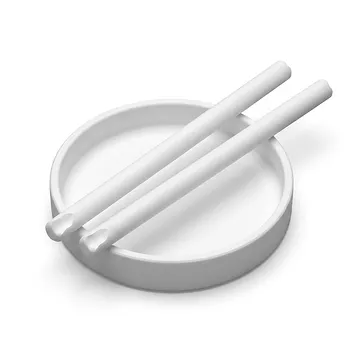
- Custom Polytetrafluoroethylene PTFE Petri Dishes 60mm Corrosion Resistant Low Background Labware
- Custom PTFE Petri Dish 30mm Corrosion Resistant Low Background Non Leaching Laboratory Ware
- Custom PTFE Petri Dish 120mm Diameter Corrosion Resistant Low Background High Purity Labware
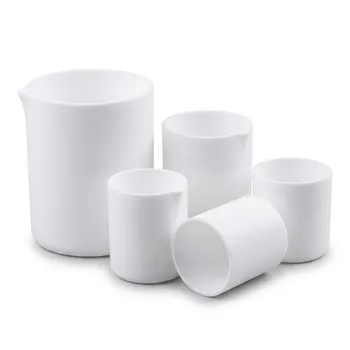
- Large Scale PTFE Beakers and Flasks for High Temperature Corrosion Resistant Laboratory Applications with Custom CNC Fabrication
People Also Ask
- Why are high-purity vessels critical for BiFeO3 synthesis? Ensuring Phase Purity
- Why is the use of high-purity PFA or PTFE labware critical during TiO2 nanoparticle purification? Protect Sample Purity
- Why is high-purity PFA trace analysis labware used for MXene? Ensure Superior Material Integrity in Research
- Why is high-purity PFA labware necessary for Znx@LS-2 zeolite ICP-OES analysis? Ensure Trace-Level Precision
- What key material characteristics make PTFE and PFA suitable for high-purity laboratory labware, trace analysis containers, and medical microporous tubing? Discover the essential properties that ensure purity.