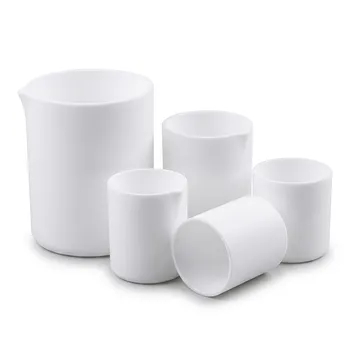
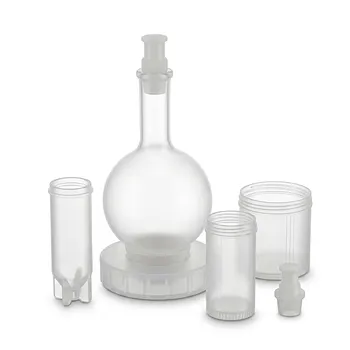
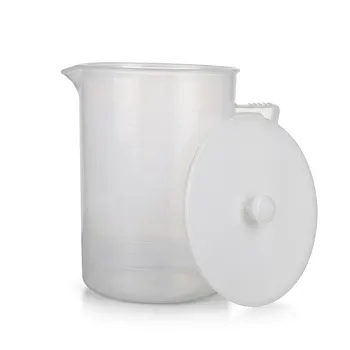
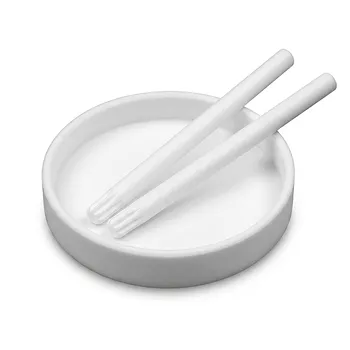
PTFE and PFA labware achieve exceptionally low contamination because their fluorinated molecular structures resist chemical reaction, ion release, absorption, and surface retention. Strong carbon-carbon and carbon-fluorine bonds protect the polymer backbone, while a dense fluorine sheath isolates it from acids, bases, solvents, and samples. Their low surface energy and negligible water absorption further reduce analyte loss, memory effects, and background contamination during trace analysis.
PTFE and PFA cannot guarantee literal zero contamination under every manufacturing, cleaning, or handling condition. Properly manufactured and prepared, however, they provide near-zero extractables, extremely low metal-ion backgrounds, and minimal sample interaction, making them among the most reliable materials for high-purity trace workflows.
Why Fluoropolymer Labware Protects Sample Integrity
The Fluorine Sheath Blocks Chemical Interaction
PTFE and PFA are perfluorinated fluoropolymers. Fluorine atoms densely surround the carbon-based polymer backbone, creating a chemically shielded surface that limits access to the underlying carbon structure.
This molecular arrangement gives the materials exceptional resistance to aggressive acids, bases, oxidizing reagents, and many organic solvents. The sample is therefore less likely to react with, decompose, or extract constituents from the vessel wall.
Strong Covalent Bonds Resist Polymer Breakdown
The carbon-carbon and carbon-fluorine bonds in these polymers are strong and chemically stable. Their bond strength is an important part of the explanation for resistance to chemical attack, although bond energy alone does not determine performance.
The fluorinated architecture, high molecular weight, crystallinity, and lack of reactive functional groups work together to make PTFE and PFA unusually inert. This is why they remain stable during acid digestion, reagent storage, and repeated analytical use.
PTFE and PFA Contain Few Mobile Contaminants
High-purity grades contain extremely low levels of residual monomers, oligomers, and extractable compounds. Their high molecular weight also means that the polymer itself is not readily dissolved or transported into aqueous samples under normal laboratory conditions.
This minimizes organic background, toxicological activity, and chemical interference from the labware. The result is a cleaner blank and greater confidence that a measured trace signal comes from the sample rather than the container.
How Their Surfaces Reduce Analyte Loss
Low Surface Energy Limits Adsorption
PTFE and PFA have very low surface energy, commonly cited in the range of approximately 14-18 dyn/cm. Their nonpolar, non-stick surfaces provide few favorable sites for many dissolved substances to bind strongly.
This reduces analyte adsorption to digestion vessels, beakers, tubing, valves, and bottles. It is particularly important when concentrations are low enough that a small amount retained on a wall can materially change the result.
Minimal Absorption Reduces Memory Effects
The materials exhibit near-zero water absorption and very low permeability compared with many conventional plastics. Aqueous reagents and samples therefore do not readily penetrate the labware or become trapped within it.
Less penetration means less carryover between runs. After suitable cleaning, the vessel is less likely to release previously handled elements or compounds into a subsequent sample.
Non-Stick Release Improves Recovery
Liquids tend to drain or rinse from fluoropolymer surfaces rather than spread across and adhere to them. Rinsing can therefore recover a larger fraction of the sample and reduce residual deposits.
This matters during evaporation, microwave or hotplate digestion, dilution, and transfer. Better recovery improves mass balance and reduces the risk that analytes are lost before instrumental measurement.
Why Metal Background Is So Low
The Polymer Does Not Readily Supply Metal Ions
Unlike some glass, ceramic, or filled polymer materials, high-purity PTFE and PFA can be produced with very low elemental impurity levels. Their chemically inert matrix does not readily dissolve and release metal ions into acidic samples.
This is essential for inductively coupled plasma mass spectrometry, atomic absorption, and other methods that measure elements at trace or ultratrace concentrations. A vessel with a small metal background can otherwise produce false positives or elevate method blanks.
No Reactive Additives Are Needed in Neat Grades
Neat PTFE and PFA are used without reinforcing fillers, pigments, or plasticizers that could introduce additional extractables. This distinction is important because the purity of the finished component depends on its complete formulation, not only on the polymer family.
Filled, colored, improperly processed, or contaminated fluoropolymer parts may not provide the same background performance as certified high-purity labware. Material selection must therefore include grade, manufacturing history, and cleanliness controls.
PTFE and PFA: Similar Chemistry, Different Manufacturing Advantages
PTFE Provides Broad Chemical and Thermal Resistance
PTFE is valued for its near-universal chemical resistance, very low friction, and non-stick surface. It is well suited to digestion vessels, liners, beakers, tubing, seals, and components exposed to aggressive reagents.
PTFE is generally processed by forming and sintering rather than conventional melt molding. Its structure and processing route can make complex shapes and transparent inspection more difficult than with PFA.
PFA Adds Melt Processability and High Purity
PFA is a perfluoroalkoxy copolymer with chemical behavior closely related to PTFE. Its melt processability allows manufacturers to produce seamless, complex, and relatively transparent components with consistent internal surfaces.
That can improve visual inspection, cleaning, fluid handling, and fabrication of bottles, tubing, fittings, and specialized trace-analysis vessels. PFA should still be selected by grade and application because its mechanical and thermal behavior is not identical to PTFE.
Both Materials Support Broad Temperature Operation
PTFE and PFA retain useful chemical stability across demanding temperature conditions, including cryogenic handling and elevated-temperature digestion within the limits specified by the manufacturer. A commonly cited fluoropolymer operating span is roughly -195°C to +260°C, but the allowable temperature depends on material, stress, pressure, duration, and geometry.
Chemical resistance at room temperature does not automatically establish suitability for every reagent at high temperature. The actual application conditions must be checked against technical data for the specific product.
What “Zero Contamination” Requires in Practice
Material Inertness Is Necessary but Not Sufficient
Fluoropolymer chemistry prevents many contamination mechanisms, but it cannot remove contamination introduced during manufacturing, packaging, transport, or laboratory handling. Particles, machining residues, airborne metals, detergents, and impure rinse water can still affect a sample.
For this reason, the technically accurate objective is near-zero contribution from the labware under a validated protocol, rather than an unconditional guarantee of zero contamination.
Cleaning Determines Real-World Background
PTFE and PFA should be cleaned using procedures compatible with the analytes and reagents involved. Acid washing, high-purity water rinsing, controlled drying, and blank verification are commonly used elements of a contamination-control process.
Cleaning must also address the outside surfaces, caps, closures, tubing connections, and tools that contact the vessel. A chemically inert vessel can still transfer contamination from an unclean surrounding component.
Product Qualification Matters
Trace-analysis labware should be sourced in a grade intended for high-purity applications. Certificates, extractables data, elemental background data, lot controls, and cleaning documentation are more meaningful indicators than the generic label “fluoropolymer.”
Laboratories should verify the complete assembly, including fittings, seals, valves, and tubing. The weakest component in contact with the sample can dominate the system blank.
Understanding the Trade-offs
Fluoropolymers Are Not Contamination-Proof
PTFE and PFA reduce chemical interaction and leaching; they do not prevent contamination from dust, handling, poor cleaning, or impure reagents. Their performance must be demonstrated with method blanks and, where appropriate, recovery studies.
Some Analytes Can Still Interact With Surfaces
Low surface energy minimizes adsorption but does not make adsorption impossible. Particular metals, particles, hydrophobic compounds, or concentrated residues may behave differently depending on solution chemistry, concentration, temperature, and contact time.
The correct response is application-specific testing rather than assuming that all analytes recover identically.
Mechanical and Thermal Limits Still Apply
PTFE is relatively soft and can deform, creep, or scratch under mechanical stress. PFA can offer fabrication and inspection advantages, but it also has application-specific limits for pressure, temperature, and dimensional stability.
Scratches, damaged seals, and deformed closures can create particle sources, trapped residues, or leaks. Chemical inertness does not eliminate the need for mechanical inspection and controlled replacement.
Cleanliness Can Increase Cost and Complexity
High-purity fluoropolymer labware, certified cleaning, dedicated storage, and blank testing generally cost more than conventional laboratory supplies. That cost is justified when contamination would compromise an expensive analysis, but not every routine workflow requires the same purity level.
The appropriate choice is the lowest-contamination system that reliably meets the method’s detection limits and recovery requirements.
Making the Right Choice for Your Goal
Choose the material and handling protocol according to the dominant risk in your analytical workflow.
- If your primary focus is aggressive acid digestion: Use certified high-purity PTFE or PFA vessels whose temperature and reagent compatibility are documented for the digestion conditions.
- If your primary focus is ultratrace elemental analysis: Select low-background, filler-free labware and qualify it with reagent blanks, rinse blanks, and representative sample-recovery tests.
- If your primary focus is minimizing analyte loss: Favor smooth, low-energy PTFE or PFA surfaces and validate recovery after rinsing, evaporation, and transfer steps.
- If your primary focus is visual inspection and complex fabrication: Consider PFA for transparent or seamless components, while confirming that its mechanical and thermal limits fit the application.
- If your primary focus is repeated-use reliability: Control cleaning, storage, handling, and replacement, and inspect for scratches, residues, deformation, and damaged fittings.
The combination of fluorine shielding, strong polymer bonds, low surface energy, minimal absorption, and low elemental background makes properly qualified PTFE and PFA labware a foundation for reliable high-purity trace analysis.
Summary Table:
| Property | PTFE | PFA | Benefit for Trace Analysis |
|---|---|---|---|
| Chemical Structure | Perfluorinated, strong C-F bonds | Perfluoroalkoxy, similar structure | Resists acids, bases, solvents; no reactive sites |
| Surface Energy | ~14-18 dyn/cm | ~14-18 dyn/cm | Reduces adsorption of analytes |
| Water Absorption | <0.01% | <0.01% | Minimizes memory effects |
| Metal Ion Leaching | Extremely low in high-purity grades | Extremely low in high-purity grades | Low background for elemental analysis |
| Processability | Forming/sintering | Melt-processable | Allows seamless, complex, transparent components |
| Temperature Range | -195°C to +260°C | -195°C to +260°C | Suitable for digestion and cryogenic handling |
| Cleanability | Easy, non-stick | Easy, non-stick | Allows effective cleaning and blank verification |
Elevate your trace analysis with KINTEK's high-purity PTFE and PFA labware. Our products are specifically designed to minimize contamination, ensuring accurate results. From digestion vessels to custom CNC machined parts, we deliver quality and reliability. Contact us today to find the perfect solution for your lab.
Related Products
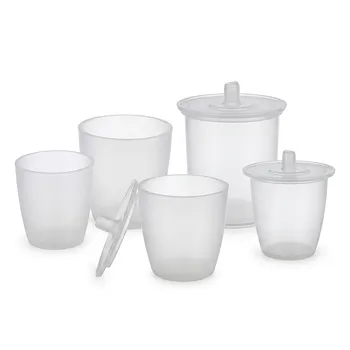
- High Purity PFA Crucible and Corrosion Resistant PTFE Beaker for Trace Analysis and Custom Laboratory Applications
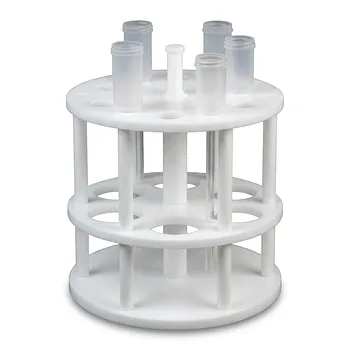
- Custom PFA Microcolumn Racks and PTFE Machined Low Background Corrosion Resistant Laboratory Fixtures
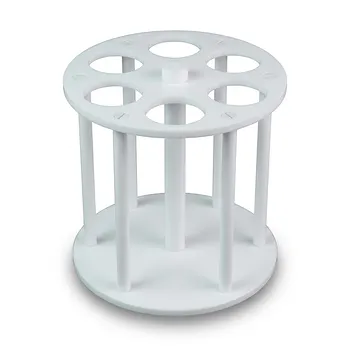
- Custom PFA Separatory Funnel Rack PTFE Machined Laboratory Support Stand Corrosion Resistant Low Background Fluoropolymer Fixture
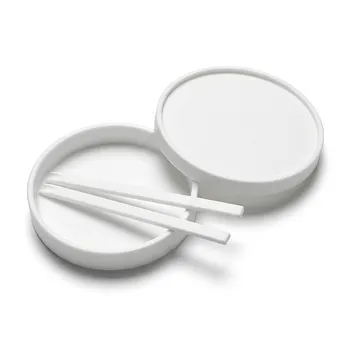
- Custom Polytetrafluoroethylene PTFE Petri Dishes 60mm Corrosion Resistant Low Background Labware
- PTFE PFA Vacuum Filtration System Corrosion Resistant Customizable Shatterproof Laboratory Device
People Also Ask
- Why are high-purity vessels critical for BiFeO3 synthesis? Ensuring Phase Purity
- Why is the use of high-purity PFA or PTFE labware critical during TiO2 nanoparticle purification? Protect Sample Purity
- Why is high-purity PFA labware necessary for Znx@LS-2 zeolite ICP-OES analysis? Ensure Trace-Level Precision
- Why is high-purity PFA trace analysis labware used for MXene? Ensure Superior Material Integrity in Research
- Why is high-purity PFA trace analysis labware used for sample processing when preparing Mo2CTx@MoS2? Ensure Material Purity