Perfluoropolymer labware is chemically inert and heat resistant because its carbon backbone is densely shielded by fluorine atoms and built from exceptionally stable covalent bonds. In materials such as PTFE and PFA, hydrogen atoms are essentially replaced by fluorine, creating a highly fluorinated chain with few chemically vulnerable sites. The strong, short C–F bonds, saturated C–C backbone, low polarizability, and tightly packed fluorine sheath collectively resist chemical attack and thermal degradation.
The key insight: Perfluoropolymers do not rely on one property alone. Their performance comes from the combination of strong carbon–fluorine bonding, complete fluorination, steric shielding of the carbon chain, and a molecular structure that offers little opportunity for acids, bases, solvents, or heat to initiate reaction.
Why Fluorination Creates Chemical Inertness
The C–F bond is exceptionally difficult to break
The carbon–fluorine bond has a dissociation energy of roughly 116 kcal/mol, or about 485 kJ/mol, making it one of the strongest single bonds formed by carbon. Breaking this bond requires substantial energy, and most laboratory reagents cannot do so under ordinary operating conditions.
This is more important than simply saying that fluorine is “strongly attached.” The bond’s high strength directly reduces the likelihood of chain scission, substitution, or extraction of fluorine from the polymer.
Fluorine has the highest electronegativity
Fluorine has the highest electronegativity on the Pauling scale, approximately 4.0. It attracts shared bonding electrons strongly, producing a highly polarized C–F bond in which the electron density is held tightly around the carbon–fluorine pair.
The resulting electrons are relatively unavailable for further chemical interaction. That limits the polymer’s ability to participate in ordinary acid–base, oxidation–reduction, or solvent-driven reactions.
Low polarizability reduces chemical interaction
Fluorine’s electrons are tightly bound and its electron cloud is difficult to distort. This gives perfluoropolymers very low polarizability and low surface energy.
As a result, many liquids do not readily wet, dissolve, or strongly interact with the surface. This helps explain the characteristic nonstick, hydrophobic, and oleophobic behavior of PTFE and related materials.
How the Polymer Structure Protects the Backbone
Fluorine forms a protective sheath
The carbon atoms form a saturated polymer backbone, while fluorine atoms surround and shield that backbone. In PTFE, the chains adopt a helical arrangement that places fluorine atoms densely around the carbon skeleton.
This arrangement acts like a molecular barrier. A reagent approaching the backbone encounters the fluorinated outer layer before it can reach the more chemically vulnerable carbon framework.
Complete fluorination removes reactive C–H sites
Hydrocarbon polymers contain carbon–hydrogen bonds that can participate in oxidation, radical reactions, and thermal decomposition. Perfluoropolymers replace those hydrogen atoms with fluorine.
The absence of ordinary C–H bonds removes many pathways by which heat, oxygen, or reactive chemicals can initiate degradation. Partially fluorinated polymers retain some C–H bonds and generally do not provide the same level of chemical and thermal resistance.
The backbone is saturated and covalent
PTFE consists primarily of a linear chain of saturated carbon atoms connected by C–C bonds, with fluorine attached to the carbon atoms. There are no easily hydrolyzed ester, amide, or ether linkages in the basic PTFE backbone.
That structural simplicity matters in laboratory environments. Many common degradation mechanisms depend on attacking a specific functional group, while the perfluorinated PTFE chain presents relatively few such targets.
Why the Same Structure Resists Heat
Strong bonds raise the energy required for decomposition
Thermal degradation begins when enough energy is available to break or rearrange polymer bonds. The strong C–F bond network increases the energy required for these processes.
The C–C backbone also contributes to structural stability. The important point is the combined bond network, rather than treating the C–F bond as the only source of heat resistance.
The fluorinated surface limits oxidative attack
At elevated temperature, oxygen and reactive species can attack many organic polymers through the formation of radicals and oxidation products. The fluorine sheath makes access to the carbon chain more difficult and leaves fewer reactive hydrogen sites available.
This gives PTFE and PFA substantially greater resistance to oxidation and thermal aging than many hydrocarbon-based plastics. They can still decompose when exposed to sufficiently high temperatures, so “heat resistant” does not mean “thermally indestructible.”
Chain packing supports dimensional stability
The dense fluorine coverage and relatively rigid, linear chain structure influence how the polymer packs and crystallizes. PTFE is highly crystalline, while PFA is a copolymer designed to improve melt processability while retaining much of the chemical resistance of PTFE.
These structural differences affect stiffness, creep, permeability, and fabrication behavior, but both materials retain the central advantage of a heavily fluorinated backbone.
Why This Matters in Laboratory Labware
Resistance to acids, bases, and solvents
PTFE and PFA generally withstand concentrated acids, strong bases, and a broad range of organic solvents because these reagents cannot readily break the polymer’s bonds or solvate and separate its chains.
This is why they are used for acid digestion vessels, reagent containers, tubing, valves, fittings, and reaction components exposed to aggressive chemicals.
Low contamination risk
The low surface energy and low reactivity of perfluoropolymers reduce adsorption, reaction, and leaching compared with many conventional materials. That is valuable in trace analysis and high-purity applications, where even small amounts of extractable material can affect results.
However, chemical inertness does not guarantee zero contamination. Manufacturing residues, fillers, surface damage, permeation, and the reagents themselves must still be controlled.
Thermal processing capability
Perfluoropolymer labware can tolerate demanding heating and digestion conditions because its molecular structure delays bond cleavage and oxidative degradation. PFA is particularly useful where a fluoropolymer must be fabricated into complex or transparent components through melt processing.
The usable temperature limit remains application-specific and depends on time, mechanical load, atmosphere, pressure, and the particular grade of material.
Understanding the Trade-offs
Chemical resistance is not universal
Perfluoropolymers resist nearly all common laboratory chemicals, but certain highly reactive fluorinating agents, molten alkali metals, and extreme high-temperature conditions can attack or degrade them.
Compatibility must therefore be checked against the actual reagent, concentration, temperature, exposure time, and stress state.
Heat resistance has a mechanical limit
A polymer can remain chemically intact while becoming soft, creeping, or dimensionally unstable under load. PTFE is especially susceptible to creep because of its low friction and relatively low stiffness at elevated temperature.
For pressure-bearing or precision components, chemical compatibility alone is insufficient; mechanical design and temperature rating also matter.
PTFE and PFA are not interchangeable
PTFE offers outstanding chemical resistance and low friction but is difficult to melt-process. PFA is melt-processable and often provides better fabrication flexibility and transparency, but its mechanical and thermal behavior differs from that of PTFE.
The correct choice depends on whether the priority is chemical exposure, optical inspection, complex geometry, dimensional control, flexibility, or manufacturing method.
High purity requires material control
Virgin, unfilled grades are normally preferred for high-purity laboratory work. Additives, pigments, reinforcement fibers, machining debris, and previous chemical exposure can introduce contamination even when the base fluoropolymer itself is inert.
Making the Right Choice for Your Goal
Choose the material by considering both molecular resistance and the real operating conditions of the labware.
- If your primary focus is maximum chemical inertness: Use a high-purity, heavily fluorinated material such as virgin PTFE or PFA and verify compatibility with the specific reagent and temperature.
- If your primary focus is complex fabrication or transparency: Consider PFA, which retains strong fluoropolymer chemical resistance while offering melt processing and improved visual inspection.
- If your primary focus is elevated-temperature operation: Check the manufacturer’s continuous-use and mechanical-load limits, because thermal softening and creep may become limiting before chemical degradation.
- If your primary focus is trace-analysis purity: Select unfilled laboratory grades, control cleaning and handling, and evaluate extractables, permeation, and prior exposure rather than assuming the polymer is contamination-free.
Perfluoropolymer labware performs reliably under severe conditions because its fluorine-protected, strongly bonded molecular structure leaves chemical reagents and heat few practical pathways to attack the material.
Summary Table:
| Feature | Chemical Inertness | Heat Resistance |
|---|---|---|
| C-F bond strength | High (116 kcal/mol) | High thermal stability |
| Electronegativity | High (4.0) | N/A |
| Polarizability | Low | N/A |
| Fluorine sheath | Protects backbone | Limits oxidative attack |
| Saturated backbone | No reactive sites | Resists thermal degradation |
Looking for high-performance PTFE or PFA labware? KINTEK offers a complete range of fluoropolymer products, from basic beakers to custom CNC-machined parts. Our materials provide exceptional chemical resistance and heat tolerance to meet your most demanding applications. Contact us today to find the perfect solution for your lab — Get in touch!
Related Products
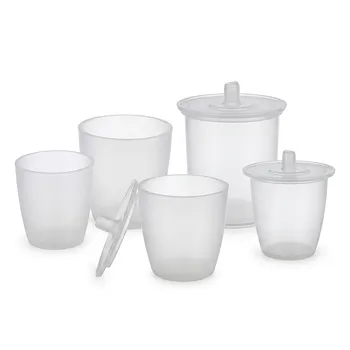
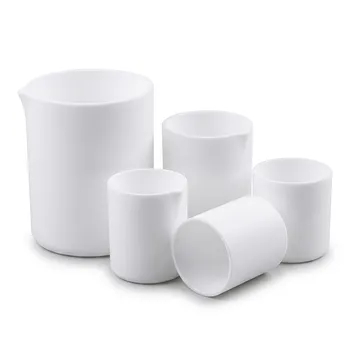
- High Purity PFA Crucible and Corrosion Resistant PTFE Beaker for Trace Analysis and Custom Laboratory Applications
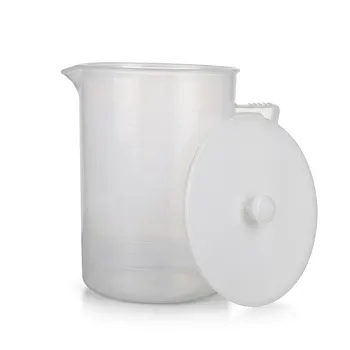
- High Purity PFA Beaker with Handle and Large Capacity Washable Soak Basket Multi Spec Teflon Laboratory Labware
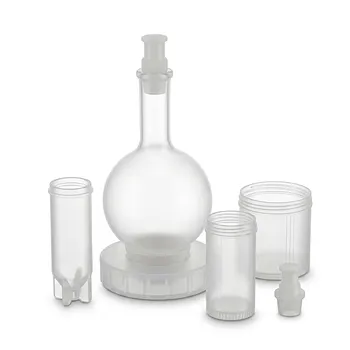
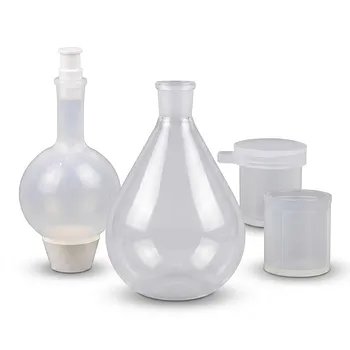
- Custom PFA Pear Shaped Flask High Purity Corrosion Resistant Labware Custom Molded Fluoropolymer Flask Glass Replacement Solution
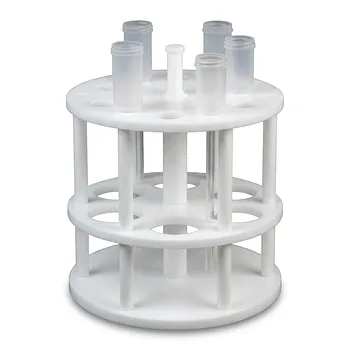
- Custom PFA Microcolumn Racks and PTFE Machined Low Background Corrosion Resistant Laboratory Fixtures
- Large Scale PTFE Beakers and Flasks for High Temperature Corrosion Resistant Laboratory Applications with Custom CNC Fabrication
People Also Ask
- Why are high-purity vessels critical for BiFeO3 synthesis? Ensuring Phase Purity
- Why is the use of high-purity PFA or PTFE labware critical during TiO2 nanoparticle purification? Protect Sample Purity
- Why is high-purity PFA labware necessary for Znx@LS-2 zeolite ICP-OES analysis? Ensure Trace-Level Precision
- Why is high-purity PFA trace analysis labware used for MXene? Ensure Superior Material Integrity in Research
- Why is high-purity PFA trace analysis labware used for sample processing when preparing Mo2CTx@MoS2? Ensure Material Purity