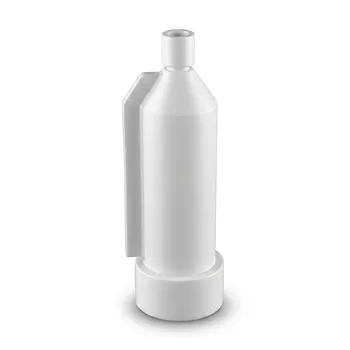
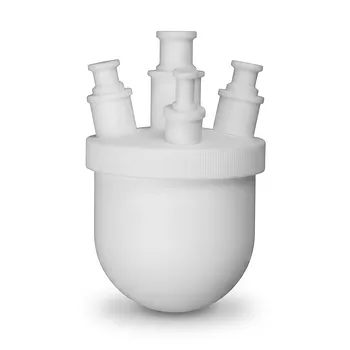
PTFE’s suitability for microchannel reactors is defined by its near-universal chemical inertness, high thermal stability, and exceptionally low surface energy. These properties allow researchers to safely facilitate reactions involving aggressive reagents—like hydrofluoric acid and reactive organometallics—while virtually eliminating the risk of channel clogging or material degradation.
PTFE provides a chemically "invisible" environment that ensures reaction purity and operational longevity, making it the gold standard for handling corrosive or fouling-prone media in continuous-flow chemistry.
The Foundation of Chemical Inertness
Resistance to Corrosive Media
PTFE is renowned for its near-universal chemical resistance, allowing it to withstand strong acids, bases, solvents, and oxidants. This includes highly aggressive substances like hydrofluoric acid that would degrade glass or stainless steel reactors.
Maintaining Reaction Purity
The carbon-fluorine backbone of PTFE provides extreme stability, ensuring the material does not leach contaminants into the reaction stream. This "inertness" is critical for research where high-purity yields and reproducible results are the primary objectives.
Compatibility with Organometallics
Beyond simple acids and bases, PTFE remains stable when exposed to reactive organometallic compounds. This wide-ranging compatibility simplifies experimental design, as a single reactor can often be used for diverse chemical syntheses.
Superior Surface Dynamics
Low Surface Energy and Anti-Fouling
One of PTFE’s most valuable traits is its exceptionally low surface energy, which creates a non-stick environment. This prevents the adhesion of solids and precipitates, significantly reducing fouling within the narrow microchannels.
Hydrophobicity and Oleophobicity
PTFE’s surface is both water and oil-repellent, which minimizes the adsorption of biomolecules or complex organic reagents to the channel walls. This ensures that the entire volume of the reagent participates in the reaction rather than sticking to the reactor.
Reduced Fluid Resistance
The material possesses a low coefficient of friction (as low as 0.05) and superior surface smoothness. This minimizes fluid resistance, allowing for more precise control over flow rates and pressure drops within the microscale environment.
Thermal and Structural Versatility
High Temperature Operating Range
PTFE maintains its structural integrity and function across a wide temperature spectrum, from -250°F up to a continuous service limit of 260°C. It features a high melting point exceeding 350°C, providing a safety buffer for exothermic processes.
Low Thermal Conductivity
The material acts as an effective thermal insulator due to its low thermal conductivity. This property is beneficial when external heating is applied, as it helps maintain localized temperature control within the reaction zones.
Precision Machinability
Despite its toughness, PTFE is easily machinable, allowing for the fabrication of complex micro-geometries and precise channel dimensions (10 to 1000 micrometers). It can be shaped into plates, tubing, or capillaries to suit specific reactor architectures.
Understanding the Trade-offs
Mechanical Creep and Deformation
While durable, PTFE is a "soft" polymer prone to mechanical creep or cold flow under high pressure or sustained stress. This can lead to the deformation of precise microchannel geometries if the reactor is not properly supported or reinforced.
Thermal Transfer Limitations
Its low thermal conductivity, while good for insulation, is a disadvantage if the goal is rapid heat quenching or highly efficient heat exchange. In these scenarios, PTFE reactors may require longer residence times or integrated metallic heat sinks compared to silicon or metal reactors.
Pressure Constraints
Due to its polymer nature, PTFE reactors typically have lower pressure ratings than their stainless steel counterparts. High-pressure applications require thicker walls or external housings to prevent the channels from bursting or leaking at connection points.
How to Apply This to Your Project
When selecting a material for your microchannel reactor, consider the specific demands of your chemical process to ensure PTFE is the optimal choice.
- If your primary focus is handling highly corrosive media: PTFE is the definitive choice, as its universal resistance prevents reactor degradation and ensures long-term safety.
- If your primary focus is preventing channel clogging: Leverage PTFE’s low surface energy to handle reactions that produce precipitates or involve "sticky" biological molecules.
- If your primary focus is extreme high-pressure synthesis: Consider a hybrid approach where PTFE liners are used within a high-strength stainless steel housing to balance inertness with structural integrity.
- If your primary focus is rapid heat exchange: Evaluate whether PTFE’s insulating properties will hinder your reaction, potentially opting for thinner channel walls to mitigate the material's low thermal conductivity.
By matching PTFE’s unique material profile to your specific chemical and mechanical requirements, you can achieve a level of process intensification and safety that traditional reactor materials cannot provide.
Summary Table:
| Key Property | Microchannel Reactor Benefit | Impact on Chemical Research |
|---|---|---|
| Chemical Inertness | Resists aggressive acids, bases, and solvents | Ensures high purity and prevents leaching |
| Low Surface Energy | Non-stick surface prevents solid accumulation | Minimizes fouling and channel clogging |
| Thermal Stability | Operates from -250°F up to 260°C (500°F) | Safely handles a wide range of exothermic reactions |
| Low Friction | Superior surface smoothness (0.05 friction coeff.) | Enables precise flow control and low pressure drops |
| Machinability | Supports complex geometries (10-1000 μm) | Allows for bespoke and high-precision reactor designs |
Elevate Your Research with Precision Fluoropolymer Solutions
At KINTEK, we specialize in turning high-performance fluoropolymers into your lab's most reliable assets. From everyday basics like beakers, reagent bottles, and centrifuge tubes to specialized microchannel reactors, electrochemical cells, and hydrothermal synthesis liners, our expertise in PTFE and PFA is unmatched.
Whether you require high-purity trace analysis tools, fluid transfer components (tubing, fittings, valves), or bespoke CNC-machined parts designed for your unique flow chemistry setup, KINTEK delivers end-to-end fabrication excellence. We handle everything from high-volume consumable orders to complex, non-standard laboratory setups with an absolute focus on material integrity.
Ready to optimize your reaction environment?
Contact KINTEK Today to consult with our experts on your custom project and discover how our high-performance laboratory supplies can enhance your research precision and operational longevity.
Related Products
- Customizable Polytetrafluoroethylene PTFE Reactor and Corrosion Resistant Teflon Flask
- Custom PTFE Multilayer Reaction Apparatus High Temperature Corrosion Resistant Threaded Modular Sieve System
- PTFE 10L Reaction Vessel with Stirring Paddle Customizable Corrosion Resistant High Temperature Reactor for Biopharmaceutical and Chemical Processing
- High Performance Customizable PTFE Reaction Vessel and Corrosion Resistant Polytetrafluoroethylene Flask for Chemical Laboratory Use
- Custom PTFE Reaction System with Hose Barb Fittings Corrosion Resistant High Sealing 2L 4L Lab Reactor with Separatory Funnel
People Also Ask
- What functional advantages do PTFE reactors provide over glass? Achieve Superior Purity and Safety in Synthesis
- What are the primary fabrication methods for capillary-based and monolithic PTFE reactors? Expert Production Insights
- Why are PTFE or PFA reaction vessels required for the selective etching process of MXene using hydrofluoric acid (HF)?
- Why is a Teflon-lined (PTFE) reactor vessel required for the hydrothermal synthesis of V2O5 and SnO2 nanomaterials?
- What is the role of high chemical inertness reaction vessels in the organic synthesis of acylhydrazone ligands? | Guide