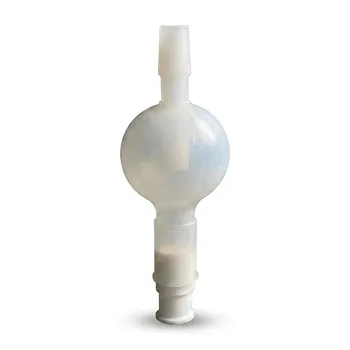
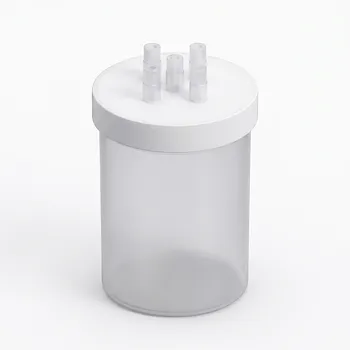
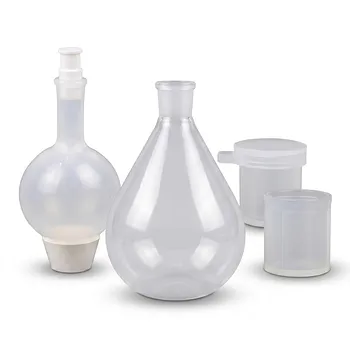
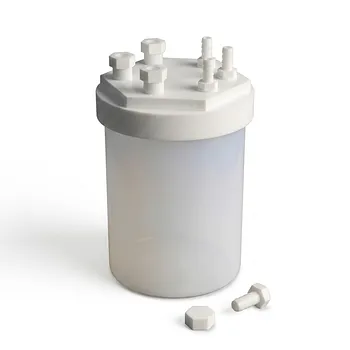
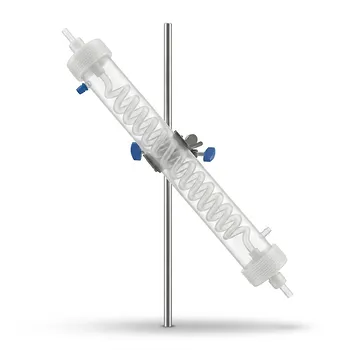
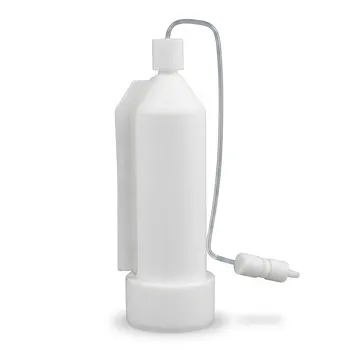
For photochemical work, PFA and FEP offer a combination of optical transparency, UV durability, and chemical resistance that ordinary glass often cannot provide. Thin PFA films can transmit more than 90% of visible light from 400–700 nm, while FEP has a low refractive index of approximately 1.341–1.347. Both materials can provide useful transmission through the UV, visible, and IR regions while resisting UV degradation and harsh chemical exposure.
The key advantage is not simply that PFA and FEP transmit light; it is that they maintain useful optical performance in chemically aggressive, UV-intensive, and high-temperature environments where conventional glass may absorb radiation, degrade, or contaminate the sample.
Why Fluoropolymer Optics Improve Photochemical Applications
Greater transmission through relevant spectral regions
PFA and FEP films provide broad optical transmission across the UV, visible, and infrared ranges compared with standard window glass. This makes them useful for photochemical reaction vessels, UV-transparent digestion containers, and optical cell windows.
For visible-light applications, the performance can be especially strong: PFA film as thin as 0.025 mm can transmit over 90% of light between 400 and 700 nm.
Better access to UV radiation
Standard glass can absorb a significant portion of UV radiation, particularly at shorter wavelengths. That absorption reduces the light reaching the reaction mixture and can limit photochemical efficiency or distort process conditions.
PFA and FEP are therefore advantageous when the reaction depends on delivering UV energy directly through the vessel wall, lid, film, or optical window.
Lower refractive index with FEP
FEP has a refractive index in the approximate range of 1.341 to 1.347. A lower refractive index can reduce optical reflection at interfaces and help improve light transmission into or out of a photochemical system.
The practical benefit depends on the surrounding medium, surface geometry, film thickness, and wavelength. It should be evaluated as part of the complete optical design rather than treated as an automatic guarantee of higher system throughput.
Why Containers Can Outperform Glass in Real Experiments
Optical performance remains usable under UV exposure
PFA and FEP have inherent resistance to UV degradation. They are less likely than many conventional polymers to yellow, embrittle, or lose performance under prolonged UV exposure.
This matters because a container that initially transmits light well may become unsuitable if its optical properties deteriorate during repeated irradiation cycles.
Chemical resistance protects the optical path
Photochemical mixtures may contain strong acids, bases, solvents, oxidants, or dissolved salts. PFA and FEP resist aggressive chemical exposure, helping preserve the transparency and physical integrity of the container.
Glass can be chemically attacked by certain reagents, while a degraded or contaminated surface can scatter light, alter transmission, or introduce unwanted reaction products.
Lower contamination supports reliable photochemistry
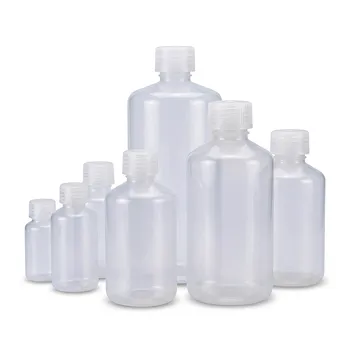
PFA containers offer very low metal-ion leaching and low surface adsorption. They can therefore help prevent the container from adding trace elements to the reaction or removing target species from solution.
This is particularly important in photochemical digestion, trace analysis, semiconductor chemical development, and experiments where impurities can alter reaction kinetics or light-sensitive chemistry.
Suitable for integrated reaction vessels and windows
Fluoropolymer films can serve as transparent barriers, liners, seals, or flexible windows. PFA and FEP containers can also be designed as reaction vessels or digestion vessels where both optical access and chemical inertness are required.
This design flexibility can be difficult to achieve with rigid glass assemblies, especially where the system requires thin walls, conformable films, or chemically resistant seals.
PFA and FEP: Where Their Optical Roles Differ
PFA for formed containers and durable labware
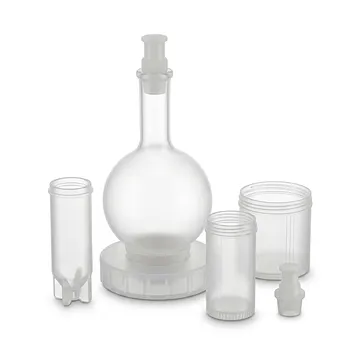
PFA is commonly suited to molded or formed labware, including beakers, reactors, and digestion vessels. It combines high chemical purity with useful optical transmission and strong resistance to corrosive environments.
Its value is greatest when the vessel must provide both chemical containment and optical access, rather than functioning only as a removable transparent film.
FEP for thin films and flexible optical components
FEP is particularly useful in thin-film applications, liners, flexible barriers, and transparent covers. Its low refractive index and broad transmission make it attractive where a lightweight or conformable optical element is needed.
Film thickness, surface treatment, and mechanical support must be selected carefully because these factors affect transmission, handling, bonding, and dimensional stability.
Selection depends on the optical geometry
The best material depends on whether light must pass through a thin film, a container wall, a window, or a complete vessel. Thickness, curvature, surface condition, and the wavelength used all influence the final optical result.
A thin film may transmit light efficiently but require support, while a thicker container wall may provide better mechanical durability at the cost of higher optical path length.
Understanding the Trade-offs
“Broad transmission” does not mean unlimited transmission
PFA and FEP are not universally superior at every wavelength or in every optical configuration. Actual transmission depends on wavelength, thickness, polymer grade, surface finish, and exposure history.
For demanding short-wavelength UV work, the material should be characterized at the exact operating wavelength rather than selected solely from a general transmission claim.
Fluoropolymers are mechanically softer than glass
Unlike rigid glass, unmodified fluoropolymers have relatively low tensile strength and can creep under sustained mechanical loads. Thin films may flex, deform, or require a supporting frame.
Wall thickness, mounting method, pressure differential, and thermal cycling must therefore be considered when designing a reaction vessel or optical window.
Thermal performance still has limits
PFA and FEP resist elevated temperatures, but each material has defined continuous and intermittent operating limits. Exceeding those limits can affect shape, sealing performance, and optical alignment.
Temperature compatibility should be checked together with chemical compatibility and mechanical loading.
Surface bonding may require treatment
Fluoropolymers have low surface energy and are naturally difficult to bond. If a film must be laminated, sealed, or attached to another substrate, a cementable or chemically treated surface may be required.
The selected treatment can affect peel strength, shear strength, chemical resistance, and long-term leak-tightness.
Glass may remain preferable in some systems
Glass, particularly specialized optical glass or fused silica, may be preferable when high rigidity, dimensional stability, scratch resistance, or a tightly controlled optical specification is the priority.
The comparison is therefore mainly against traditional glass labware, especially where ordinary glass absorbs too much UV or suffers chemical attack—not a claim that fluoropolymers replace every specialized optical material.
Making the Right Choice for Your Goal
Choose the material and construction based on the actual wavelength, chemistry, temperature, thickness, and mechanical demands of the application.
- If your primary focus is UV reaction efficiency: Use PFA or FEP when ordinary glass would absorb too much UV, and verify transmission at the specific operating wavelength.
- If your primary focus is visible-light photochemistry: Thin PFA film can provide high visible transmission, with reported transmission above 90% from 400–700 nm at a thickness of 0.025 mm.
- If your primary focus is chemical purity: Prefer high-purity PFA or FEP where low leaching and low adsorption are needed to prevent contaminants from changing the reaction or analytical result.
- If your primary focus is a flexible optical barrier or liner: Evaluate FEP film thickness, support, surface treatment, and bonding requirements before finalizing the design.
- If your primary focus is dimensional stability and rigidity: Compare fluoropolymer construction with glass or fused silica, particularly for thick windows, pressure-bearing vessels, or precision optical alignment.
For photochemical applications, PFA and FEP are most valuable when optical transmission must coexist with UV exposure, aggressive chemistry, and exceptionally clean sample handling.
Summary Table:
Optical Advantages of PFA and FEP vs. Traditional Glass
| Feature | PFA/FEP | Traditional Glass |
|---|---|---|
| Visible Light Transmission | Up to >90% (thin films) | Good, but may reflect or absorb |
| UV Transmission | Excellent in UV range | Absorbs significant UV |
| Chemical Resistance | Inert to most chemicals | Susceptible to acid/base attack |
| UV Durability | Resists degradation | May degrade with prolonged UV |
| Refractive Index (FEP) | Low (~1.34) | Higher, causing more reflection |
| Contamination | Very low leaching/adsorption | Possible ion leaching |
Both materials maintain optical clarity in harsh environments, ideal for photochemistry.
Enhance your photochemical experiments with KINTEK's high-performance PTFE and PFA labware. Our products deliver exceptional UV transparency, chemical resistance, and purity, ensuring reliable results even in the most demanding conditions. Whether you need custom reaction vessels, transparent films, or complete lab setups, our end-to-end CNC machining capabilities provide tailored solutions. Contact us today to discuss your specific requirements and discover how we can optimize your photochemical processes.
Get in touch with our experts now!
Related Products
- High Purity PFA Crucible and Corrosion Resistant PTFE Beaker for Trace Analysis and Custom Laboratory Applications
- Custom PFA Pear Shaped Flask High Purity Corrosion Resistant Labware Custom Molded Fluoropolymer Flask Glass Replacement Solution
- Custom PFA Reaction Bottles High Purity PTFE Reaction Vessels Corrosion Resistant Petrochemical Containers
- Semiconductor Electronic Grade PFA Sampling Bottle for Ultrapure Reagent Storage and Trace Analysis
- High Purity PFA Chromatography Columns and Collection Bottles Corrosion Resistant Fluoropolymer Filtration Systems for Trace Analysis
People Also Ask
- Why are high-purity vessels critical for BiFeO3 synthesis? Ensuring Phase Purity
- Why is the use of high-purity PFA or PTFE labware critical during TiO2 nanoparticle purification? Protect Sample Purity
- Why is high-purity PFA labware necessary for Znx@LS-2 zeolite ICP-OES analysis? Ensure Trace-Level Precision
- Why is high-purity PFA trace analysis labware used for MXene? Ensure Superior Material Integrity in Research
- Why is high-purity PFA trace analysis labware recommended for trace element detection? Achieve Gold Standard PPT Accuracy