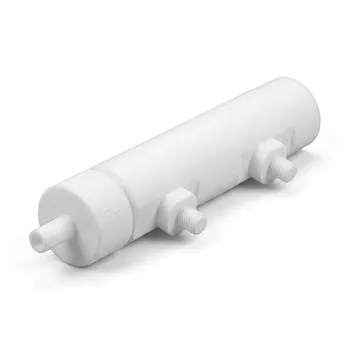
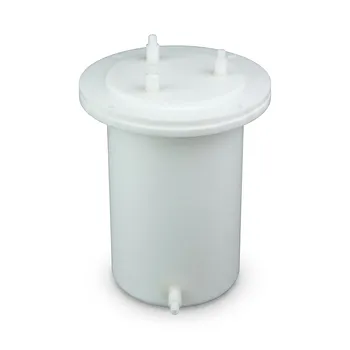
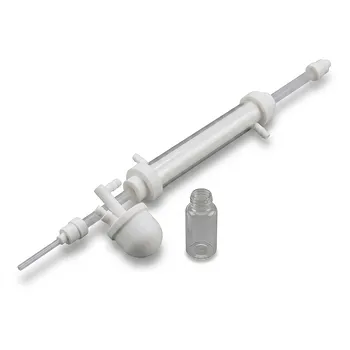
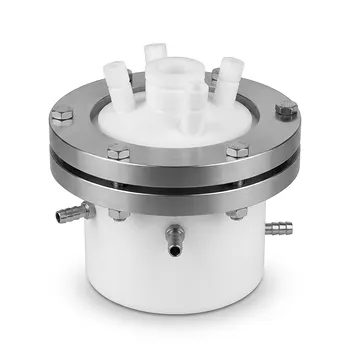
Teflon microchannel reactors are specialized continuous-flow devices designed to facilitate chemical reactions within channels of microscopic dimensions. These systems, typically featuring channel widths between 50 and 1000 micrometers, are either fabricated from or lined with polytetrafluoroethylene (PTFE). Their primary function is to enable the safe processing of highly aggressive reagents and corrosive conditions that would typically degrade or destroy standard glass or metal reactor vessels.
The core value of a Teflon microchannel reactor lies in its marriage of extreme chemical inertness with the physics of microfluidics. By confining reactions to a microscale environment, these reactors provide unparalleled heat transfer and safety when handling the most hazardous substances in modern chemistry.
The Architecture of Microscale Synthesis
Precise Dimensional Control
The defining characteristic of these reactors is their microscale geometry, with lateral dimensions strictly controlled between 50 and 1000 micrometers. This precision ensures that reagents interact in a highly predictable continuous-flow environment rather than a traditional batch setting.
Material Integrity of PTFE
By utilizing polytetrafluoroethylene (PTFE), these reactors gain a unique level of chemical resistance. This material allows for the safe handling of halogens, strong acids, and aggressive solvents that are known to cause catastrophic equipment failure in conventional metal or glass infrastructure.
Massive Specific Surface Area
The transition to microchannels increases the specific surface area to a range of 20,000 to 50,000 m²/m³. This massive surface-to-volume ratio is the engine behind the reactor's ability to manage energy-intensive processes with extreme efficiency.
Primary Functions and Process Advantages
Superior Heat Transfer Management
The high surface-area-to-volume ratio allows for rapid heat dissipation, which is critical for managing highly exothermic reactions. In processes like Fischer-Tropsch synthesis, this efficiency enables the reactor to suppress gas-phase free radical reactions and achieve single-pass conversion rates exceeding 70%.
Enhanced Operational Safety
Safety is inherently built into the design through low hold-up volumes, which typically range from microliters to milliliters. Because the volume of reagents present at any single moment is so small, potential runaway reactions become self-limiting and manageable.
Optimized Product Selectivity
By providing a tightly controlled environment, these reactors significantly improve the selectivity of target hydrocarbons. The ability to maintain precise temperature and residence time gradients prevents the formation of unwanted byproducts common in larger, less uniform systems.
Understanding the Trade-offs
Mechanical and Pressure Limitations
While PTFE is chemically superior, it lacks the mechanical strength of stainless steel or specialized alloys. This often limits the operating pressure and temperature of the reactor compared to metal counterparts, requiring careful engineering for high-pressure applications.
Potential for Channel Fouling
The microscopic nature of the channels makes them susceptible to clogging or fouling if solids precipitate during the reaction. Maintaining a clear flow path is essential, as even minor blockages can significantly alter the pressure drop and residence time distribution across the device.
Thermal Conductivity Constraints
Although the microscale dimensions facilitate heat transfer, PTFE itself is a thermal insulator. To compensate for this, these reactors must be designed with very thin walls or integrated into support structures that provide the necessary thermal conductivity for the overall system.
Making the Right Choice for Your Project
Implementation Strategies
- If your primary focus is handling highly corrosive acids or halogens: Utilize PTFE reactors to eliminate the risk of metallic contamination and equipment corrosion.
- If your primary focus is managing high exothermicity: Leverage the microchannel's high surface area to maintain isothermal conditions and prevent thermal runaway.
- If your primary focus is increasing process selectivity: Use the precise residence time control of continuous flow to minimize secondary reactions and boost yield.
By integrating the chemical resilience of Teflon with the physical advantages of microfluidics, you can transform hazardous, unpredictable batch processes into stable, high-efficiency continuous operations.
Summary Table:
| Feature | Technical Detail | Primary Benefit |
|---|---|---|
| Material | PTFE (Polytetrafluoroethylene) | Extreme resistance to aggressive acids and halogens |
| Channel Dimensions | 50 to 1000 micrometers | Precise control over microscale synthesis environment |
| Specific Surface Area | 20,000 to 50,000 m²/m³ | Rapid heat dissipation for exothermic reactions |
| Volume Management | Low hold-up (microliters to milliliters) | Enhanced safety; prevents large-scale runaway reactions |
| Process Type | Continuous-flow | Optimized product selectivity and single-pass conversion |
Transform Your Chemical Processes with KINTEK’s Fluoropolymer Expertise
Maximize your lab's safety and precision with high-performance solutions from KINTEK. We maintain an exclusive and absolute focus on fluoropolymer materials, manufacturing virtually all imaginable laboratory supplies crafted from PTFE and PFA.
Whether you need everyday basic labware (beakers, measuring cylinders, crucibles, and reagent bottles), advanced fluid transfer components (tubing, fittings, and valves), or sophisticated reaction apparatus like custom microchannel reactors, battery testing fixtures, and microwave digestion vessels, we deliver excellence. Backed by end-to-end custom CNC fabrication, KINTEK is equipped to provide everything from complex non-standard machined parts to high-volume orders tailored to your exact specifications.
Ready to upgrade your laboratory setup? Contact us today to discover how our bespoke fluoropolymer solutions can drive your next breakthrough!
Related Products
- Customizable Polytetrafluoroethylene PTFE Reactor and Corrosion Resistant Teflon Flask
- High Temperature Teflon Continuous Reaction System and HF Resistant Three Neck Flask for Petrochemical Processing
- High Purity PTFE Reaction Vessel with Electric Stirring System and Customizable 5L Tank including Buchner Funnel Filtration Assembly
- High Performance Customizable PTFE Reaction Vessel and Corrosion Resistant Polytetrafluoroethylene Flask for Chemical Laboratory Use
- High Purity Custom PTFE Laboratory Reaction Tank with Baffles for Low Background Trace Analysis
People Also Ask
- Why are PP or PTFE reactors preferred over glass in tribocatalysis? Maximize Charge Separation & Catalytic Efficiency
- What functional advantages do PTFE reactors provide over glass? Achieve Superior Purity and Safety in Synthesis
- What are the primary fabrication methods for capillary-based and monolithic PTFE reactors? Expert Production Insights
- Why are PTFE or PFA reaction vessels required for the selective etching process of MXene using hydrofluoric acid (HF)?
- Why is a Teflon-lined (PTFE) reactor vessel required for the hydrothermal synthesis of V2O5 and SnO2 nanomaterials?