PTFE is more stable than polyethylene because its carbon backbone is enclosed by strong, tightly packed fluorine atoms. In PTFE, replacing polyethylene’s hydrogen atoms with fluorine creates stronger C–F bonds and a protective fluorine sheath around the polymer chain. This combination increases resistance to thermal bond rupture, limits chemical access to the backbone, and gives PTFE a melting range near 327–342°C, compared with approximately 105–140°C for PE.
PTFE’s advantage comes from both bond strength and molecular geometry: strong C–F bonds resist thermal degradation, while the dense fluorine envelope shields the carbon backbone from reagents, solvents, and molecular penetration.
Why PTFE withstands higher temperatures
Stronger bonds require more energy to break
The C–F bond in PTFE has a reported bond energy of approximately 116 kcal/mol, compared with about 99.5 kcal/mol for a C–H bond in polyethylene.
This higher bond strength makes thermal scission and oxidative attack more difficult. PTFE therefore retains its chemical structure at temperatures where PE softens, melts, or begins to degrade.
The fluorinated backbone has a higher melting point
PTFE typically exhibits a primary melting transition near 342°C and a commonly cited secondary melting point near 327°C. Conventional polyethylene grades generally melt between 105°C and 140°C, depending on density and molecular structure.
This difference allows PTFE labware to tolerate high-temperature digestion, reaction, and fluid-handling conditions that would deform ordinary PE components.
Chain geometry restricts molecular movement
PTFE chains adopt a helical conformation in which fluorine atoms densely surround the carbon backbone. The large electron cloud and steric bulk of fluorine restrict access to the chain and reduce the ease with which neighboring segments can approach and rearrange.
This structure contributes to PTFE’s high thermal stability, although it does not make the material immune to deformation under sustained mechanical load.
Why PTFE is more chemically inert
Fluorine shields the carbon backbone
In polyethylene, the carbon backbone is decorated with relatively small hydrogen atoms, leaving the hydrocarbon structure more accessible to heat, oxidants, and solvents.
PTFE replaces those hydrogens with fluorine atoms that form a dense outer sheath. Chemical species therefore have much greater difficulty reaching or attacking the underlying C–C backbone.
The C–F bond is strongly polarized and difficult to disrupt
Fluorine is highly electronegative, producing a strongly polarized C–F bond. Although polarity alone does not explain all of PTFE’s resistance, the bond’s strength and the surrounding fluorine environment make chemical substitution, abstraction, and chain attack energetically unfavorable.
The result is exceptional resistance to concentrated acids, bases, and many aggressive organic solvents.
PTFE has extremely low solubility
PTFE is effectively insoluble in common solvents under ordinary laboratory conditions, particularly below its melting temperature. This is a stronger performance characteristic than simply being “solvent resistant”: the polymer generally does not dissolve, swell significantly, or release polymer constituents into the sample.
That property is valuable in digestion vessels, crucibles, tubing, fittings, and trace-analysis containers where contamination and leaching must be minimized.
Structural properties that improve laboratory performance
A low-energy, nonstick surface
The outer fluorine layer gives PTFE a chemically stable surface with very low surface energy. Liquids tend to wet and adhere to it less readily than they do to many conventional plastics.
This helps reduce residue retention, simplifies cleaning, and limits sample carryover in analytical applications.
Minimal chemical leaching
Because PTFE’s backbone is composed primarily of strong C–C and C–F bonds and is protected by fluorine, the polymer is unlikely to react with or dissolve into the chemicals it contains.
Virgin, properly processed PTFE is therefore well suited to high-purity applications where extractables and contamination are concerns.
Resistance to aggressive processing environments
PTFE labware can maintain its chemical integrity during severe acid digestion and exposure to many halogenated or organic chemical systems. Its practical continuous-use temperature is commonly around 260°C, even though its melting transitions occur at substantially higher temperatures.
The difference matters: a material can remain solid above its recommended continuous-use temperature while still experiencing creep, dimensional change, or accelerated degradation.
How PE differs at the molecular level
PE has a hydrocarbon backbone
Polyethylene consists of repeating –CH₂–CH₂– units. Its C–C backbone is protected only by hydrogen atoms, which are smaller and provide less steric and electronic shielding than fluorine.
PE can still offer useful chemical resistance, especially at moderate temperatures, but its lower melting point and less protected backbone limit performance in severe laboratory environments.
PE softens and deforms earlier
As temperature rises, PE chains gain mobility and the material loses stiffness well before PTFE reaches its melting transition. This makes PE more vulnerable to warping, dimensional loss, and permeation during hot chemical processing.
The exact limit depends on the PE grade, load, exposure time, and chemical environment.
Understanding the Trade-offs
PTFE is not mechanically rigid at high temperature
PTFE has excellent chemical and thermal resistance but relatively low stiffness and a tendency to creep under sustained load, especially as temperature increases.
Labware that must hold pressure, maintain tight dimensions, or support heavy assemblies may require reinforcement, external support, or a different material.
PTFE has a finite upper temperature limit
PTFE does not remain chemically unchanged indefinitely at extreme temperatures. Thermal decomposition becomes increasingly important well above normal operating conditions, and fumes from overheated fluoropolymers can be hazardous.
The practical operating limit should therefore be based on the manufacturer’s temperature rating, exposure duration, mechanical load, and ventilation requirements.
Chemical inertness is not absolute in every condition
PTFE is resistant to most laboratory chemicals, but certain highly reactive systems, molten alkali metals, elemental fluorine, and some high-temperature fluorinating conditions can attack it.
Compatibility should be evaluated for the actual chemical, concentration, temperature, pressure, and exposure time rather than inferred from the material name alone.
PTFE is more difficult to process and join
PTFE’s chemical resistance also makes it difficult to bond, weld, or modify using conventional methods. It is typically fabricated through specialized processing rather than ordinary melt processing used for many thermoplastics.
This can increase component cost and limit design flexibility compared with PE.
Making the Right Choice for Your Goal
Select the material based on the combined requirements of temperature, chemistry, mechanical loading, cleanliness, and cost.
- If your primary focus is maximum chemical inertness: Choose PTFE for aggressive acids, bases, solvents, digestion media, and high-purity analytical applications.
- If your primary focus is high-temperature service: Choose PTFE when temperatures approach or exceed PE’s softening and melting range, while remaining within the manufacturer’s continuous-use limit.
- If your primary focus is low cost and moderate-temperature handling: Choose PE when the chemical environment is compatible and operating temperatures remain well below its softening range.
- If your primary focus is dimensional stability under load: Evaluate reinforced PTFE or alternative engineering materials, because unfilled PTFE can creep at elevated temperature.
- If your primary focus is trace-level cleanliness: Prefer suitable virgin PTFE and verify extractables, processing history, and compatibility with the specific analytical method.
PTFE’s superior performance is ultimately a molecular consequence: strong C–F bonds and a dense fluorine sheath protect the carbon backbone from both heat and chemical attack.
Summary Table:
| Property | PTFE | Polyethylene (PE) |
|---|---|---|
| Bond energy (C-F vs C-H) | ~116 kcal/mol | ~99.5 kcal/mol |
| Melting range | 327–342°C | 105–140°C |
| Continuous use temperature | ~260°C | Lower (varies) |
| Chemical resistance | Excellent against most acids, bases, solvents | Good but limited |
| Solubility | Insoluble in most solvents | Swells in some solvents |
| Surface energy | Low (nonstick) | Higher |
| Leaching/extractables | Minimal | Higher potential |
| Mechanical rigidity | Low, creeps under load | Moderate, softer at high temps |
| Processing ease | Difficult to bond/weld | Easy to melt process |
Upgrade your lab with PTFE fluoropolymer labware from KINTEK. Our PTFE and PFA products deliver unmatched thermal stability and chemical inertness, ensuring reliable performance in your most demanding applications. Whether you need beakers, digestion vessels, or custom machined parts, our end-to-end CNC capabilities cover everything from standard labware to complex custom setups. Contact us today to find the perfect solution for your lab and experience the KINTEK advantage—high purity, durability, and precision.
Contact us now to discuss your requirements or request a quote.
Related Products
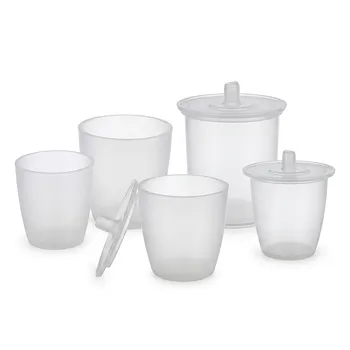
- High Purity PFA Crucible and Corrosion Resistant PTFE Beaker for Trace Analysis and Custom Laboratory Applications
- Custom Polytetrafluoroethylene PTFE Petri Dishes 60mm Corrosion Resistant Low Background Labware
- Custom PTFE Petri Dish 30mm Corrosion Resistant Low Background Non Leaching Laboratory Ware
- Custom PTFE Petri Dish 120mm Diameter Corrosion Resistant Low Background High Purity Labware
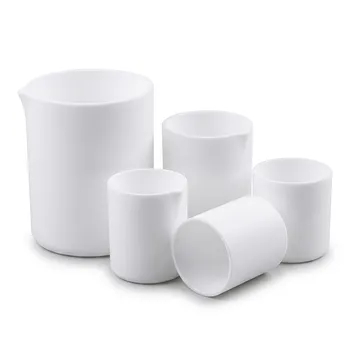
- Large Scale PTFE Beakers and Flasks for High Temperature Corrosion Resistant Laboratory Applications with Custom CNC Fabrication
People Also Ask
- Why are high-purity vessels critical for BiFeO3 synthesis? Ensuring Phase Purity
- Why is the use of high-purity PFA or PTFE labware critical during TiO2 nanoparticle purification? Protect Sample Purity
- Why is high-purity PFA trace analysis labware used for MXene? Ensure Superior Material Integrity in Research
- Why is high-purity PFA labware necessary for Znx@LS-2 zeolite ICP-OES analysis? Ensure Trace-Level Precision
- Why is high-purity PFA trace analysis labware used for sample processing when preparing Mo2CTx@MoS2? Ensure Material Purity