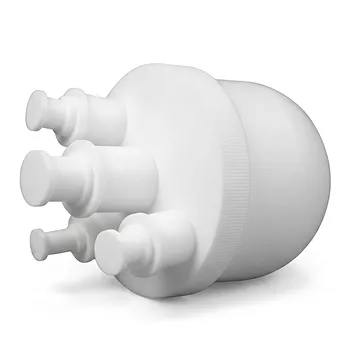
The microchannel geometry in Teflon reactors fundamentally redefines transport phenomena by maximizing surface-to-volume ratios and enforcing a strictly laminar flow regime. This architecture provides a surface-area-to-volume ratio between 10,000 and 100,000 m²/m³, enabling heat-transfer coefficients of 1–500 MW m⁻³ K⁻¹ and ensuring mixing occurs predictably through molecular diffusion.
By shifting from bulk-controlled to surface-controlled physics, microchannel reactors allow for near-instantaneous temperature regulation and highly predictable mass transfer. This precision effectively eliminates the stochastic variables commonly found in traditional batch processing.
The Dominance of Surface-to-Volume Ratio
Exponential Scaling of Contact Area
The primary advantage of microchannel geometry is the massive increase in available surface area relative to the fluid volume. In Teflon microreactors, this ratio is orders of magnitude higher than in conventional stirred-tank reactors.
This high ratio ensures that every molecule within the channel is in close proximity to the reactor walls. Consequently, the reactor's physical boundaries exert much greater control over the chemical environment than in macro-scale systems.
Enhancing Interfacial Phenomena
Because the geometry is so confined, transport distances for mass and energy are significantly reduced. This reduction allows for faster equilibrium and more efficient interactions between phases or between the fluid and the wall.
Mastering Fluid Dynamics in Small Channels
The Stability of Laminar Flow
Microchannels typically operate at low Reynolds numbers, often remaining well below 100. This results in a strictly laminar flow regime where fluid moves in parallel layers without the chaotic eddies of turbulence.
Laminar flow provides a high degree of predictability for residence time distribution. Engineers can model the path and speed of reactants with extreme accuracy, leading to more consistent product quality.
Mixing via Molecular Diffusion
In the absence of turbulence, mixing is driven entirely by molecular diffusion. While this may seem slower than mechanical agitation, the microscopic distances across the channel width allow diffusion to occur rapidly and uniformly.
This controlled mixing prevents the localized concentration gradients often found in larger vessels. By ensuring uniform reactant contact, the reactor minimizes side reactions and improves overall yield.
Achieving Near-Instantaneous Thermal Control
High Heat-Transfer Coefficients
The microchannel geometry enables exceptional heat-transfer coefficients ranging from 1 to 500 MW m⁻³ K⁻¹. This capability is a direct result of the small characteristic lengths and high surface area mentioned previously.
Such high coefficients allow the system to remove or add energy almost as quickly as it is generated or required. This creates a "thermal stiffness" that keeps the reaction temperature locked to the set point.
Eliminating Thermal Gradients and Hot Spots
Because heat transfer is so efficient, hot spots in exothermic reactions are virtually eliminated. The energy released by a reaction is dissipated through the Teflon walls before it can cause a significant localized temperature rise.
This level of control is critical for managing highly energetic or sensitive chemistries. It allows operators to run reactions at higher concentrations or temperatures that would be considered unsafe in traditional hardware.
Understanding the Trade-offs
Pressure Drop and Pumping Requirements
The same small dimensions that provide high surface area also create significant resistance to flow. This results in a high pressure drop across the microchannel, which may require specialized pumping systems to maintain flow rates.
Sensitivity to Clogging and Fouling
Microchannels are highly susceptible to clogging if the reaction involves solids or if precipitates form during the process. Unlike a large tank, a single particulate can cause a total failure of the flow path, requiring meticulous filtration of inputs.
Scaling Through Numbering-Up
Scaling a microchannel process is not done by making the channels larger, but by "numbering-up" or duplicating the channels. While this maintains the transport advantages, it increases the complexity of the manifold system required to distribute flow evenly across all channels.
How to Apply This to Your Project
Recommendations for Process Implementation
- If your primary focus is safety in exothermic reactions: Utilize the 1–500 MW m⁻³ K⁻¹ heat-transfer capacity to manage heat release and prevent thermal runaway.
- If your primary focus is high-purity specialty chemicals: Leverage the predictable laminar flow and diffusion-based mixing to ensure uniform residence times and minimize by-products.
- If your primary focus is rapid process optimization: Use the predictable scaling of microchannels to transition from laboratory discovery to production without the traditional "scale-up" lag.
The precision of microchannel geometry transforms chemical manufacturing from an exercise in managing bulk averages into a disciplined mastery of molecular-level transport.
Summary Table:
| Advantage | Technical Metric / Feature | Operational Benefit |
|---|---|---|
| Surface-to-Volume Ratio | 10,000 – 100,000 m²/m³ | Massive contact area; shifts physics from bulk to surface control. |
| Heat Transfer | 1 – 500 MW m⁻³ K⁻¹ | Near-instantaneous thermal regulation; eliminates hot spots. |
| Flow Dynamics | Strictly Laminar (Low Reynolds < 100) | Highly predictable residence time distribution and product quality. |
| Mixing Mechanism | Molecular Diffusion | Uniform reactant contact; minimizes side reactions and improves yield. |
| Scalability | "Numbering-up" Strategy | Seamless transition from lab to production without scale-up lag. |
Elevate Your Lab Precision with KINTEK’s Fluoropolymer Expertise
Maximize your reactor performance with high-performance materials and precision engineering. KINTEK is your premier partner for high-performance fluoropolymer solutions, specializing in an exhaustive range of PTFE and PFA laboratory supplies.
From everyday essentials (beakers, crucibles, reagent bottles, and centrifuge tubes) to high-purity trace analysis instruments and comprehensive fluid transfer components (tubing, valves, and fittings), we provide the tools necessary for rigorous scientific environments. Our expertise extends to advanced reaction apparatus, including custom electrochemical cells, microwave digestion vessels, and the very microchannel reactors that redefine transport phenomena.
Why choose KINTEK?
- Custom Fabrication: End-to-end CNC machining for complex, non-standard parts and bespoke laboratory setups.
- Material Excellence: An absolute focus on high-performance PTFE and PFA for ultimate chemical resistance.
- Scalable Solutions: We handle everything from single custom prototypes to high-volume industrial orders.
Ready to optimize your chemical processing? Contact our technical team today to discuss your custom project or bulk supply needs!
Related Products
- Customizable Polytetrafluoroethylene PTFE Reactor and Corrosion Resistant Teflon Flask
- High Temperature Teflon Continuous Reaction System and HF Resistant Three Neck Flask for Petrochemical Processing
- High Temperature Corrosion Resistant PTFE Reaction Flask Custom Multi Neck Laboratory Vessel with Flat or U Bottom
- High Performance Customizable PTFE Reaction Vessel and Corrosion Resistant Polytetrafluoroethylene Flask for Chemical Laboratory Use
- High Purity PTFE Reaction Vessel with Electric Stirring System and Customizable 5L Tank including Buchner Funnel Filtration Assembly
People Also Ask
- Why are PP or PTFE reactors preferred over glass in tribocatalysis? Maximize Charge Separation & Catalytic Efficiency
- What functional advantages do PTFE reactors provide over glass? Achieve Superior Purity and Safety in Synthesis
- What are the primary fabrication methods for capillary-based and monolithic PTFE reactors? Expert Production Insights
- Why are PTFE or PFA reaction vessels required for the selective etching process of MXene using hydrofluoric acid (HF)?
- Why is a Teflon-lined (PTFE) reactor vessel required for the hydrothermal synthesis of V2O5 and SnO2 nanomaterials?