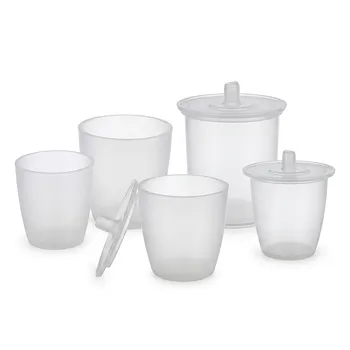
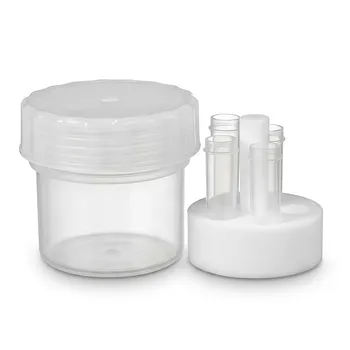
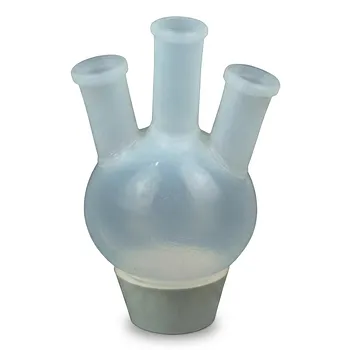
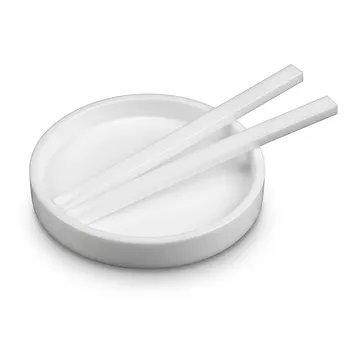
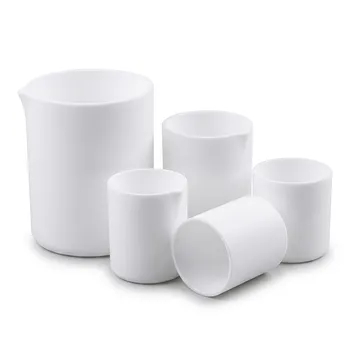
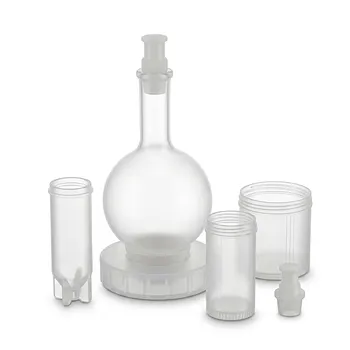
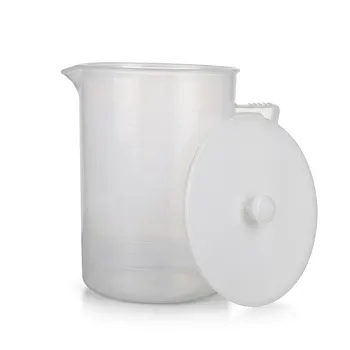
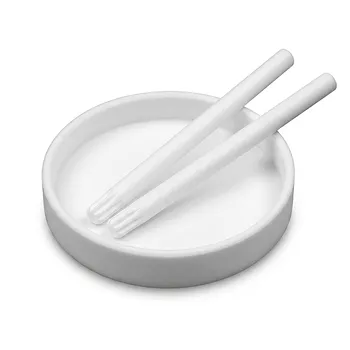
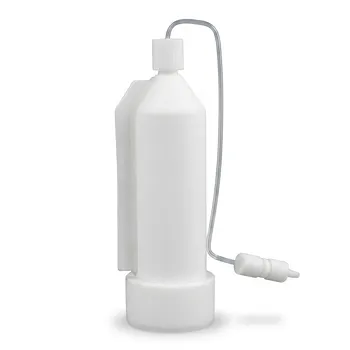
PTFE and PFA fluoropolymer labware can support continuous operation up to approximately 260°C (500°F). This rating gives both materials exceptional resistance to melting, deformation, and loss of structural integrity in demanding laboratory applications. They also provide a UL 94 V-0 flammability rating, making them substantially more heat-resistant than common lab plastics such as polypropylene, nylon 6,6, and polycarbonate.
PTFE and PFA are premier choices for high-temperature labware because both can operate continuously at up to 260°C while maintaining chemical purity and dimensional stability. This limit is a continuous-use rating, not permission to approach their melting or decomposition temperatures.
What the 260°C Rating Means
Continuous service temperature
The 260°C maximum continuous-use temperature describes the approximate upper limit for sustained operation while preserving useful mechanical performance. It applies to applications such as digestion vessels, crucibles, reaction apparatus, sample containers, and high-temperature fluid-transfer tubing.
Operating below this limit helps prevent softening, warping, seal failure, and dimensional changes in machined or molded components.
Continuous use is different from melting
PTFE melts at approximately 340°C to 342°C, while PFA melts at roughly 305°C, with some references reporting a broader PFA melting range. These melting points are substantially above the recommended continuous service temperature.
The difference matters because a material can remain solid while already losing stiffness, creep resistance, or dimensional accuracy. Labware should therefore be designed around the continuous-use rating, not the melting point.
Comparison with common lab plastics
PTFE and PFA have a considerably higher continuous-use temperature capability than several widely used laboratory plastics:
- Polypropylene: approximately 105°C
- Nylon 6,6: approximately 105°C
- Polycarbonate: approximately 121°C
- FEP: approximately 205°C
- ETFE and ECTFE: approximately 150°C
- PVDF and PCTFE: approximately 120°C
This makes PTFE and PFA particularly suitable for thermal processes that exceed the practical limits of standard plastic labware.
How PTFE and PFA Maintain Thermal Stability
Resistance to deformation
Both fluoropolymers retain useful structural integrity across a broad high-temperature range. When operated within the 260°C limit, they are less likely than common lab plastics to melt, deform, or lose their intended geometry.
That stability is important for vessels, fittings, tubing, and seals, where small dimensional changes can cause leakage or inaccurate sample handling.
Chemical and high-purity performance
Thermal stability is especially valuable when heat is combined with aggressive chemicals. PTFE and PFA labware are commonly selected for boiling acid digestions, microwave digestion systems, sample evaporation, high-temperature synthesis, and high-purity fluid handling.
Their resistance helps minimize concerns about material breakdown, contamination, and chemical leaching during properly controlled use.
Flammability performance
PTFE and PFA are associated with the high UL 94 V-0 flammability classification cited in the reference material. This indicates strong resistance to sustained burning under the UL 94 test method.
A flammability classification does not eliminate the need for temperature controls, appropriate spacing, or laboratory exhaust. It describes behavior in a specific standardized test and should not be treated as a general guarantee of safety in every thermal environment.
Different strengths of PTFE and PFA
PTFE generally has the higher melting point and greater ultimate thermal resistance, particularly at temperatures well above normal laboratory service conditions. PFA provides similar continuous-use performance while offering lower melt viscosity and melt-processability.
That processability allows PFA to be molded into intricate, transparent, high-purity shapes that are difficult to manufacture from PTFE. The choice is therefore not based on temperature alone; geometry, fabrication method, transparency, and purity requirements also matter.
Where This Thermal Capability Matters
Microwave digestion vessels
Microwave digestion exposes vessels to elevated temperatures, aggressive reagents, and pressure-related mechanical demands. PTFE and PFA can maintain their form and chemical performance when the process is controlled within the applicable operating limits.
The vessel design must still account for pressure, temperature gradients, closure systems, and the specific chemical mixture.
Crucibles and reaction apparatus
Crucibles and custom reaction components benefit from the materials' resistance to thermal deformation and chemical attack. PTFE may be preferred when maximum thermal margin is important, while PFA can be advantageous for complex molded components or applications requiring visibility.
Neither material should be selected solely because its melting point is higher than the process temperature. Continuous loading, mechanical stress, and exposure time also influence service life.
Fluid-transfer tubing and fittings
High-temperature tubing, valves, and fittings must preserve dimensional accuracy to maintain reliable seals. Exceeding the service temperature can cause creep, deformation, or loss of seal integrity even before visible melting occurs.
For these components, the temperature rating of the complete assembly may be lower than that of the raw polymer because pressure, fitting geometry, reinforcement, and mechanical load affect performance.
Understanding the Trade-offs
The 260°C limit must be respected
The 260°C value is an upper continuous-use limit, not a target operating temperature. High-temperature processes should remain comfortably below it when possible, especially when the component is under pressure, load, or repeated thermal cycling.
A conservative operating margin reduces the risk of deformation, premature aging, and failure at seals or interfaces.
Melting and degradation are separate hazards
Heating above the melting point can destroy the intended shape of the labware, but hazardous degradation products can become a concern at still higher temperatures. The exact onset and rate of degradation depend on the polymer grade, atmosphere, exposure time, and heating conditions.
The supplied references differ on the precise temperatures for the onset of significant PTFE and PFA degradation. The practical conclusion is consistent: do not use routine laboratory equipment near melting or decomposition temperatures.
Overheating can produce hazardous fumes
When fluoropolymers are overheated, they can release particulate fumes and decomposition products. At sufficiently high temperatures, reported hazards include carbonyl fluoride, which can hydrolyze to hydrofluoric acid, and other highly toxic fluorinated compounds.
Overheated PTFE fumes can cause polymer fume fever, a temporary flu-like illness involving symptoms such as fever and chills. Processes involving possible overheating require accurate temperature monitoring, effective exhaust ventilation, and procedures appropriate to the chemicals and equipment involved.
Fabrication equipment also needs protection
Thermal processing or fabrication equipment used with fluoropolymers may be exposed to corrosive off-gassing if the resin overheats. Components in such equipment should be compatible with the potential decomposition products.
This consideration applies to manufacturing and repair environments as well as laboratory use.
Making the Right Choice for Your Goal
Select the material based on both the temperature profile and the physical design requirements of the application.
- If your primary focus is continuous high-temperature service: Choose PTFE or PFA labware rated for operation up to approximately 260°C, and maintain a deliberate margin below that limit.
- If your primary focus is maximum ultimate thermal resistance: Favor PTFE, which generally has the higher melting point and better stability at extreme temperatures above normal service conditions.
- If your primary focus is complex molded or transparent labware: Favor PFA, which offers melt-processability and high-purity fabrication while retaining near-PTFE continuous thermal performance.
- If your primary focus is safe high-temperature processing: Use precise temperature controls, prevent exposure to melting or decomposition conditions, and provide effective exhaust ventilation.
PTFE and PFA deliver exceptional thermal stability when their continuous-use limits are treated as engineering boundaries rather than approximate suggestions.
Summary Table:
| Material | Max Continuous Use Temp (°C) | Melting Point (°C) | Key Thermal Feature |
|---|---|---|---|
| PTFE | ~260 | ~340-342 | Highest melting point; excellent thermal resistance |
| PFA | ~260 | ~305 | Melt-processable; transparent; similar continuous use |
| FEP | ~205 | ~260 | Lower continuous temp than PTFE/PFA |
| ETFE/ECTFE | ~150 | ~270 | Lower temperature rating |
| PVDF/PCTFE | ~120 | ~178/218 | Moderate temperature capability |
| Polypropylene | ~105 | ~160 | Low heat resistance |
| Nylon 6,6 | ~105 | ~255 | Low continuous use temp |
| Polycarbonate | ~121 | ~267 | Moderate heat resistance |
Looking for high-performance PTFE or PFA labware that can withstand continuous use up to 260°C? KINTEK offers a comprehensive range of fluoropolymer labware, from digestion vessels and crucibles to custom CNC machined components, all designed for extreme thermal and chemical resistance. With our end-to-end customization and high-purity materials, we ensure your lab operates safely and efficiently. Contact us today to discuss your requirements and get a tailored solution!
Related Products
- High Purity PFA Crucible and Corrosion Resistant PTFE Beaker for Trace Analysis and Custom Laboratory Applications
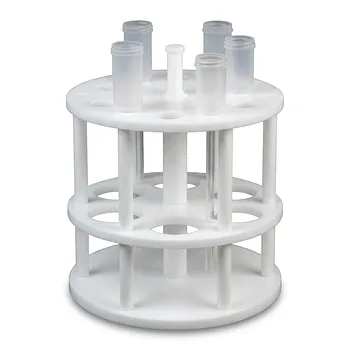
- Custom PFA Microcolumn Racks and PTFE Machined Low Background Corrosion Resistant Laboratory Fixtures
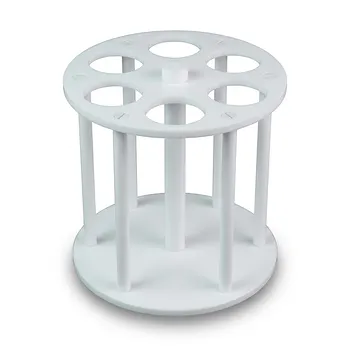
- Custom PFA Separatory Funnel Rack PTFE Machined Laboratory Support Stand Corrosion Resistant Low Background Fluoropolymer Fixture
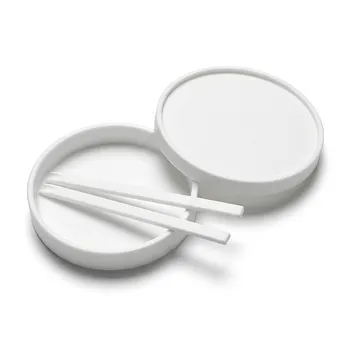
- Custom Polytetrafluoroethylene PTFE Petri Dishes 60mm Corrosion Resistant Low Background Labware
- PTFE PFA Vacuum Filtration System Corrosion Resistant Customizable Shatterproof Laboratory Device
People Also Ask
- Why are high-purity vessels critical for BiFeO3 synthesis? Ensuring Phase Purity
- Why is the use of high-purity PFA or PTFE labware critical during TiO2 nanoparticle purification? Protect Sample Purity
- Why is high-purity PFA labware necessary for Znx@LS-2 zeolite ICP-OES analysis? Ensure Trace-Level Precision
- Why is high-purity PFA trace analysis labware used for MXene? Ensure Superior Material Integrity in Research
- Why is high-purity PFA trace analysis labware used for sample processing when preparing Mo2CTx@MoS2? Ensure Material Purity