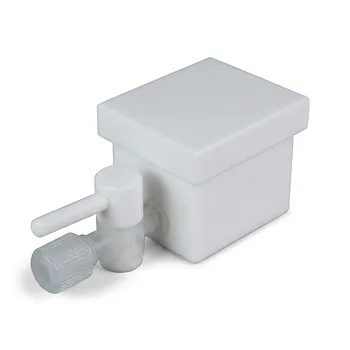
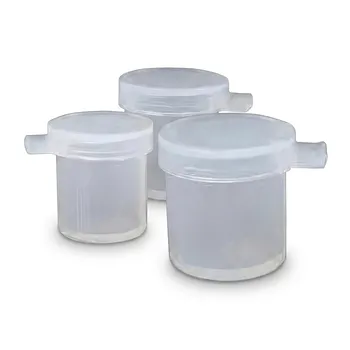
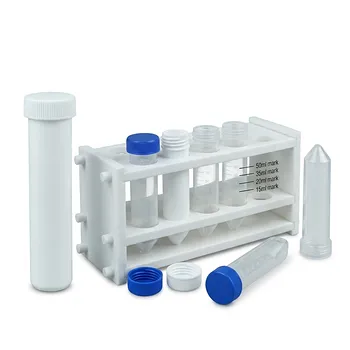
The phase-out of APFO/PFOA surfactants is significant because it reduces a potential source of persistent fluorinated contamination in materials used for ultra-trace analysis. Modern PFA and PTFE manufactured through PFOA-free processes can provide the chemical resistance, low extractables, and low background levels required for digestion vessels, trace-analysis containers, and other high-purity labware. This matters because even small amounts of leachable organic or ionic residues can distort measurements when analytes are present at extremely low concentrations.
PFOA-free polymerization improves the contamination-control profile of fluoropolymer labware, but it is only one part of material qualification. High-purity PFA and PTFE must also be evaluated through appropriate extractables, leachables, blank, and application-specific testing.
Why APFO and PFOA Were Used
Their role in fluoropolymer production
APFO, the ammonium salt of PFOA, was historically used as a processing aid and surfactant in aqueous dispersion or emulsion polymerization of fluoropolymers such as PTFE, PFA, and FEP.
The surfactant helped stabilize polymer particles in water and support consistent polymer formation. This made it useful for producing fluoropolymer resins with controlled processing characteristics.
Why the chemistry became a concern
PFOA and related long-chain perfluorinated compounds are highly persistent and can remain in the environment for extended periods. Their bioaccumulation and toxicity concerns led regulators and manufacturers to pursue the elimination of APFO/PFOA from fluoropolymer production.
The resulting industry transition involved alternative fluorinated processing aids, ether-containing fluoropolymer surfactants, and polymerization approaches that reduce or avoid the need for these legacy materials.
Why This Matters for Trace-Analysis Labware
Trace analysis magnifies small contamination sources
In routine applications, a very small residue may have no measurable effect. In ICP-MS, ultra-trace elemental analysis, or other highly sensitive workflows, however, minor contamination can become comparable to the analyte concentration itself.
A residue from the manufacturing process may contribute to reagent blanks, elevate background signals, or reduce confidence in a low-level result.
Residual surfactants can affect sample integrity
Processing aids may remain as residual contaminants in a polymer matrix or associated aqueous dispersion. If those residues are released during contact with strong acids, heating, digestion, or extended storage, they can enter the sample or reagent.
For labware used in microwave digestion, acid digestion, or trace-metal preparation, minimizing potential leachables is therefore part of protecting the analytical blank.
PFA and PTFE are chosen for more than chemical resistance
PFA and PTFE offer broad resistance to strong acids, bases, and organic solvents, making them suitable for aggressive preparation conditions. They also have low surface energy and generally low levels of extractables when properly manufactured and cleaned.
These characteristics help reduce both contamination from the container and loss of analytes through adsorption onto the vessel wall.
High-purity PFA is especially useful for demanding workflows
PFA combines fluoropolymer chemical resistance with useful melt-processability and transparency in many laboratory formats. It is commonly used for digestion tubes, reagent bottles, wash bottles, vessels, and custom-machined components where low background and cleanability are important.
The benefit is not simply that PFA is “inert.” The complete material, manufacturing process, surface condition, cleaning history, and intended application determine whether it is suitable for trace work.
What the Manufacturing Change Improves
Lower concern about legacy PFOA residues
A PFOA-free polymerization process reduces the likelihood that APFO/PFOA-related residues are carried into finished resin or fabricated labware.
This supports tighter control of organic extractables and reduces concern about introducing legacy persistent fluorinated compounds into laboratory environments or samples.
Better alignment with environmental requirements
The phase-out also supports regulatory compliance and responsible chemical management. Laboratories increasingly need suppliers to document restricted substances, processing chemistry, and material composition throughout the supply chain.
For procurement teams, the change makes the manufacturing route relevant to qualification decisions rather than merely an environmental preference.
Preservation of the properties laboratories need
Replacing APFO/PFOA does not eliminate the need for the underlying fluoropolymer performance. Qualified modern resins must still provide the chemical resistance, thermal performance, mechanical integrity, and low-contamination characteristics expected from PFA or PTFE labware.
The important question is whether the finished material meets the application’s purity requirements, not simply whether the product carries a PFOA-free label.
Understanding the Trade-offs
PFOA-free does not mean contaminant-free
Alternative surfactants and polymerization aids may have different extraction behavior, and their safety or environmental profiles must be assessed on their own merits. Eliminating one legacy substance does not automatically prove that every alternative has negligible impact.
Suppliers should provide relevant chemical disclosures and testing rather than relying on a broad process claim.
Material purity depends on the full supply chain
Contamination can be introduced during resin handling, compounding, machining, cleaning, packaging, or storage. A PFOA-free resin can still produce unsuitable labware if fabrication equipment, lubricants, additives, or cleaning processes introduce unwanted residues.
Trace-analysis qualification should therefore cover the finished component, not only the base polymer.
“Low extractables” is application-specific
Extractables depend on the solvent, temperature, contact time, surface area, and extraction procedure. Results from a water extraction may not predict behavior in concentrated nitric acid, hydrochloric acid, organic solvents, or heated digestion conditions.
Testing should resemble the actual analytical workflow whenever possible.
Supplier claims require verification
Terms such as high purity, ultra-pure, and PFOA-free can describe different test scopes. A robust specification should identify the relevant analytes, detection limits, extraction conditions, lot controls, and documentation requirements.
For critical methods, laboratories should establish method blanks and perform incoming-lot verification rather than treating certification alone as proof of performance.
How to Apply This to Your Project
The phase-out should inform both material selection and contamination-control procedures.
- If your primary focus is trace-metal accuracy: Select PFA or PTFE labware made from qualified PFOA-free resin and verify finished-part blanks, extractables, and leachables under the acids, temperatures, and contact times used in your method.
- If your primary focus is regulatory and environmental compliance: Require documentation of APFO/PFOA phase-out, current processing aids where relevant, restricted-substance status, and lot-level traceability from the supplier.
- If your primary focus is reproducibility: Use consistent labware grades, cleaning protocols, packaging, and replacement intervals, then monitor reagent and procedural blanks for changes over time.
- If your primary focus is procurement risk: Evaluate the complete manufacturing and qualification process rather than selecting solely on the basis of a PFOA-free declaration.
For high-purity trace analysis, the phase-out is valuable because it removes a significant legacy contamination concern while reinforcing the need to qualify the entire finished labware system.
Summary Table:
| Aspect | Legacy APFO/PFOA Surfactants | Modern PFOA-Free Surfactants |
|---|---|---|
| Environmental impact | Persistent, bioaccumulative, toxic concerns | Reduced environmental persistence |
| Contamination risk | Potential residues leachable into samples | Lower risk of fluorinated surfactant residues |
| Manufacturing process | Used as processing aids in emulsion polymerization | Alternative aids or polymerization methods |
| Labware suitability | May require additional qualification for trace analysis | Better suited for high-purity trace analysis |
| Regulatory compliance | Increasingly restricted | Aligns with stricter environmental regulations |
Ensure your lab meets the highest purity standards with our PFOA-free PFA and PTFE labware. KINTEK offers a full range of high-performance fluoropolymer products, from basic labware to custom CNC-machined components, designed to minimize contamination and maximize accuracy in your trace analysis. Contact our experts today to discuss your specific requirements and benefit from our certified low-extractables materials and end-to-end support. Contact us now!
Related Products
- High Purity PFA Crucible and Corrosion Resistant PTFE Beaker for Trace Analysis and Custom Laboratory Applications
- Custom PFA Microcolumn Racks and PTFE Machined Low Background Corrosion Resistant Laboratory Fixtures
- Custom Polytetrafluoroethylene PTFE Petri Dishes 60mm Corrosion Resistant Low Background Labware
- PTFE PFA Vacuum Filtration System Corrosion Resistant Customizable Shatterproof Laboratory Device
- Custom PTFE Petri Dish 30mm Corrosion Resistant Low Background Non Leaching Laboratory Ware
People Also Ask
- Why are high-purity vessels critical for BiFeO3 synthesis? Ensuring Phase Purity
- Why is the use of high-purity PFA or PTFE labware critical during TiO2 nanoparticle purification? Protect Sample Purity
- Why is high-purity PFA trace analysis labware used for MXene? Ensure Superior Material Integrity in Research
- Why is high-purity PFA trace analysis labware recommended for trace element detection? Achieve Gold Standard PPT Accuracy
- Why is high-purity PFA labware necessary for Znx@LS-2 zeolite ICP-OES analysis? Ensure Trace-Level Precision