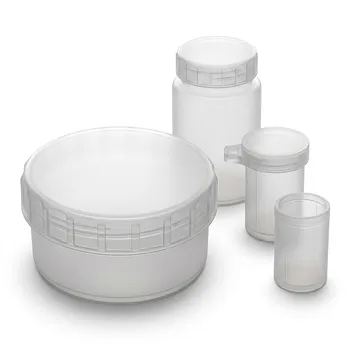
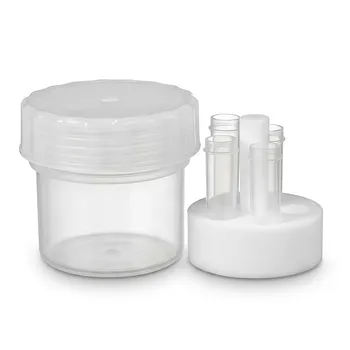
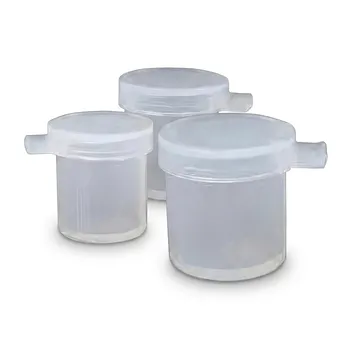
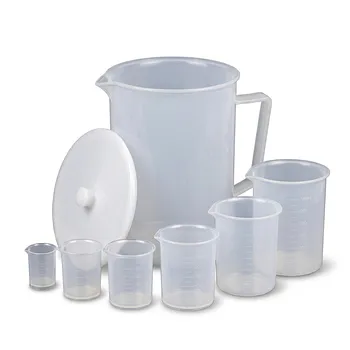
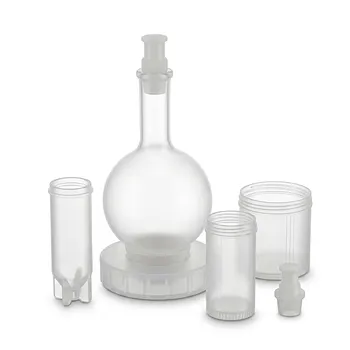
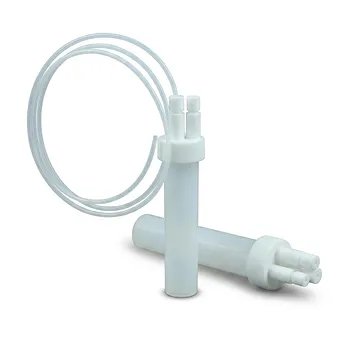
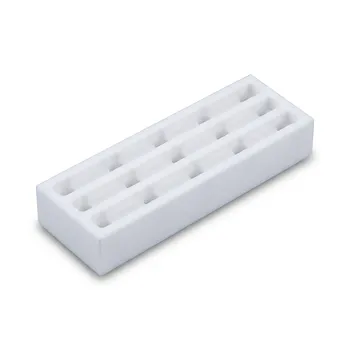
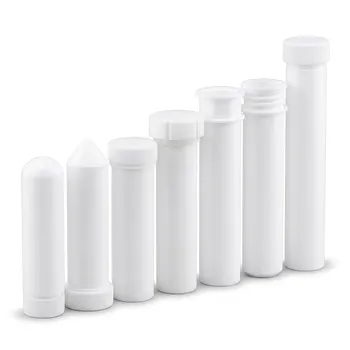
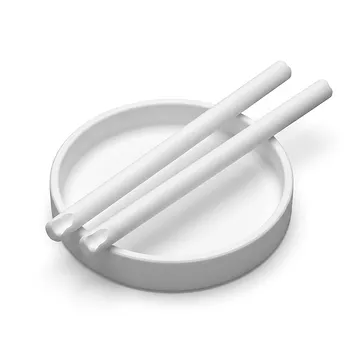
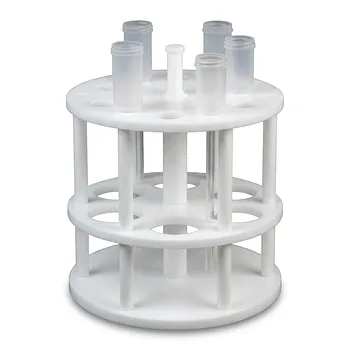
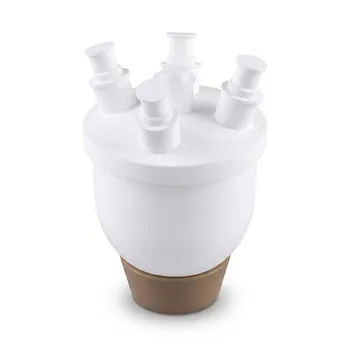
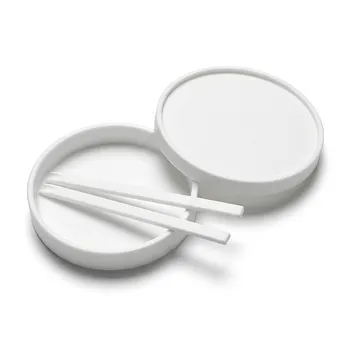
High-purity PFA and PTFE labware are indispensable in the synthesis of $VS_2$ and $MoS_2$ precursors because they provide absolute chemical inertness against aggressive reagents. These materials prevent the leaching of metallic impurity ions and resist corrosion from the strong acids, bases, and reducing agents typically used in transition metal dichalcogenide (TMD) preparation. By eliminating background contamination, these fluoropolymers ensure the phase purity and electrochemical stability of the final catalyst.
Core Takeaway: The use of high-purity PFA or PTFE is a non-negotiable requirement for ensuring that the chemical environment remains pristine during the dissolution of metal salts and reducing agents. This prevents trace metal contamination that would otherwise degrade the catalytic performance of $VS_2$ or $MoS_2$ in applications like lithium-sulfur batteries.
The Chemical Imperative: Resistance to Aggressive Reagents
Neutralizing the Risk of Corrosion
The preparation of $VS_2$ and $MoS_2$ often involves the dissolution of precursors like vanadium pentoxide ($V_2O_5$) using strong reducing agents such as oxalic acid. Standard laboratory glassware can be susceptible to surface leaching or micro-corrosion when exposed to these highly reactive or acidic environments. High-purity PFA and PTFE are virtually non-reactive, ensuring the container remains structuraly intact and chemically silent throughout the reaction.
Eliminating Metallic Impurity Leaching
Even trace amounts of foreign metal ions leached from container walls can "poison" the synthesis of transition metal dichalcogenides. These impurities can interfere with the crystal growth process, leading to undesired secondary phases or structural defects. Using fluoropolymer labware ensures that the only metal ions present in the solution are those intended for the precursor, maintaining the integrity of the chemical system.
Stability in Reducing Environments
Reducing agents used to manage the oxidation states of vanadium or molybdenum are highly sensitive to external catalysts. PTFE and PFA provide a stable environment that does not participate in or catalyze unintended side reactions. This stability is critical for achieving the precise stoichiometry required for high-performance electrocatalysts.
Impact on Material Performance and Phase Purity
Ensuring Catalyst Efficiency in Li-S Batteries
The primary utility of $VS_2$ and $MoS_2$ in modern energy storage is managing polysulfide conversion in lithium-sulfur batteries. Any introduced impurities from the labware can decrease the stability of the electrocatalyst, leading to faster degradation and lower power capacity. High-purity vessels ensure the resulting materials have the necessary surface chemistry to facilitate efficient electron transfer.
Achieving Precise Phase Purity
Synthesis of TMD nanoparticles requires strict control over the reaction environment to reach the correct crystalline phase (e.g., the M-phase in vanadium oxides). Background contamination from standard materials can act as unintended nucleation sites, disrupting the phase purity of the final product. High-performance fluoropolymers prevent these trace elements from entering the system, resulting in more predictable and repeatable experimental outcomes.
Preventing Reagent Adsorption
PFA and PTFE possess extremely low surface energy, which prevents the adsorption of metal ions or reactive species onto the vessel walls. This ensures that the actual concentration of the precursor in the solution matches the calculated values, which is vital for precise synthesis. Furthermore, the non-stick properties facilitate easy cleaning and prevent "carry-over" contamination between different batches.
Understanding the Trade-offs and Limitations
Thermal Constraints and Mechanical Properties
While PFA and PTFE are chemically superior, they have lower thermal limits compared to borosilicate glass or quartz. Users must ensure that synthesis temperatures do not exceed the melting or softening points of the fluoropolymer (typically around 250°C to 300°C depending on the specific grade). Additionally, PTFE is opaque, which can make it difficult to visually monitor color changes or precipitate formation during the reaction.
Cost and Material Grade Considerations
The cost of high-purity PFA labware is significantly higher than standard laboratory materials. It is critical to distinguish between "virgin" high-purity fluoropolymers and recycled grades, as lower-quality versions may still contain trace processing aids or residues. For trace element analysis and high-sensitivity synthesis, the investment in premium-grade materials is necessary to justify the accuracy of the research.
How to Apply This to Your Project
Choosing the Right Material for Your Goal
When selecting labware for TMD precursor processing, consider the following recommendations:
- If your primary focus is absolute purity and trace analysis: Use high-purity PFA, as it offers the lowest leaching rates and the smoothest surface finish for cleaning.
- If your primary focus is cost-effective bulk synthesis: Use PTFE beakers and stirring bars, which provide the same chemical inertness as PFA at a lower price point, provided visual monitoring is not required.
- If your primary focus is high-temperature hydrothermal synthesis: Ensure the PFA or PTFE is used as a liner within a stainless steel autoclave to prevent material deformation under pressure.
By prioritizing high-purity fluoropolymers, you safeguard the electrochemical integrity and phase purity of your transition metal dichalcogenide materials.
Summary Table:
| Feature | Benefit | Impact on VS2/MoS2 Synthesis |
|---|---|---|
| Chemical Inertness | Resists strong acids & reducing agents | Prevents vessel corrosion during precursor dissolution |
| Zero Leaching | No metallic impurity release | Eliminates "poisoning" and ensures phase purity |
| Low Surface Energy | Prevents reagent adsorption | Maintains precise stoichiometry and easy cleaning |
| High-Purity Material | No background contamination | Optimizes electrochemical stability for Li-S batteries |
Elevate Your Research with KINTEK’s High-Performance Fluoropolymers
Precision in transition metal dichalcogenide synthesis demands labware that never compromises your results. At KINTEK, we specialize in high-purity PFA and PTFE laboratory supplies designed for the most demanding chemical environments.
We offer a comprehensive range of solutions, from everyday basic labware—including beakers, measuring cylinders, crucibles, reagent bottles, and digestion tubes—to advanced fluid transfer components like tubing, fittings, and valves. For specialized research, our expertise extends to bespoke reaction apparatus, such as hydrothermal synthesis liners, microwave digestion vessels, and custom electrochemical cells.
Backed by end-to-end custom CNC fabrication, KINTEK can deliver everything from complex non-standard machined parts to high-volume orders, ensuring an absolute focus on high-performance fluoropolymer materials. Don't let trace contamination degrade your catalyst’s performance.
Ready to optimize your lab setup for superior material performance? Contact us today to discuss your project!
References
- Thilini Boteju, Venkataraman Thangadurai. Synergistic Effect of VS<sub><b>2</b></sub>/MoS<sub><b>2</b></sub> as an Electrocatalyst for Accelerating Polysulfide Conversion in Lithium–Sulfur Batteries. DOI: 10.1021/acsami.5c12948
This article is also based on technical information from Kintek Knowledge Base .
Related Products
- High Purity PFA Crucible and Corrosion Resistant PTFE Beaker for Trace Analysis and Custom Laboratory Applications
- High Purity PTFE Trays Corrosion Resistant Laboratory Labware Customizable Square Round Fluoropolymer Trays
- PFA Reaction Jar Corrosion Resistant Wide Mouth PTFE Lab Bottle High Purity Chemical Vessel
- High Purity PTFE PFA Plastic Crucible for Corrosion Resistant Acid Digestion and Trace Analysis
- Corrosion Resistant PTFE Support with PFA Transparent Reaction Tank and High Purity PFA Sampling Tube for Trace Analysis
People Also Ask
- Why are high-purity vessels critical for BiFeO3 synthesis? Ensuring Phase Purity
- Why is the use of high-purity PFA or PTFE labware critical during TiO2 nanoparticle purification? Protect Sample Purity
- Why is high-purity PFA labware necessary for Znx@LS-2 zeolite ICP-OES analysis? Ensure Trace-Level Precision
- Why is high-purity PFA trace analysis labware used for MXene? Ensure Superior Material Integrity in Research
- What key material characteristics make PTFE and PFA suitable for high-purity laboratory labware, trace analysis containers, and medical microporous tubing? Discover the essential properties that ensure purity.