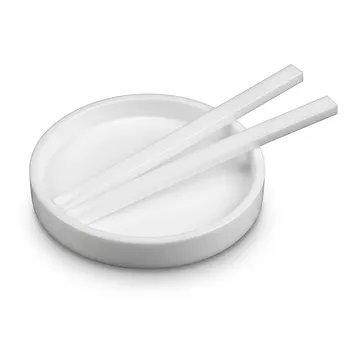
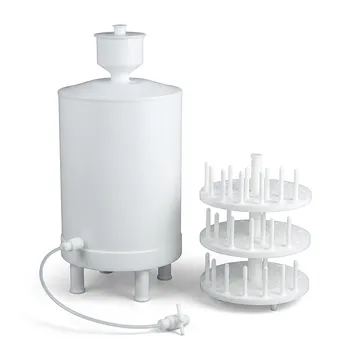
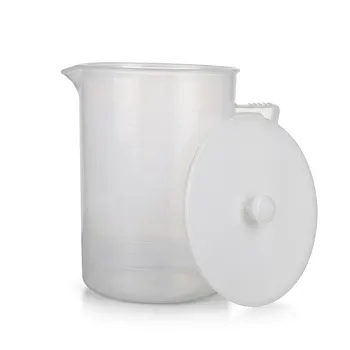
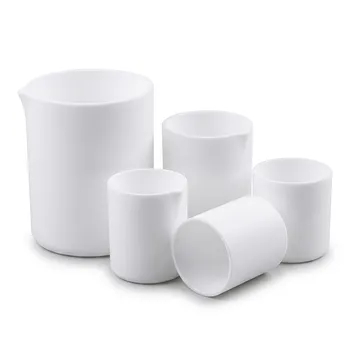
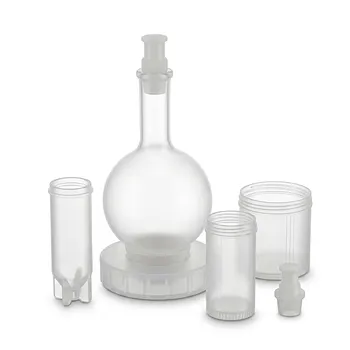
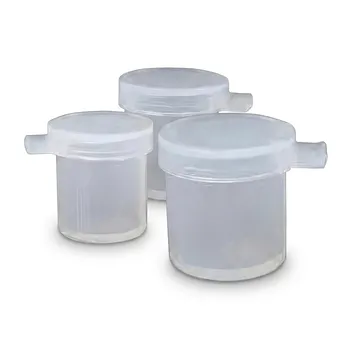
PTFE and PFA are preferred when laboratory equipment must withstand extreme heat, aggressive chemicals, and contamination-sensitive work. Both provide continuous-use temperatures around 260°C (500°F), exceptional resistance to concentrated acids, strong bases, and organic solvents, and very low surface adhesion. FEP, ETFE, and PVDF remain useful materials, but their lower temperature limits or narrower chemical-performance range make them less suitable for the most demanding applications.
PTFE is the benchmark for chemical inertness, thermal stability, low friction, and non-wetting behavior, while PFA provides similar performance with the added advantage of melt-processability and greater design flexibility.
Why High-Temperature Performance Matters
PTFE and PFA tolerate more severe heating
PTFE and PFA generally support continuous operating temperatures of approximately 260°C, making them suitable for acid digestion, heated chemical containment, and high-temperature fluid handling.
By comparison, FEP is typically limited to about 200°C, while ETFE and PVDF are commonly limited to roughly 150°C. These differences become decisive when vessels or tubing must remain in contact with aggressive reagents during prolonged heating.
Thermal stability protects process reliability
At elevated temperatures, chemical attack accelerates and weaker materials can soften, deform, swell, or lose dimensional stability. PTFE and PFA preserve their performance across a wider combination of temperature, chemical concentration, and exposure time.
This is particularly important in microwave digestion vessels and trace-analysis equipment, where material failure can compromise both safety and analytical results.
Why Chemical Inertness Matters
PTFE and PFA resist a broad range of reagents
PTFE and PFA are highly resistant to concentrated acids, strong bases, organic solvents, and many strong oxidizing environments. Their fluorinated molecular structure provides a protective fluorine-rich surface that is difficult for most chemicals to attack.
FEP also has strong chemical resistance, but its lower thermal ceiling reduces its suitability for the most severe heated applications. ETFE and PVDF offer valuable engineering properties, yet their chemical resistance is generally less comprehensive under aggressive conditions, especially at elevated temperatures.
Chemical resistance reduces contamination risk
In trace analysis, the material must not introduce metals, extractables, or reaction products into the sample. PTFE and PFA minimize the risk of container-wall degradation and chemical contamination, helping preserve low background levels.
This makes them appropriate for digestion vessels, storage bottles, crucibles, tubing, valves, and fittings used with high-purity or contamination-sensitive samples.
Resistance is not the same as universal immunity
No fluoropolymer should be treated as immune to every chemical under every condition. Temperature, concentration, pressure, exposure time, mechanical stress, and permeation requirements should be checked against the supplier’s compatibility data before selection.
Why Low Surface Adhesion Improves Labware
Low friction reduces sample retention
PTFE has an exceptionally low coefficient of friction, and PFA also provides very low-friction, non-wetting surfaces. Samples are less likely to adhere to vessel walls or tubing compared with many alternative materials.
That reduces residue, scaling, carryover, and cleaning difficulty—important advantages when changing between samples or working at trace concentrations.
Non-wetting surfaces support cleanability
A non-wetting surface helps liquids drain more completely and limits the formation of persistent films. In fluid-transfer systems, this can reduce hold-up volume and lower the chance that one sample will contaminate the next.
These characteristics are valuable even when the material is not exposed to the highest possible temperature, because cleanliness and repeatability are central laboratory requirements.
PTFE and PFA Solve Different Manufacturing Problems
PTFE is the performance benchmark
PTFE combines excellent thermal and chemical stability with very low friction and strong dielectric performance. It is well suited to machined parts, seals, vessels, tubing, and standard laboratory supplies.
Its main manufacturing limitation is that it cannot normally be processed through conventional melt injection molding or extrusion. PTFE generally requires techniques such as compression molding, paste extrusion, or CNC machining.
PFA retains performance while enabling complex shapes
PFA provides thermal and chemical performance comparable to PTFE while being melt-processable. It can be extruded or injection-molded into complex, clear, and weldable components.
That makes PFA especially useful for high-purity tubing, valve bodies, specialized fittings, microwave vessels, and electrochemical cell components where intricate geometry or transparent inspection is beneficial.
FEP is a practical moderate-temperature alternative
FEP offers good chemical resistance and melt-processability, often at lower cost or with easier processing than the higher-performance options. Its approximately 200°C continuous-use limit, however, makes it less appropriate for the most aggressive heated processes.
For moderate-temperature fluid handling, cable jackets, and applications where the additional thermal margin is unnecessary, FEP can be a sound choice.
ETFE and PVDF prioritize other properties
ETFE provides substantially higher tensile strength, toughness, and cut-through resistance than PTFE or PFA. PVDF can also be attractive where mechanical strength, processability, or specific electrical and chemical properties are more important than maximum resistance.
These advantages do not make them inferior materials; they reflect different design priorities. Their lower temperature limits and, in many aggressive environments, reduced chemical resistance make them less suitable for demanding high-purity labware.
Understanding the Trade-offs
PTFE sacrifices easy fabrication
PTFE’s exceptional performance comes with manufacturing constraints. Machining or specialized forming can increase cost and limit the practical complexity of parts compared with injection-molded materials.
PFA often solves this problem, but it may not be the best choice when the lowest friction, specific mechanical behavior, or lowest material cost is the overriding requirement.
PFA is not automatically superior in every application
PFA is often preferred for complex molded or transparent components, but component design still matters. Pressure, creep, wall thickness, permeation, sealing method, and thermal cycling must be evaluated rather than inferred from chemical resistance alone.
Stronger materials may be better for mechanical service
ETFE’s higher tensile strength and toughness can make it preferable for structural covers, protective liners, or components exposed to abrasion and impact. Choosing PTFE or PFA solely because they have higher chemical and temperature ratings may produce an unnecessarily weak or expensive mechanical design.
Temperature ratings require application context
A continuous-use rating is not the same as a guaranteed rating for every short-term exposure, pressure condition, or thermal cycle. Confirm the actual temperature at the polymer, not just the temperature of the surrounding oven, bath, or process fluid.
Making the Right Choice for Your Goal
The best material depends on whether chemical purity, temperature, mechanical strength, or manufacturing flexibility is the primary constraint.
- If your primary focus is maximum chemical resistance and lowest surface adhesion: Choose PTFE for demanding containment, seals, machined components, and contamination-sensitive laboratory work.
- If your primary focus is complex, high-purity molded or transparent components: Choose PFA when you need PTFE-like thermal and chemical performance with melt-processability, welding, or intricate geometry.
- If your primary focus is moderate-temperature chemical handling: Consider FEP when its approximately 200°C operating limit provides sufficient margin.
- If your primary focus is mechanical toughness and tensile strength: Consider ETFE when impact, cut-through, or structural performance outweighs the need for maximum temperature and chemical resistance.
- If your primary focus is a balanced engineering material for less severe service: Evaluate PVDF when its mechanical or processing advantages meet the chemical and temperature requirements.
PTFE and PFA are preferred not because the other fluoropolymers lack value, but because they provide the widest performance margin when heat, chemical attack, cleanliness, and reliability must all be controlled at once.
Summary Table:
| Property | PTFE | PFA | FEP | ETFE | PVDF |
|---|---|---|---|---|---|
| Continuous Temp. | ~260°C | ~260°C | ~200°C | ~150°C | ~150°C |
| Chemical Resistance | Excellent | Excellent | Good | Moderate | Moderate |
| Surface Adhesion | Very Low | Very Low | Low | Moderate | Moderate |
| Processability | Difficult (machining, etc.) | Excellent (melt-processable) | Good (melt-processable) | Good (melt-processable) | Good (melt-processable) |
| Typical Use | High-performance labware, seals | Complex high-purity components | Moderate-temperature handling | Mechanical parts | General engineering |
Elevate your lab's performance with KINTEK's precision PTFE and PFA labware, designed for extreme heat and chemical resistance. From standard beakers to custom electrochemical cells, our CNC machining capabilities ensure a perfect fit for your high-purity applications. Contact us today to discuss your requirements and experience unmatched reliability and purity.
Related Products
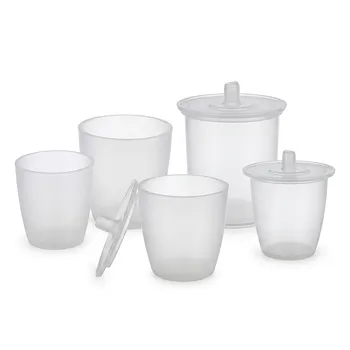
- High Purity PFA Crucible and Corrosion Resistant PTFE Beaker for Trace Analysis and Custom Laboratory Applications
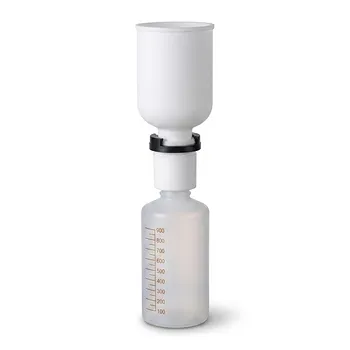
- Custom PTFE Constant Pressure Separatory Funnel Corrosion Resistant Low Background Labware for PFA Flasks
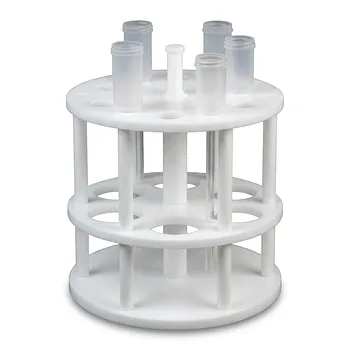
- Custom PFA Microcolumn Racks and PTFE Machined Low Background Corrosion Resistant Laboratory Fixtures
- PTFE PFA Vacuum Filtration System Corrosion Resistant Customizable Shatterproof Laboratory Device
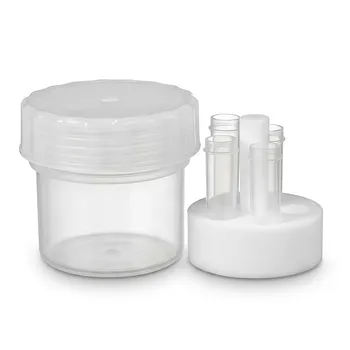
- Corrosion Resistant PTFE Support with PFA Transparent Reaction Tank and High Purity PFA Sampling Tube for Trace Analysis
People Also Ask
- Why are high-purity vessels critical for BiFeO3 synthesis? Ensuring Phase Purity
- Why is the use of high-purity PFA or PTFE labware critical during TiO2 nanoparticle purification? Protect Sample Purity
- Why is high-purity PFA trace analysis labware used for MXene? Ensure Superior Material Integrity in Research
- Why is high-purity PFA labware necessary for Znx@LS-2 zeolite ICP-OES analysis? Ensure Trace-Level Precision
- What key material characteristics make PTFE and PFA suitable for high-purity laboratory labware, trace analysis containers, and medical microporous tubing? Discover the essential properties that ensure purity.