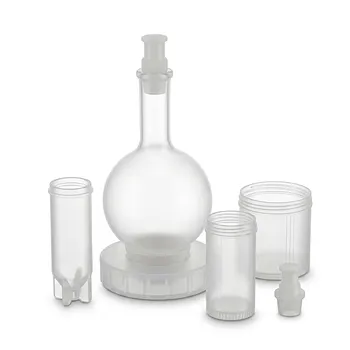
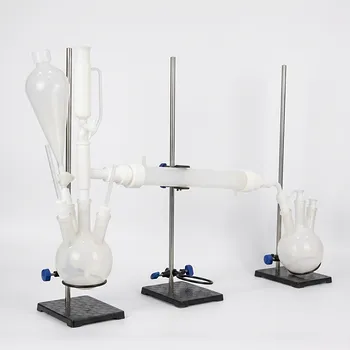
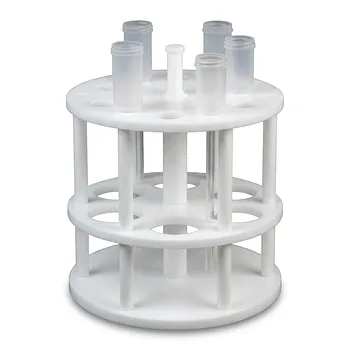
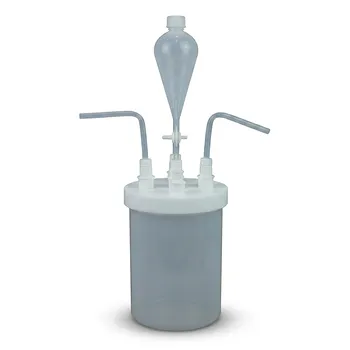
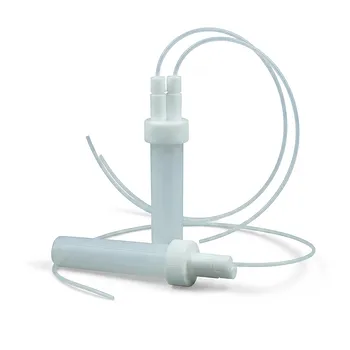
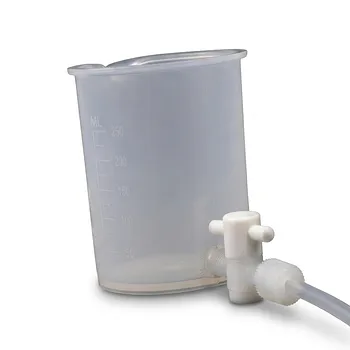
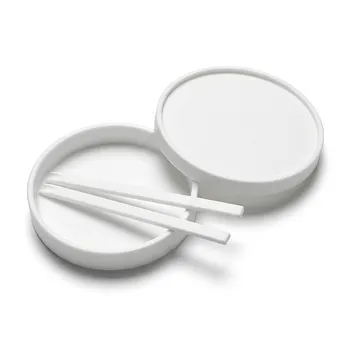
PFA labware is the industry standard for trace antimony analysis because it eliminates the two primary sources of measurement error: sample contamination and analyte loss. When analyzing Cs2NaScCl6:Sb3+ crystals via ICP-MS, PFA prevents metal ions from leaching into the sample while its ultra-smooth surface ensures that trace Sb3+ ions do not stick to the container walls. This combination is essential for maintaining the integrity of parts-per-billion (ppb) or parts-per-trillion (ppt) measurements.
The preference for PFA in ICP-MS analysis stems from its exceptional chemical inertness and minimal surface adsorption. By virtually eliminating secondary contamination and "memory effects," PFA ensures that the detected antimony levels reflect the true composition of the crystal rather than artifacts from the labware.
Eliminating Secondary Contamination
Low Metal Ion Leaching Background
PFA is synthesized to maintain an extremely low metallic background, which is critical for trace-level detection. Traditional glassware or lower-grade plastics can leach metal ions into acidic digestion solutions, which would falsely inflate the detected concentration of trace elements like antimony.
Chemical Inertness in Harsh Reagents
Analyzing crystals like Cs2NaScCl6:Sb3+ often requires aggressive acid digestion to fully dissolve the sample. PFA’s high corrosion resistance ensures the vessel remains intact and unreactive even when exposed to the concentrated acids necessary for sample preparation.
Prevention of Environmental Permeability
PFA components in the sample introduction system, such as tubing and nebulizers, have extremely low chemical permeability. This prevents environmental contaminants from penetrating the system and ensures the high-purity sample remains isolated from the laboratory atmosphere.
Preserving Sample Integrity through Surface Science
Mitigation of the "Wall-Hanging" Effect
Antimony ions are prone to adsorption, where they physically or chemically bond to the inner surfaces of a container. PFA’s superior internal surface smoothness prevents these ions from "sticking," ensuring the entire sample reaches the ICP-MS plasma for accurate quantification.
Reduction of Memory Effects
Because PFA does not retain ions on its surface, it minimizes memory effects—where residue from a previous sample affects subsequent readings. This leads to shorter rinse times and higher lab throughput without sacrificing the reproducibility of the data.
Enhanced Accuracy for Forensics and Research
In high-sensitivity applications, even microscopic "carry-over" can invalidate a comparative analysis. PFA ensures that the accuracy and reproducibility of data remain undisturbed, which is vital when performing precise elemental characterization of doped crystals.
Understanding the Trade-offs
Cost and Initial Investment
PFA labware is significantly more expensive than standard PTFE or polypropylene alternatives. While the long-term data reliability justifies the expense, it requires a higher upfront budget for laboratory setup and inventory.
Thermal Constraints
While PFA is thermally stable, it has lower temperature limits than quartz or specialized ceramics. Exceeding its thermal threshold during aggressive digestion can lead to vessel deformation, potentially compromising the seal of digestion tubes.
Maintenance and Cleaning Protocols
To maintain the "ultra-trace" benefits of PFA, rigorous acid-leaching cleaning procedures are required. Failure to properly decontaminate the labware between uses can negate its low-background advantages and lead to cross-contamination.
Strategic Implementation for Trace Analysis
Selecting the right material depends on the sensitivity requirements of your specific analytical goal.
- If your primary focus is maximum detection sensitivity: Utilize PFA for every stage of the process, from initial acid digestion to the final sample introduction tubing.
- If your primary focus is high-throughput routine testing: Leverage PFA’s smooth surfaces to significantly reduce rinse times and minimize cross-contamination between consecutive samples.
- If your primary focus is cost-efficiency: Reserve PFA exclusively for critical trace elements like antimony, while using high-quality polypropylene for less sensitive bulk elemental analysis.
By prioritizing PFA labware, researchers can achieve the precision and repeatability necessary to advance the study of high-purity crystalline materials.
Summary Table:
| Feature | Benefit for ICP-MS Trace Analysis | Impact on Analytical Results |
|---|---|---|
| Low Metal Leaching | Eliminates secondary contamination from containers | Ensures accurate detection of trace Sb3+ levels |
| Ultra-Smooth Surface | Prevents "wall-hanging" or analyte adsorption | Guarantees high sample recovery and integrity |
| Chemical Inertness | Resists aggressive acid digestion (HCl, HNO3) | Safely processes complex doped crystals |
| Minimal Memory Effects | Reduces residue carry-over between samples | Shortens rinse times and increases throughput |
Elevate Your Analytical Precision with KINTEK
When your research demands parts-per-trillion accuracy, the quality of your labware is non-negotiable. KINTEK specializes in high-performance fluoropolymer solutions designed specifically for the most demanding trace analysis environments.
From everyday basic labware like PFA beakers, measuring cylinders, crucibles, and digestion tubes to specialized fluid transfer components (tubing, fittings, valves) and sample prep tools (filters, pipettes, spatulas), we provide the inert environment your samples require. Our expertise extends to advanced apparatus, including microwave digestion vessels, hydrothermal synthesis liners, and custom electrochemical cells, all crafted with an absolute focus on PTFE and PFA excellence.
Whether you need high-volume standard consumables or complex non-standard machined parts via our end-to-end custom CNC fabrication, KINTEK is your partner in laboratory integrity.
Contact us today to request a quote or discuss your custom PFA requirements and ensure your results are never compromised by contamination.
References
- Hao Suo, Feng Wang. Excitation-mode-selective emission through multiexcitonic states in a double perovskite single crystal. DOI: 10.1038/s41377-024-01689-7
This article is also based on technical information from Kintek Knowledge Base .
Related Products
- Custom PFA Pear Shaped Flask High Purity Corrosion Resistant Labware Custom Molded Fluoropolymer Flask Glass Replacement Solution
- High Purity PFA Crucible and Corrosion Resistant PTFE Beaker for Trace Analysis and Custom Laboratory Applications
- High Purity PFA Constant Pressure Condensation Reaction System Acid Resistant High Temperature Customizable Teflon Labware
- High Purity PFA Sample Dissolution Cups Acid Resistant Chemical Digestion Vessels with Lids Trace Analysis Labware
- High Purity PFA Beaker with Handle and Large Capacity Washable Soak Basket Multi Spec Teflon Laboratory Labware
People Also Ask
- Why Use PFA Labware for MnFe2O4/rGO Precursors? Ensure Stoichiometric Precision and Purity
- What are the primary properties of PFA for high-performance labware? Achieve ultra-trace purity & thermal stability.
- Why is PFA labware recommended for CuBi2O4? Protect high-purity precursors and ensure semiconductor bandgap accuracy.
- How does PFA labware enhance the accuracy of ultra-trace element analysis? Achieving PPT Precision with Zero Leaching
- What role does PFA labware play in semiconductor manufacturing? Ensuring Ultra-Pure Yields and Zero Contamination