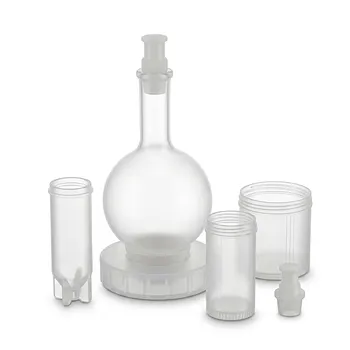
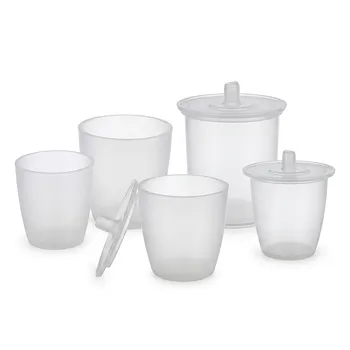
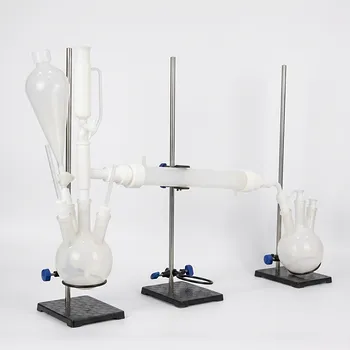
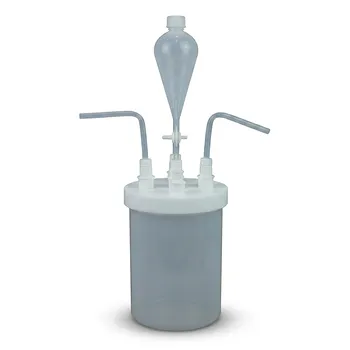
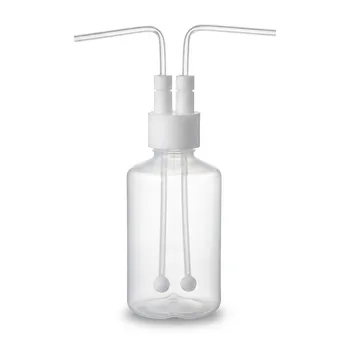
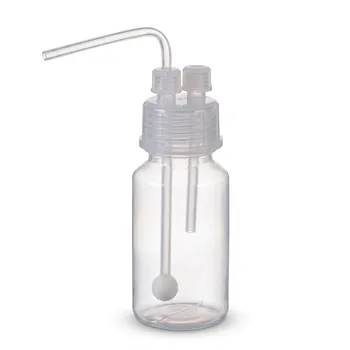
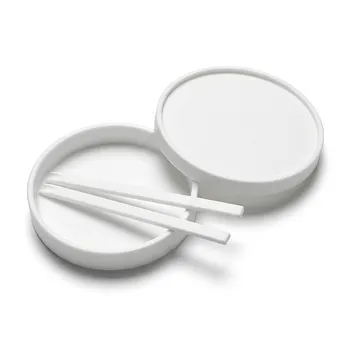
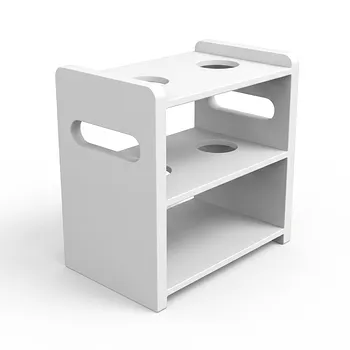
Low-surface-energy PFA labware and PTFE phase-separation tools are critical because they prevent superhydrophobic and superoleophobic F-POSS macromers from adhering to equipment surfaces. F-POSS materials can exhibit extremely low surface tension, reported as low as 9.3 mN/m, so they readily resist wetting yet may cling to or spread unpredictably across conventional glass, metal, or polymer surfaces. PFA separation funnels and custom-machined PTFE components reduce adhesion, contamination, phase-transfer losses, and uncertainty during synthesis, purification, and characterization.
The central issue is sample recovery: F-POSS macromers are designed to repel water and oils, but those same low-energy properties can make them difficult to handle in ordinary labware. PTFE and PFA provide chemically resistant, non-wetting contact surfaces that support cleaner phase separation and more reliable analytical results.
Why F-POSS Macromers Are Difficult to Handle
Their Surface Energy Is Exceptionally Low
Long-chain fluoroalkyl POSS compounds contain dense fluorinated segments that produce strong water and oil repellency. Their surface tension can be far below that of many common laboratory liquids and materials.
This creates a useful macroscopic property, but it also changes how the material interacts with equipment. Instead of behaving like a readily wetting solution, an F-POSS-containing phase may form droplets, leave films, or resist complete drainage.
Superhydrophobicity and Superoleophobicity Affect Both Phases
Superhydrophobic F-POSS materials strongly repel aqueous liquids. Superoleophobic behavior also limits wetting by nonpolar organic solvents, including fluorinated solvents used in synthesis and purification.
Consequently, a macromer can interact poorly with both the aqueous and organic sides of a liquid-liquid extraction. Conventional labware may retain part of the sample at the walls, interfaces, stopcock, or vessel outlet.
Fluorinated Segments Prefer Interfaces
Fluorinated chains tend to segregate toward interfaces, including boundaries between the material, liquid, and air. This concentrates low-energy fluorinated groups at surfaces where they can control wetting and adhesion.
For F-POSS macromers, that behavior increases the importance of every contact surface in the workflow. The vessel is not a passive container; its surface chemistry can influence recovery and contamination.
How PTFE and PFA Improve Phase Separation
They Reduce Wall Adhesion
PTFE and PFA have intrinsically low surface energy and highly non-wetting surfaces. Their smooth, non-porous structures reduce the tendency of fluorinated macromers and droplets to remain attached to vessel walls.
Lower adhesion means more of the target material reaches the intended phase and can be collected. This is especially important when working with small quantities or high-value macromers.
They Support Cleaner Liquid-Liquid Separation
A PFA separation funnel provides a low-adhesion environment for separating dense fluorinated solvent layers from aqueous sulfate mixtures. Reduced wetting and residue formation help the phases drain more completely and make the boundary easier to manage.
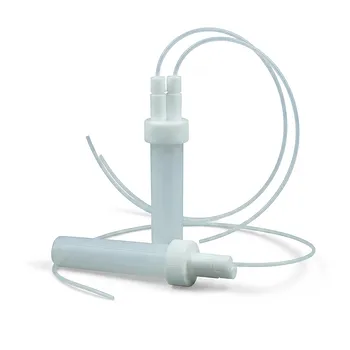
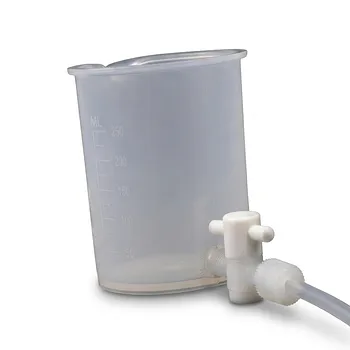
Custom PTFE components can extend this benefit to specialized geometries, valves, fittings, transfer paths, and collection vessels. The result is a more controlled separation process with less material trapped in the equipment.
They Limit Sample Hold-Up
Sample hold-up occurs when material remains in tubing, fittings, vessel corners, stopcocks, or outlet channels instead of entering the collection vessel. Low-friction PTFE and low-energy PFA surfaces minimize this retained volume.
This improves practical yield and makes transfers more reproducible. It also reduces the difference between the amount processed and the amount ultimately recovered.
They Reduce Contamination and Carryover
Residual F-POSS films can contaminate a subsequent experiment or distort trace measurements. Because PTFE and PFA resist adhesion and are straightforward to clean, they reduce residue accumulation between procedures.
Their non-porous structure also limits absorption or partitioning of organic compounds into the equipment itself. This is valuable when accurate composition, purity, or surface-property measurements are required.
Why Material Compatibility Matters
Chemical Resistance Protects the Workflow
PTFE and PFA are resistant to many aqueous reagents and organic solvents used in synthesis and purification. This allows them to remain stable while providing the low-energy contact surface required for F-POSS handling.
The equipment therefore contributes less chemical interference and is less likely to degrade or swell under the relevant processing conditions.
Low Friction Helps Drainage and Transfer
PTFE has a very low coefficient of friction and strong inherent lubricity. These characteristics help droplets and residues move through transfer components rather than remaining distributed across the surface.
The benefit is practical: cleaner transfers, less fluid drag, and fewer locations where the sample can remain trapped.
Non-Porous Surfaces Simplify Cleaning
PFA and PTFE do not present the same porous or easily penetrated structure associated with some other materials. Deposits are less likely to become embedded in the surface, allowing more effective cleaning between experiments.
That supports repeatable purification and characterization, particularly when trace contamination can affect results.
What This Means for Characterization
Recovery Affects Reported Composition
Losses to vessel walls or transfer paths can change the effective composition of the recovered macromer. The resulting sample may no longer accurately represent the synthesized material.
Maximizing recovery is therefore not only a yield concern. It protects the validity of subsequent compositional, structural, and performance measurements.
Residues Can Distort Surface-Property Results
F-POSS macromers are often evaluated for water and oil repellency, coating behavior, or polymer-composite performance. Residual contaminants, solvent differences, or cross-contamination can alter those measurements.
Low-adhesion equipment helps preserve the intended chemical state of the sample before it is analyzed or incorporated into a composite.
Equipment Choice Improves Reproducibility
When the same low-energy materials are used consistently across separation and transfer steps, uncontrolled surface interactions become less significant. This makes recovery and handling behavior more consistent from batch to batch.
Reproducibility is especially important when comparing macromer formulations or evaluating small changes in fluorinated chain structure.
Understanding the Trade-Offs
Low Adhesion Does Not Eliminate Handling Challenges
PTFE and PFA reduce retention, but they cannot eliminate all droplet formation, interfacial instability, or transfer losses. F-POSS systems may still require controlled drainage, appropriate phase identification, and careful collection.
The equipment addresses a major source of error, but it does not replace disciplined phase-separation technique.
Smooth Surfaces May Make Droplets Move Unexpectedly
A highly non-wetting surface can cause droplets to roll, slide, or detach suddenly. Without controlled positioning and flow, this may lead to splashing or unintended transfer between phases.
Operators should account for the low-friction behavior when selecting funnel geometry, flow rates, tubing paths, and collection vessels.
PTFE and PFA Are Not Interchangeable in Every Design
Both materials provide low-energy fluoropolymer surfaces, but the best choice depends on the component and process requirements. PFA is useful for transparent or formed labware such as separation funnels, while PTFE is well suited to machined components, fittings, valves, and specialized inserts.
The design should consider visibility, mechanical form, temperature exposure, connection integrity, and cleaning requirements in addition to surface energy.
Surface Condition Still Matters
Scratches, residues, and accumulated deposits can change local wetting behavior even when the underlying material is PTFE or PFA. Damaged or poorly cleaned equipment may therefore undermine the expected recovery and contamination advantages.
Inspection and validated cleaning remain necessary parts of the workflow.
Making the Right Choice for Your Goal
Select the equipment according to the failure mode that matters most in your process.
- If your primary focus is maximum sample recovery: Use PFA separation funnels and PTFE transfer components to minimize wall adhesion, fluid retention, and hold-up during phase separation.
- If your primary focus is analytical accuracy: Use clean, non-porous PTFE or PFA vessels to reduce adsorption, carryover, and contamination that could alter characterization results.
- If your primary focus is reliable liquid-liquid separation: Use low-energy fluoropolymer contact surfaces throughout the funnel, outlet, fittings, and collection path.
- If your primary focus is repeatable purification: Standardize PTFE and PFA components and maintain consistent cleaning and inspection practices between batches.
For superhydrophobic and superoleophobic F-POSS macromers, low-surface-energy labware is a process-control requirement that protects recovery, purity, and measurement reliability.
Summary Table:
| Key Challenge with F-POSS Macromers | How PFA/PTFE Helps |
|---|---|
| Extremely low surface energy (9.3 mN/m) causes unpredictable adhesion and spreading | Low-surface-energy PFA/PTFE minimizes wall adhesion and promotes clean phase separation |
| Phase separation losses due to droplet retention and film formation | Smooth, non-porous surfaces reduce sample hold-up and improve recovery |
| Analytical inaccuracies from residues and carryover | Non-reactive, easy-to-clean surfaces prevent contamination and ensure reproducibility |
| Reproducibility issues in purification and characterization | Consistent low-adhesion components standardize handling and improve batch-to-batch consistency |
Ensure precise handling of advanced fluorine materials with KINTEK's PTFE and PFA labware. Our custom-machined components and separation funnels minimize sample loss and contamination, ideal for F-POSS research and high-purity analysis. From bespoke electrochemical cells to complete fluid transfer systems, we provide the low-energy surfaces you need for accurate results. Contact us today to discuss your custom requirements and optimize your workflow!
Related Products
- Custom PFA Pear Shaped Flask High Purity Corrosion Resistant Labware Custom Molded Fluoropolymer Flask Glass Replacement Solution
- High Purity PFA Crucible and Corrosion Resistant PTFE Beaker for Trace Analysis and Custom Laboratory Applications
- High Purity PFA Constant Pressure Condensation Reaction System Acid Resistant High Temperature Customizable Teflon Labware
- High Purity PFA Sample Dissolution Cups Acid Resistant Chemical Digestion Vessels with Lids Trace Analysis Labware
- High Purity PFA Beaker with Handle and Large Capacity Washable Soak Basket Multi Spec Teflon Laboratory Labware
People Also Ask
- Why Use PFA Labware for MnFe2O4/rGO Precursors? Ensure Stoichiometric Precision and Purity
- How does PFA labware enhance the accuracy of ultra-trace element analysis? Achieving PPT Precision with Zero Leaching
- What are the primary properties of PFA for high-performance labware? Achieve ultra-trace purity & thermal stability.
- Why is PFA labware recommended for CuBi2O4? Protect high-purity precursors and ensure semiconductor bandgap accuracy.
- What role does PFA labware play in semiconductor manufacturing? Ensuring Ultra-Pure Yields and Zero Contamination