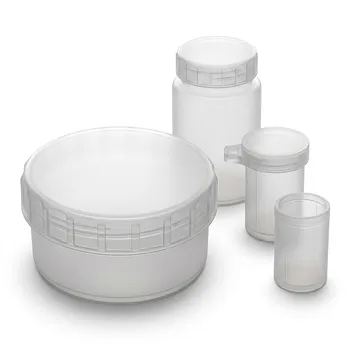
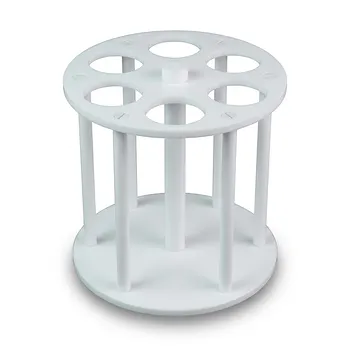
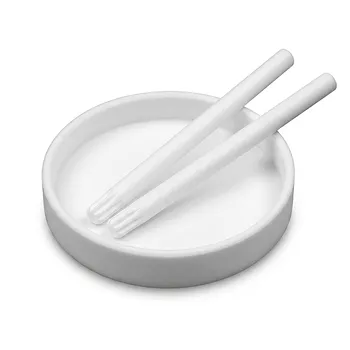
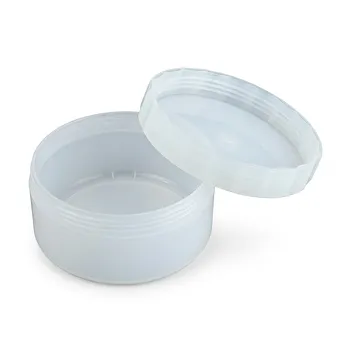
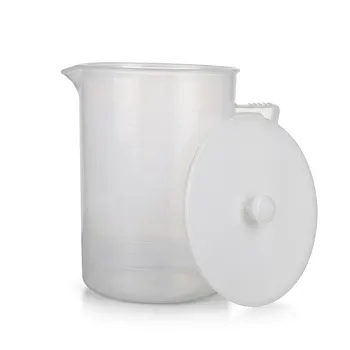
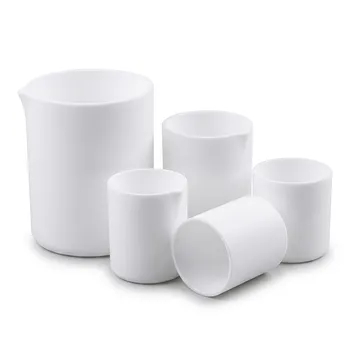
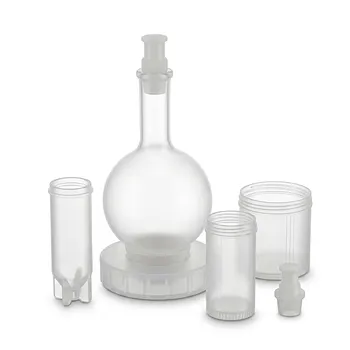
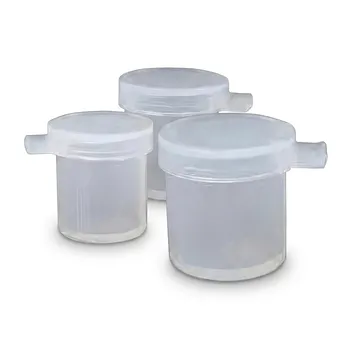
PTFE and PFA provide the greatest thermal margin: PTFE melts at approximately 327 °C, while PFA typically melts at 302–310 °C. FEP melts lower, around 260–282 °C, and PVDF is substantially lower at approximately 155–192 °C. For high-temperature laboratory labware and digestion vessels, this hierarchy generally favors PTFE or PFA—but melting point alone does not define the safe operating temperature.
PTFE offers the highest melting point, while PFA provides nearly comparable thermal performance with much easier melt processing and better clarity. FEP is appropriate for less demanding high-temperature fluid handling, and PVDF is generally better suited to moderate-temperature structural or fluid components.
Why the Melting-Point Difference Matters
Melting point is a measure of thermal headroom
A polymer does not need to reach its melting point before becoming unsuitable. Mechanical strength, dimensional stability, creep resistance, pressure capability, and chemical performance can decline well below the melting transition.
The melting point is therefore best viewed as an indicator of thermal headroom, not as a recommended operating temperature.
PTFE and PFA occupy the high-temperature tier
PTFE melts at approximately 327 °C, with some data reported broadly in the 320–340 °C range. PFA melts at approximately 302–310 °C, depending on grade and formulation.
Both materials generally support continuous service temperatures around 260 °C, although the allowable temperature depends on stress, pressure, exposure time, geometry, and the specific manufacturer’s rating.
FEP and PVDF have less thermal margin
FEP typically melts at approximately 260–282 °C, placing it below PTFE and PFA for high-temperature structural applications. Its flexibility, chemical resistance, and melt processability still make it useful for tubing and transfer components.
PVDF melts at approximately 155–192 °C, depending on grade. It can provide higher tensile strength and stiffness than some fluoropolymers, but its lower thermal transition limits its suitability for severe hot-acid digestion or high-temperature vessel construction.
What This Means for Digestion Vessels
PTFE is suited to severe chemical and thermal exposure
PTFE is a strong choice for high-temperature reaction vessels, liners, crucibles, seals, and machined laboratory components. It combines a high melting point with exceptional chemical resistance and low friction.
Its major manufacturing limitation is that it is not conventionally melt-processible. PTFE is typically compressed and sintered, then machined or fabricated into the required geometry.
PFA combines high temperature performance with processability
PFA provides thermal performance close to PTFE while being melt-processible. It can be injection-molded or extruded into smooth, complex, seamless components.
This makes PFA particularly valuable for microwave digestion vessels, trace-analysis containers, tubing, valves, and fittings where low porosity, high purity, intricate geometry, or weldability is important.
Clarity can improve laboratory operation
PFA is often translucent or optically clear, allowing users to observe sample condition, liquid level, residue, or contamination without opening the vessel.
That visibility is useful in high-purity analytical work and process monitoring, although clarity should not be treated as a substitute for confirming chemical compatibility or pressure suitability.
FEP is better for lower-temperature fluid handling
FEP retains strong chemical resistance and flexibility but has less thermal margin than PTFE or PFA. It is commonly better suited to fluid-transfer tubing, protective linings, and standard labware operating below the most demanding digestion temperatures.
Using FEP for a vessel subjected to prolonged high temperature, internal pressure, or mechanical loading can increase the risk of creep, deformation, and loss of dimensional accuracy.
PVDF is generally a moderate-temperature option
PVDF can be attractive when rigidity, tensile strength, or mechanical performance is more important than extreme temperature resistance. It is often used for structural fluid-handling parts and mechanical components at moderate temperatures.
For severe acid digestion or high-temperature microwave vessels, however, its lower melting range provides substantially less safety margin than PTFE or PFA.
The Processing Difference Between PTFE and PFA
PTFE favors robust machined construction
PTFE has extremely high melt viscosity and does not flow like a conventional molten thermoplastic. Its components are therefore commonly produced through powder processing, sintering, and machining.
This is advantageous when the design calls for thick-wall vessels, heavy-duty blocks, liners, gaskets, or custom one-off parts.
PFA favors complex, smooth, high-purity geometries
PFA’s lower melt viscosity allows conventional melt fabrication. Manufacturers can produce intricate channels, smooth internal surfaces, thin walls, and integrated features more easily than with PTFE.
For laboratory vessels, this can reduce crevices and contamination sites while supporting repeatable production and high-purity fluid handling.
The practical selection is not simply “higher melting point wins”
PTFE has the higher melting point, but PFA may be the better engineering choice when the vessel requires clarity, molding, seamless construction, complex geometry, or low micro-porosity.
Both can be appropriate for high-temperature digestion; the deciding factor is often the combination of temperature, pressure, geometry, purity, and manufacturing method.
Understanding the Trade-offs
Do not use melting point as the operating limit
A vessel may deform or lose mechanical strength before it melts, especially under internal pressure or sustained load. Always compare the actual temperature-pressure-time profile with the supplier’s continuous-use and pressure ratings.
Microwave digestion adds pressure and chemical complexity
Microwave digestion vessels experience more than elevated temperature. Internal pressure, rapid thermal cycling, concentrated acids, sample composition, and vessel geometry all influence performance.
Material selection must therefore consider pressure-rated vessel design, closure integrity, wall thickness, and the specific digestion method—not only polymer thermal data.
PFA is not automatically superior in every design
PFA’s processability and clarity are major advantages, but PTFE can be preferable for thick, mechanically robust, or custom-machined components. The optimal material depends on whether fabrication flexibility or maximum thermal margin is the primary constraint.
FEP and PVDF should not be selected by chemical resistance alone
FEP and PVDF may resist many chemicals effectively, but chemical compatibility does not guarantee dimensional stability at high temperature. A material can remain chemically intact while softening, creeping, or losing pressure capability.
Making the Right Choice for Your Goal
The following rules provide a practical starting point, subject to the manufacturer’s temperature, pressure, and chemical-compatibility data.
- If your primary focus is maximum thermal margin: Choose PTFE, particularly for robust machined vessels, liners, crucibles, seals, and severe chemical exposure.
- If your primary focus is complex geometry and high purity: Choose PFA because it combines near-PTFE thermal performance with melt processability, smooth surfaces, and low-contamination construction.
- If your primary focus is visible sample monitoring: Choose optically clear or translucent PFA for applications where observing the sample or liquid level is valuable.
- If your primary focus is flexible fluid transfer at lower temperatures: Consider FEP, provided the operating temperature, pressure, and mechanical load remain within its rated limits.
- If your primary focus is rigid components at moderate temperatures: Consider PVDF when its mechanical strength and stiffness are more important than extreme-temperature capability.
- If your primary focus is microwave or severe acid digestion: Start with PTFE or PFA and verify the complete vessel design, including pressure rating, thermal cycling, closure system, and chemical compatibility.
The right fluoropolymer is the one that preserves both chemical integrity and mechanical stability throughout the complete temperature–pressure–time profile of the laboratory process.
Summary Table:
| Polymer | Melting Point (°C) | Continuous Service Temp (°C) | Key Advantages | Typical Applications |
|---|---|---|---|---|
| PTFE | ~327 | ~260 | Highest thermal margin, exceptional chemical resistance, low friction | Reaction vessels, liners, crucibles, seals, custom machined parts |
| PFA | 302-310 | ~260 | Near-PTFE thermal performance, melt-processible, clarity, high purity | Microwave digestion vessels, trace-analysis containers, tubing, valves, fittings |
| FEP | 260-282 | ~200 (typical) | Flexibility, chemical resistance, melt-processible | Fluid-transfer tubing, protective linings, standard labware |
| PVDF | 155-192 | ~150 (typical) | Rigidity, tensile strength, stiffness | Structural fluid-handling parts, mechanical components at moderate temperatures |
Ready to select the ideal fluoropolymer for your high-temperature labware? KINTEK offers a comprehensive range of PTFE and PFA products, from stock labware to custom CNC-machined components. Our experts can help you navigate thermal, chemical, and processing requirements to ensure optimal performance. Contact us today to discuss your application and benefit from our OEM/ODM support, certification, and reliable supply. Get in touch now!
Related Products
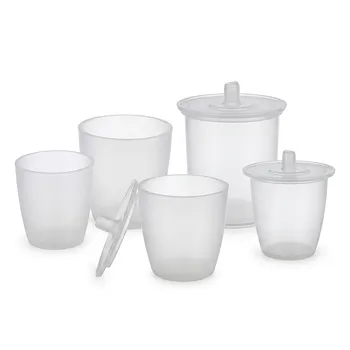
- High Purity PFA Crucible and Corrosion Resistant PTFE Beaker for Trace Analysis and Custom Laboratory Applications
- Custom PTFE Constant Pressure Separatory Funnel Corrosion Resistant Low Background Labware for PFA Flasks
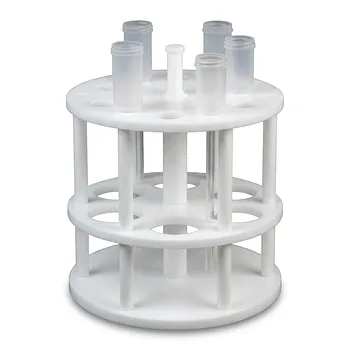
- Custom PFA Microcolumn Racks and PTFE Machined Low Background Corrosion Resistant Laboratory Fixtures
- PTFE PFA Vacuum Filtration System Corrosion Resistant Customizable Shatterproof Laboratory Device
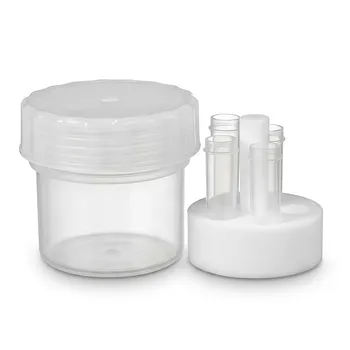
- Corrosion Resistant PTFE Support with PFA Transparent Reaction Tank and High Purity PFA Sampling Tube for Trace Analysis
People Also Ask
- Why are high-purity vessels critical for BiFeO3 synthesis? Ensuring Phase Purity
- Why is the use of high-purity PFA or PTFE labware critical during TiO2 nanoparticle purification? Protect Sample Purity
- Why is high-purity PFA labware necessary for Znx@LS-2 zeolite ICP-OES analysis? Ensure Trace-Level Precision
- Why is high-purity PFA trace analysis labware used for MXene? Ensure Superior Material Integrity in Research
- What key material characteristics make PTFE and PFA suitable for high-purity laboratory labware, trace analysis containers, and medical microporous tubing? Discover the essential properties that ensure purity.