The primary advantages of using PTFE in plain bearings are its exceptionally low coefficient of friction, inherent self-lubricating properties, and high resistance to chemicals and wear. When used as a liner or integrated into a metallic matrix, PTFE eliminates the need for external lubrication like oil or grease, which drastically reduces maintenance requirements and improves operational reliability in a wide range of conditions.
The core problem with many traditional bearings is their reliance on external lubrication, which introduces complexity, requires ongoing maintenance, and creates a failure point in contaminated or corrosive environments. PTFE plain bearings solve this by creating a maintenance-free system that simplifies mechanical design, extends service life, and ensures consistent, smooth performance.
The Core Performance Advantages of PTFE
Polytetrafluoroethylene (PTFE) offers a unique combination of properties that make it a superior material for the sliding layer in plain bearings.
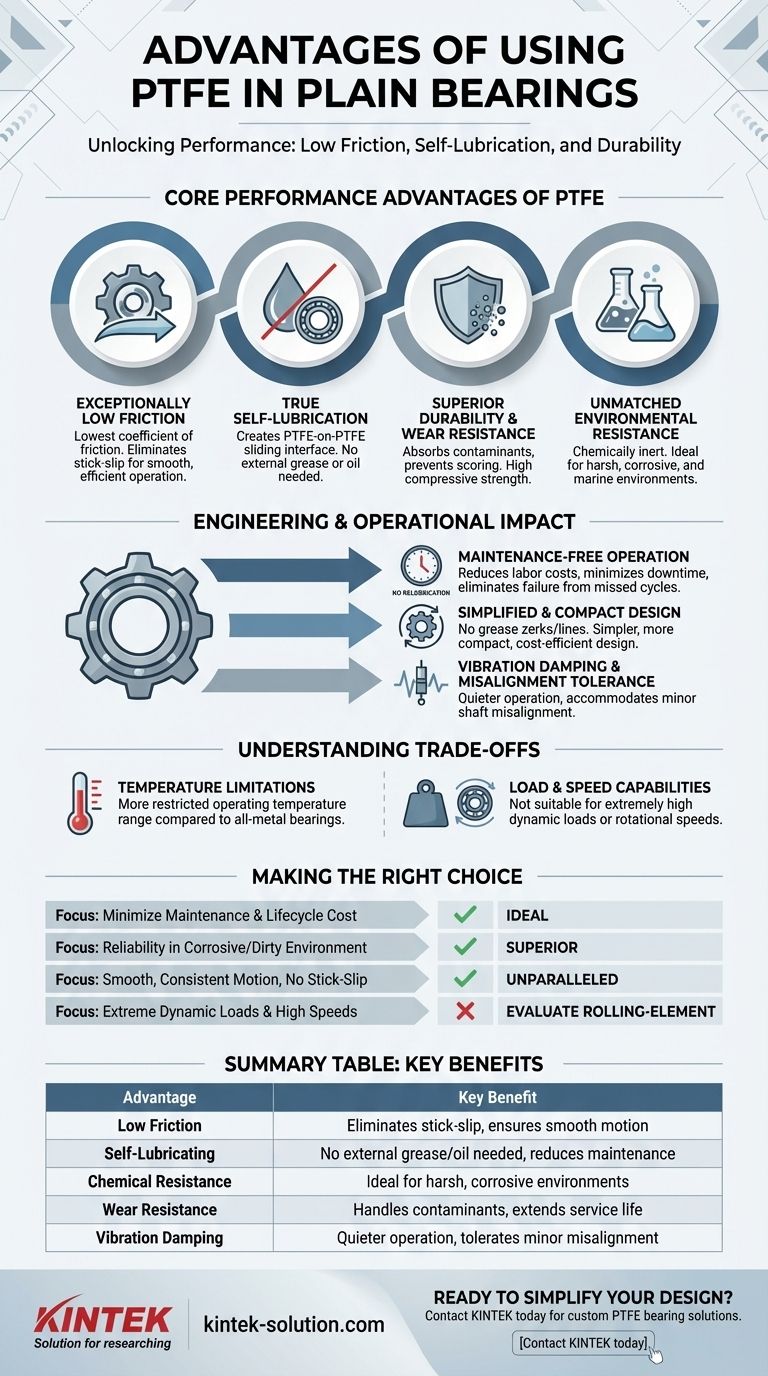
Exceptionally Low Friction
PTFE boasts the lowest coefficient of friction of any known solid material. This intrinsic property ensures smooth, efficient operation from the first moment of movement.
Crucially, this low friction helps to eliminate "stick-slip", a phenomenon of jerking motion at low speeds that can plague traditionally lubricated systems. The friction coefficient can even decrease as pressure increases, ensuring consistent performance under load.
True Self-Lubrication
The material's molecular structure allows it to transfer a thin film to the mating metal surface, creating a highly effective PTFE-on-PTFE sliding interface.
This self-lubricating nature completely removes the need for external grease or oil. As a result, the bearing does not attract dirt, dust, or other contaminants that can accelerate wear in lubricated joints.
Superior Durability and Wear Resistance
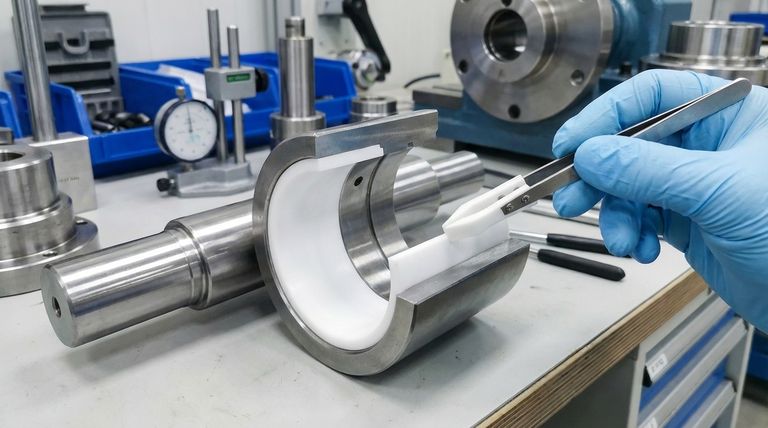
When integrated into a bearing structure, such as a liner woven into a metallic backing, PTFE exhibits excellent durability. It can absorb small contaminant particles, embedding them into its surface and preventing them from scoring or damaging the mating shaft.
PTFE also possesses high compressive strength, allowing it to handle significant static loads without deforming. This makes it a robust choice for many structural and industrial applications.
Unmatched Environmental Resistance
PTFE is chemically inert, meaning it is virtually unaffected by solvents, acids, and other corrosive substances. This makes PTFE-lined bearings ideal for use in chemical processing, marine, and other harsh environments where traditional bearings would quickly degrade.
Furthermore, it acts as an electrical and thermal insulator, which can be a critical design advantage in specific applications.
The Engineering and Operational Impact
These material properties translate directly into significant practical benefits for designers, operators, and maintenance teams.
Maintenance-Free Operation
The most significant operational advantage is the elimination of maintenance. There is no need for a relubrication schedule, which reduces labor costs, minimizes downtime, and removes the risk of bearing failure due to missed lubrication cycles.
Simplified and Compact Design
Without the need for grease zerks, oil lines, or sealing systems, the overall mechanical design can be simpler, more compact, and more cost-efficient. This simplicity also allows for tighter fits and reduced internal clearances, leading to more precise movement.
Vibration Damping and Misalignment Tolerance
The slightly compliant nature of a PTFE liner helps to dampen vibrations within a mechanical system, leading to quieter operation. It can also accommodate minor shaft misalignment without a catastrophic loss in performance, adding a layer of resilience to the design.
Understanding the Trade-offs
While highly advantageous, PTFE bearings are not a universal solution. Understanding their limitations is key to successful application.
Temperature Limitations
Compared to all-metal bearings, PTFE has a more restricted operating temperature range. Extremely high temperatures generated by high-speed or high-load conditions can cause the material to degrade.
Load and Speed Capabilities
While static load capacity is excellent, PTFE plain bearings may not be suitable for applications with extremely high dynamic loads or rotational speeds. In such cases, the heat generated can exceed the material's limits, making a rolling-element bearing a more appropriate choice.
Material Selection is Critical
The performance of a "PTFE bearing" is highly dependent on its construction. A high-quality, reinforced PTFE liner bonded to a steel backing will have vastly different capabilities than a simple, molded PTFE component. Specifying the correct construction for the load and environment is essential.
Making the Right Choice for Your Application
Selecting the right bearing technology depends entirely on your primary design goals.
- If your primary focus is minimizing maintenance and lifecycle cost: A PTFE plain bearing is the ideal choice due to its self-lubricating, "fit and forget" nature.
- If your primary focus is reliability in a corrosive or dirty environment: PTFE's chemical inertness and ability to function without attracting contaminants make it the superior option.
- If your primary focus is smooth, consistent motion without stick-slip: PTFE's uniquely low coefficient of friction provides unparalleled performance, especially in oscillating or slow-moving applications.
- If your primary focus is managing extreme dynamic loads or very high speeds: You should evaluate whether a rolling-element (ball or roller) bearing is better suited to handle the resulting heat and stress.
By leveraging the unique properties of PTFE, you are choosing a solution engineered for simplicity, longevity, and predictable performance.
Summary Table:
| Advantage | Key Benefit |
|---|---|
| Low Friction | Eliminates stick-slip, ensures smooth motion |
| Self-Lubricating | No external grease/oil needed, reduces maintenance |
| Chemical Resistance | Ideal for harsh, corrosive environments |
| Wear Resistance | Handles contaminants, extends service life |
| Vibration Damping | Quieter operation, tolerates minor misalignment |
Ready to simplify your design and eliminate bearing maintenance?
KINTEK specializes in precision PTFE components, including custom plain bearing liners and seals for the semiconductor, medical, laboratory, and industrial sectors. Our expertise in custom fabrication—from prototypes to high-volume orders—ensures you get a bearing solution engineered for your specific load, environment, and performance requirements.
Contact KINTEK today to discuss how our PTFE components can enhance your application's reliability and reduce lifecycle costs.
Visual Guide
Related Products
- Custom PTFE Sleeves and Hollow Rods for Advanced Applications
- Custom Graphite Filled PTFE Rods for Advanced Industrial Applications
- Customizable PTFE Rods for Advanced Industrial Applications
- Customizable PTFE Heat Insulation Plate High Temperature Corrosion Resistant Laboratory Support Layered Multi Tier Stand
- Custom PTFE Insulating Gaskets and Corrosion Resistant Fluoropolymer Seals for Industrial Electrical Applications
People Also Ask
- What industries benefit most from custom PTFE parts? Solve Extreme Environment Challenges
- What advantages do custom PTFE parts offer for industrial efficiency? Boost Uptime & Cut Costs
- What design considerations are important for custom PTFE parts? Design for Performance & Reliability
- What industries use custom PTFE parts and for what purposes? Solve Critical Challenges with High-Performance Materials
- What are the main advantages of using PTFE for custom parts? Solve Complex Engineering Challenges