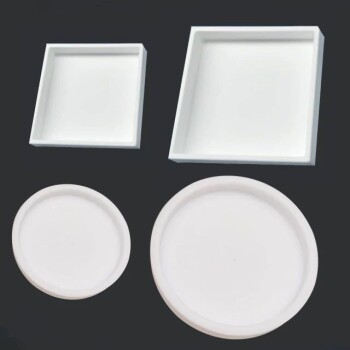
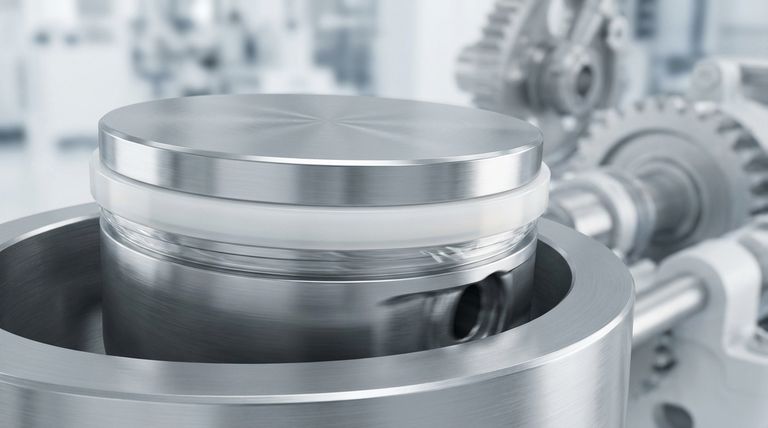
In load-bearing applications, PTFE is utilized as a self-lubricating solid. Its primary function is to create an extremely low-friction surface between moving parts, eliminating the need for traditional liquid lubricants like oil or grease. Components such as bearings, piston rings, and slide plates are made from PTFE to directly reduce wear, minimize energy loss, and ensure smooth, consistent movement under load.
The core value of PTFE in load-bearing systems is its ability to function as a dry lubricant. This eliminates the need for external oils or greases, drastically reducing maintenance while preventing component wear and ensuring smooth, efficient operation in environments where traditional lubrication would fail or cause contamination.
The Core Principle: Overcoming Friction Without Lubricants
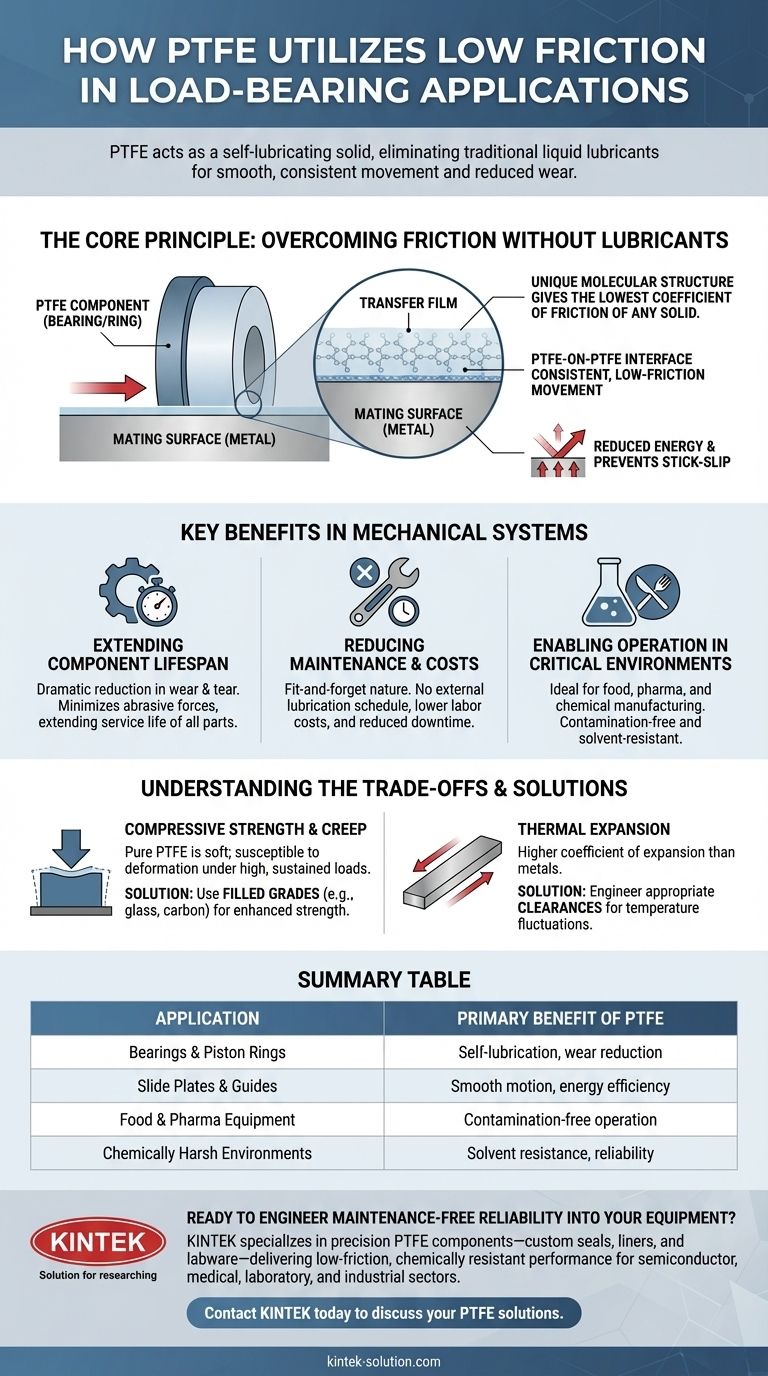
PTFE's effectiveness comes from its unique molecular structure, which gives it the lowest coefficient of friction of any known solid. This property is not a coating or an additive; it is an inherent characteristic of the material itself.
The Mechanism of Self-Lubrication
When a component made of PTFE slides against another surface, it creates a transfer film. This means a microscopic layer of PTFE is deposited on the mating surface, resulting in a smooth, PTFE-on-PTFE interface.
This mechanism is what provides the consistent, low-friction movement, as the parts are essentially gliding on a thin layer of the polymer itself.
Direct Impact on Performance
This self-lubricating action reduces the energy required to move a system, improving overall operational efficiency. It prevents the "stick-slip" phenomenon common in other materials, leading to smoother and more predictable motion, which is critical in precision machinery.
Key Benefits in Mechanical Systems
Deploying PTFE in load-bearing roles is a strategic choice to solve specific engineering challenges, moving beyond simple friction reduction to deliver tangible operational advantages.
Extending Component Lifespan
The most direct benefit of low friction is a dramatic reduction in wear and tear. By minimizing the abrasive forces between moving parts, PTFE extends the service life of both the PTFE component and the surface it slides against.
This is especially valuable for gears, guides, and other parts where constant sliding action would otherwise lead to rapid degradation.
Reducing Maintenance and Costs
PTFE components require no external lubrication schedule. This "fit-and-forget" nature eliminates the labor and material costs associated with regular greasing or oiling, while also reducing equipment downtime for maintenance.
Enabling Operation in Critical Environments
Many industries cannot use traditional lubricants due to the risk of contamination or chemical incompatibility. PTFE is an ideal solution in these scenarios.
It is widely used in food processing, pharmaceutical, and textile manufacturing, where product purity is paramount. It also excels in applications where solvents would dissolve and wash away conventional lubricants.
Understanding the Trade-offs
While its low-friction properties are unparalleled, PTFE is not a universal solution. An objective assessment requires acknowledging its mechanical limitations.
Compressive Strength and Creep
Compared to metals, pure PTFE is a relatively soft material. Under high, sustained loads, it can be susceptible to creep, which is the tendency to slowly deform over time.
For applications with very high contact pressures, filled grades of PTFE (mixed with glass, carbon, or other agents) are often used to enhance strength and rigidity.
Thermal Expansion
PTFE has a higher coefficient of thermal expansion than most metals. This means it expands and contracts more significantly with temperature changes.
Designers must account for this by engineering appropriate clearances to prevent binding or failure in systems that experience wide temperature fluctuations.
When to Specify PTFE for Your Application
Choosing PTFE is about matching its unique strengths to your primary operational goal.
- If your primary focus is reducing maintenance and extending service life: PTFE is ideal for creating components that require no external lubrication schedule, directly engineering reliability into the system.
- If you are designing for a clean or chemically harsh environment: Use PTFE where traditional oils or greases would contaminate products (e.g., food, pharma) or be dissolved by solvents.
- If your goal is to maximize energy efficiency and smooth operation: PTFE minimizes frictional losses in sliding systems, ensuring more input energy is converted into useful work with predictable, consistent movement.
Ultimately, incorporating PTFE is a strategic decision to replace ongoing maintenance with inherent material performance.
Summary Table:
| Application | Primary Benefit of PTFE |
|---|---|
| Bearings & Piston Rings | Self-lubrication, wear reduction |
| Slide Plates & Guides | Smooth motion, energy efficiency |
| Food & Pharma Equipment | Contamination-free operation |
| Chemically Harsh Environments | Solvent resistance, reliability |
Ready to engineer maintenance-free reliability into your equipment?
KINTEK specializes in precision PTFE components—from custom seals and liners to complex labware—that deliver the low-friction, chemically resistant performance detailed in this article. Whether you need prototypes or high-volume production for the semiconductor, medical, laboratory, or industrial sectors, our expertise ensures your components meet exacting standards for durability and efficiency.
Contact KINTEK today to discuss how our PTFE solutions can solve your specific load-bearing challenges.
Visual Guide
Related Products
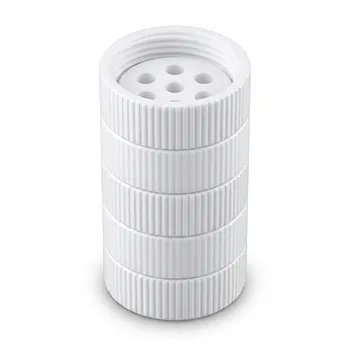
- Custom PTFE Filtration System Acid Resistant High Purity Semiconductor Grade Chemical Processing Filter
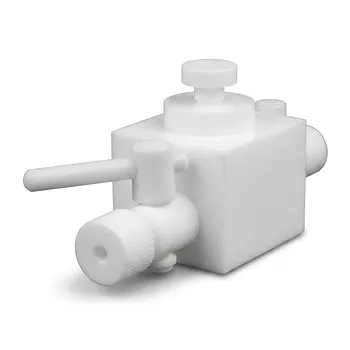
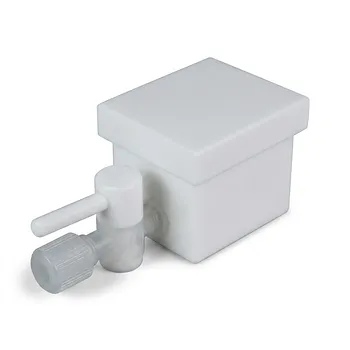
- High Corrosion Resistant PTFE Faucet Polytetrafluoroethylene Valve for Chemical Storage Drums and Fluid Transfer Systems Customizable Industrial Grade
- PTFE PFA Vacuum Filtration System Corrosion Resistant Customizable Shatterproof Laboratory Device
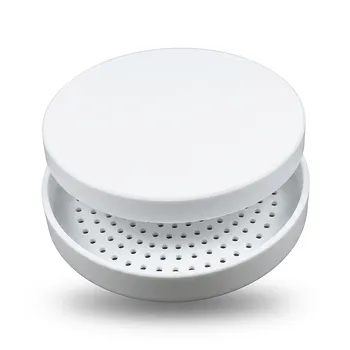
- PTFE Corrosion Resistant Filter with PFA Valve Connections and Integrated Sieve Plate
- High Temperature Chemical Resistant 50ml PTFE Syringe Customized Teflon Injector with Threaded Seal for Trace Analysis
People Also Ask
- What makes PTFE filtration systems advantageous for industrial and scientific use? Unmatched Chemical & Thermal Stability
- What sizes and pore options are available for PTFE filters? Choose the Right Filter for Your Application
- What steps are involved in selecting the proper PTFE filter? A 4-Step Guide to Optimal Filtration
- What temperature resistance do PTFE filters offer? Unmatched Thermal Stability from -200°C to +260°C
- How does the hydrophobicity of PTFE filters benefit their use? Ensure Uninterrupted Gas Flow and Solvent Filtration