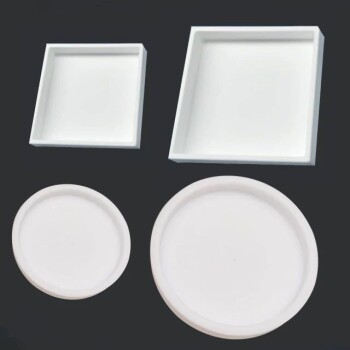
Polytetrafluoroethylene (PTFE) is a high-performance synthetic fluoropolymer composed entirely of carbon and fluorine. It is best known for its extreme chemical resistance, stability across a wide range of temperatures, and one of the lowest coefficients of friction of any solid material. These properties make it a uniquely versatile problem-solver in demanding industrial, medical, and commercial applications.
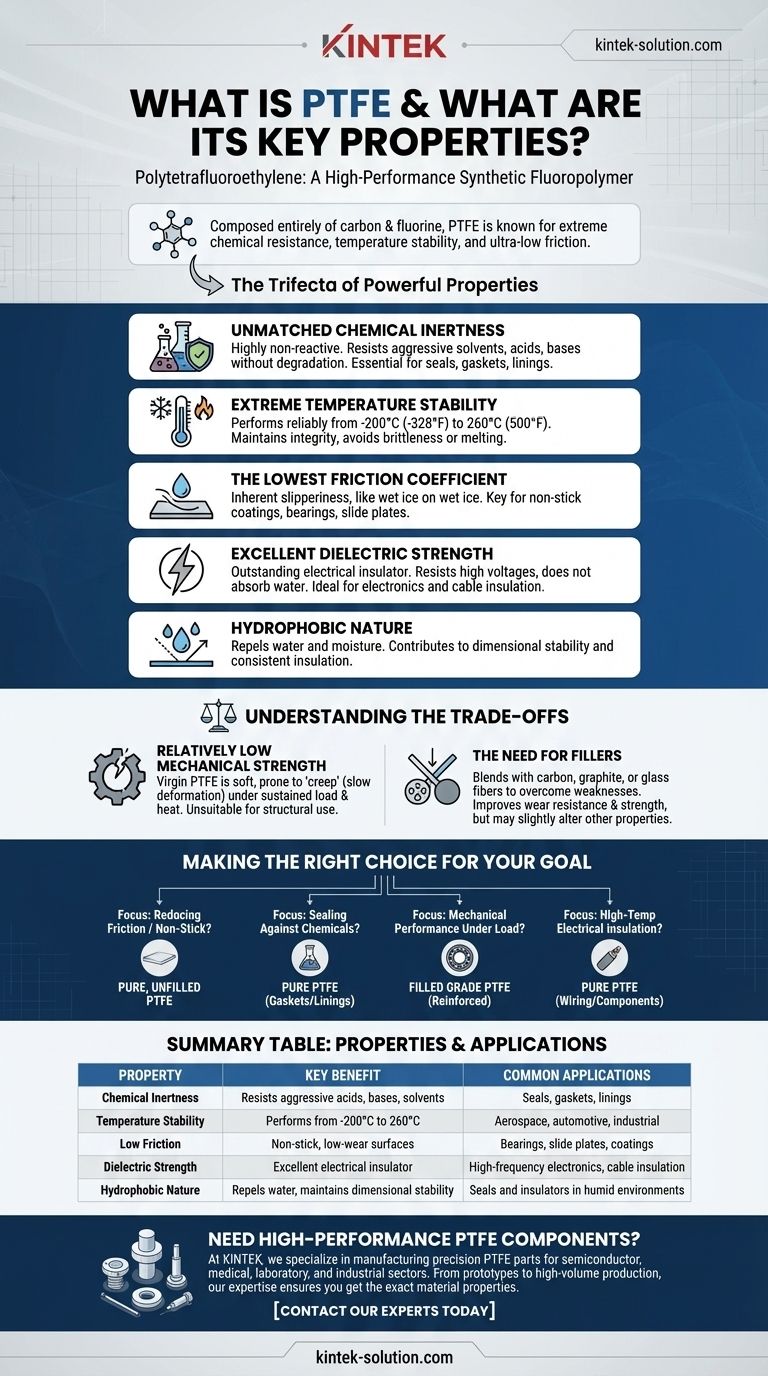
The strength of the carbon-fluorine bond gives PTFE a trifecta of powerful properties: it is nearly impervious to chemical attack, remains stable in extreme temperatures, and is exceptionally slippery. Understanding these core traits is the key to leveraging it effectively.
The Core Properties of PTFE Explained
To understand why PTFE is so widely used, we must look at the specific characteristics that arise from its molecular structure. Each property solves a distinct set of engineering challenges.
Unmatched Chemical Inertness
The carbon-fluorine bonds in PTFE are exceptionally strong and stable. This molecular structure makes the material highly non-reactive.
It can withstand exposure to the most aggressive solvents, acids, and bases without degrading. This makes it an essential material for seals, gaskets, and linings in the chemical and petrochemical industries.
Extreme Temperature Stability
PTFE performs reliably across an exceptionally broad thermal range, from cryogenic conditions at -200°C (-328°F) up to continuous service at 260°C (500°F).
Unlike many polymers that become brittle in the cold or melt in the heat, PTFE maintains its integrity, making it suitable for applications in aerospace, automotive, and industrial processing.
The Lowest Friction Coefficient
PTFE has one of the lowest coefficients of friction of any known solid, often compared to wet ice on wet ice. This inherent slipperiness is the source of its famous non-stick or anti-adhesion properties.
This is critical not only for cookware but also for industrial applications like low-friction bearings, slide plates, and coatings for equipment where minimizing resistance is essential.
Excellent Dielectric Strength
PTFE is an outstanding electrical insulator. It resists high voltages and does not absorb water, ensuring its insulating properties remain stable even in humid environments.
This makes it a preferred material for high-frequency electronics, cable insulation, and components in sensitive electrical equipment.
Hydrophobic Nature
PTFE is hydrophobic, meaning it repels water and water-containing substances. It does not absorb moisture, which contributes to its dimensional stability and consistent performance as an insulator and sealant.
Understanding the Trade-offs
While its properties are exceptional, PTFE is not the solution for every problem. An objective assessment requires understanding its limitations.
Relatively Low Mechanical Strength
In its pure, or "virgin," state, PTFE is a relatively soft material. Under a sustained mechanical load, especially at elevated temperatures, it can be prone to "creep," or slow deformation.
This makes pure PTFE unsuitable for high-load structural applications without reinforcement.
The Need for Fillers
To overcome its mechanical weaknesses, PTFE is often blended with fillers like carbon, graphite, or glass fibers.
These fillers dramatically improve wear resistance, reduce creep, and increase compressive strength. However, adding them can slightly alter other properties, such as the friction coefficient or chemical resistance, requiring a careful balance for each application.
Making the Right Choice for Your Goal
Selecting the correct material grade depends entirely on the primary engineering challenge you need to solve.
- If your primary focus is reducing friction or creating a non-stick surface: Pure, unfilled PTFE is the ideal choice due to its exceptionally low friction coefficient.
- If your primary focus is sealing against aggressive chemicals: PTFE's chemical inertness makes it a default material for gaskets and linings in corrosive environments.
- If your primary focus is mechanical performance under load: A filled grade of PTFE is necessary, as additives like carbon or glass significantly improve its resistance to creep and wear.
- If your primary focus is high-temperature electrical insulation: The combination of PTFE's thermal stability and high dielectric strength makes it a superior choice for wiring and components.
By understanding both its powerful advantages and its specific limitations, you can leverage PTFE to solve some of the most demanding engineering problems.
Summary Table:
| Property | Key Benefit | Common Applications |
|---|---|---|
| Chemical Inertness | Resists aggressive acids, bases, and solvents | Seals, gaskets, linings in chemical processing |
| Temperature Stability | Performs from -200°C to 260°C | Aerospace, automotive, and industrial components |
| Low Friction | Non-stick, low-wear surfaces | Bearings, slide plates, coatings |
| Dielectric Strength | Excellent electrical insulator | High-frequency electronics, cable insulation |
| Hydrophobic Nature | Repels water, maintains dimensional stability | Seals and insulators in humid environments |
Need high-performance PTFE components tailored to your specific requirements?
At KINTEK, we specialize in manufacturing precision PTFE parts—including seals, liners, and custom labware—for the semiconductor, medical, laboratory, and industrial sectors. Whether you need a prototype or a high-volume production run, our expertise in custom fabrication ensures you get the exact material properties and performance your application demands.
Contact our experts today to discuss how our PTFE solutions can solve your most challenging engineering problems.
Visual Guide
Related Products
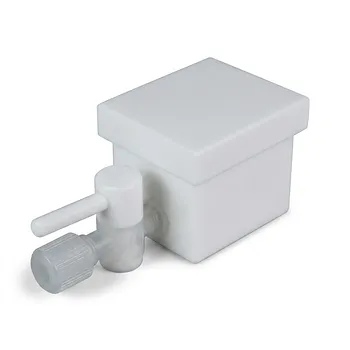
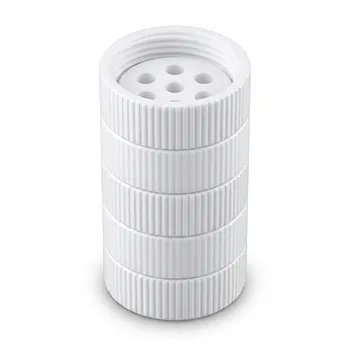
- Custom PTFE Filtration System Acid Resistant High Purity Semiconductor Grade Chemical Processing Filter
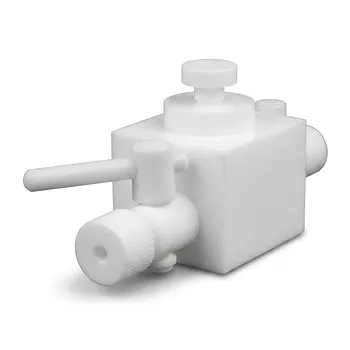
- High Corrosion Resistant PTFE Faucet Polytetrafluoroethylene Valve for Chemical Storage Drums and Fluid Transfer Systems Customizable Industrial Grade
- PTFE PFA Vacuum Filtration System Corrosion Resistant Customizable Shatterproof Laboratory Device
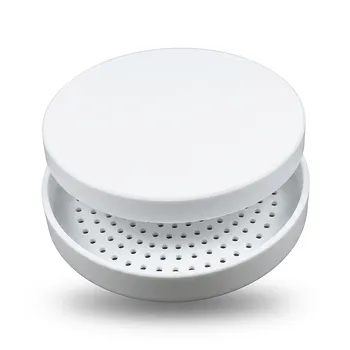
- PTFE Corrosion Resistant Filter with PFA Valve Connections and Integrated Sieve Plate
- High Temperature Chemical Resistant 50ml PTFE Syringe Customized Teflon Injector with Threaded Seal for Trace Analysis
People Also Ask
- What makes PTFE filtration systems advantageous for industrial and scientific use? Unmatched Chemical & Thermal Stability
- What steps are involved in selecting the proper PTFE filter? A 4-Step Guide to Optimal Filtration
- What sizes and pore options are available for PTFE filters? Choose the Right Filter for Your Application
- How does the hydrophobicity of PTFE filters benefit their use? Ensure Uninterrupted Gas Flow and Solvent Filtration
- What temperature resistance do PTFE filters offer? Unmatched Thermal Stability from -200°C to +260°C