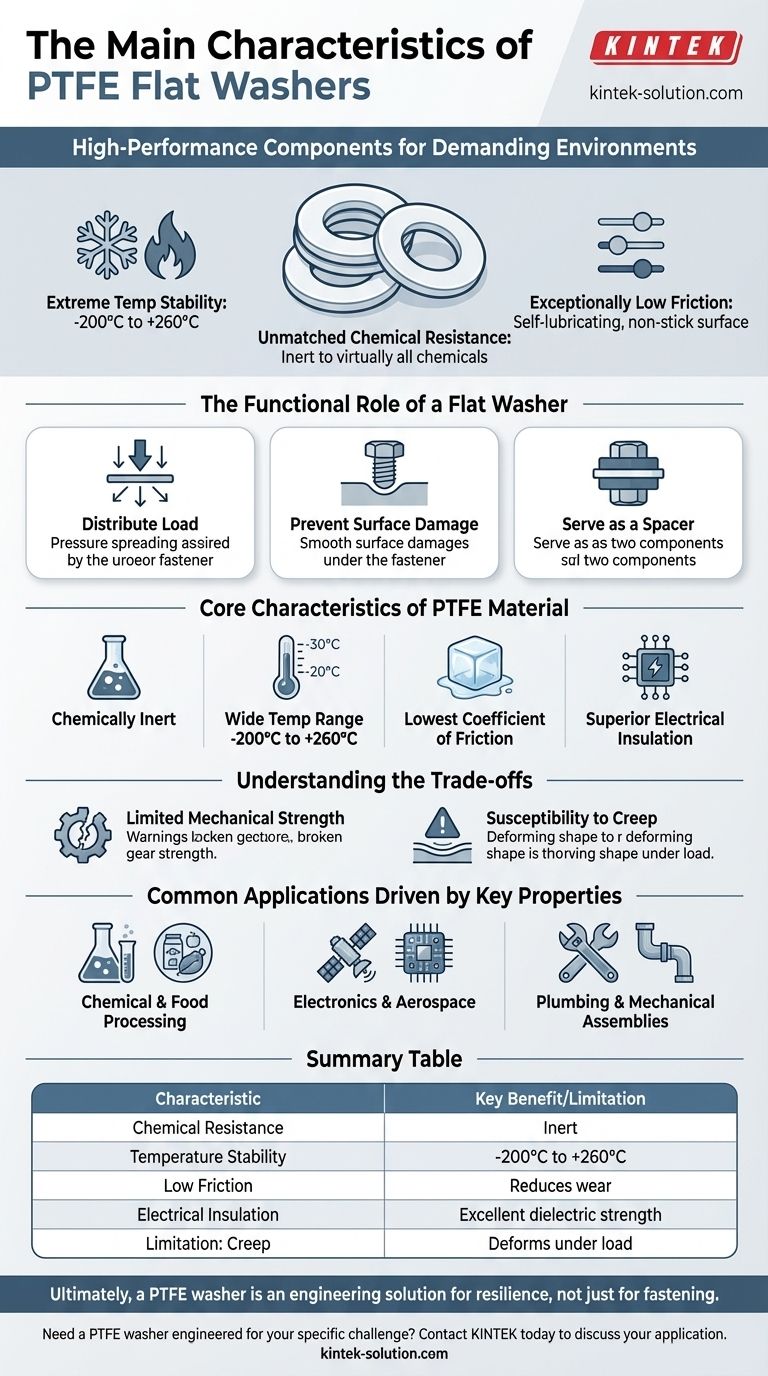
At their core, PTFE flat washers are high-performance components defined by three primary characteristics: an extremely low coefficient of friction, exceptional resistance to virtually all chemicals, and the ability to operate across a vast range of temperatures. These properties make them the definitive choice for sealing, spacing, and insulation in demanding industrial environments where conventional materials would fail.
Choosing a PTFE flat washer is not a decision about mechanical strength, but about environmental resilience. Its value lies in its chemical inertness, temperature stability, and electrical insulation, making it a problem-solver for applications involving corrosive substances, extreme temperatures, or electrical isolation.
The Functional Role of a Flat Washer
Before examining the material itself, it's crucial to understand the fundamental purpose of any flat washer.
Distributing Load
A washer's primary job is to distribute the pressure of a nut or bolt head over a wider surface area. This prevents the fastener from damaging the material it's being secured to.
Preventing Surface Damage
By creating a smooth, stable surface for the fastener to turn against, a washer protects delicate or finished surfaces from being marred during tightening.
Serving as a Spacer
In many assemblies, washers are used to create a specific gap or to align components correctly, acting as a simple and precise spacer.
Core Characteristics of PTFE Material
The unique properties of Polytetrafluoroethylene (PTFE) are what distinguish these washers from standard metal or plastic alternatives.
Unmatched Chemical Resistance
PTFE is chemically inert to nearly all industrial chemicals, acids, and bases. This makes it an essential component in chemical processing, pharmaceutical, and food-grade applications where corrosion or contamination is unacceptable.
Extreme Temperature Stability
These washers perform reliably across an exceptionally wide temperature range, typically from -200°C to +260°C (-328°F to +500°F). This allows them to be used in everything from cryogenic systems to high-temperature industrial equipment.
Exceptionally Low Friction
PTFE has one of the lowest coefficients of friction of any solid material, often compared to wet ice on wet ice. This self-lubricating, non-stick surface is ideal for dynamic assemblies where it can reduce wear and prevent seizing.
Superior Electrical Insulation
As an excellent electrical insulator with high dielectric strength, PTFE is widely used in electronics. It effectively isolates components, preventing short circuits, especially in high-temperature or high-frequency applications.
Understanding the Trade-offs
While its properties are exceptional, PTFE is not the solution for every problem. Understanding its limitations is critical for proper application.
Limited Mechanical Strength
PTFE is a relatively soft material. It does not possess the high tensile or compressive strength of metals. For high-load structural applications, a metallic washer is often required.
Susceptibility to Creep Under Load
The most significant drawback of PTFE is its tendency to "creep," or cold flow. When placed under a constant compressive load, the material will slowly deform over time, which can lead to a loss of bolt tension and joint integrity.
Common Applications Driven by Key Properties
The choice to use a PTFE washer is almost always driven by a specific environmental challenge.
In Chemical and Food Processing
Here, its chemical inertness and non-contaminating nature are paramount. The washers will not degrade when exposed to aggressive cleaning agents or process chemicals, ensuring purity.
In Electronics and Aerospace
The combination of high-temperature resistance and electrical insulation makes PTFE ideal for mounting components on circuit boards or isolating fasteners in sensitive aerospace assemblies.
In Plumbing and Mechanical Assemblies
In applications with delicate surfaces or the need for a low-friction seal, PTFE washers prevent galling and provide a reliable, corrosion-proof seal.
Making the Right Choice for Your Application
To determine if a PTFE washer is the correct component, evaluate your primary engineering goal.
- If your primary focus is preventing corrosion or contamination: PTFE's chemical inertness is its most valuable asset, making it ideal for food, medical, and chemical processing.
- If your primary focus is electrical isolation: PTFE's high dielectric strength provides a reliable insulating barrier in electronics and high-voltage equipment.
- If your primary focus is reducing friction in a dynamic assembly: The self-lubricating, non-stick surface of PTFE reduces wear and ensures smooth movement without external lubricants.
- If your primary focus is high structural load and clamp force retention: You should evaluate a harder material, as PTFE's tendency to creep can compromise the joint's integrity over time.
Ultimately, a PTFE washer is an engineering solution for resilience, not just for fastening.
Summary Table:
| Characteristic | Key Benefit |
|---|---|
| Chemical Resistance | Inert to virtually all chemicals, acids, and bases |
| Temperature Stability | Performs from -200°C to +260°C (-328°F to +500°F) |
| Low Friction | Self-lubricating, non-stick surface reduces wear |
| Electrical Insulation | Excellent dielectric strength for isolating components |
| Limitation: Creep | Can deform under constant load, affecting clamp force |
Need a PTFE washer engineered for your specific challenge?
KINTEK specializes in manufacturing high-performance PTFE components, including seals, liners, and labware, for the semiconductor, medical, laboratory, and industrial sectors. Our precision production and custom fabrication services—from prototypes to high-volume orders—ensure you get a component that delivers unmatched chemical resistance, temperature stability, and reliability.
Contact KINTEK today to discuss your application and get a custom solution.
Visual Guide
Related Products
- Custom PTFE Gas Washing Bottle Corrosion Resistant Low Background Fluoropolymer Gas Absorption Vessel
- PTFE Circular Wafer Carrier 6 Inch Acid Alkali Resistant Semiconductor Cleaning Basket Customizable
- Custom PTFE Wafer Cleaning Baskets Semiconductor Silicon Wafer Holders Low Background Fluoropolymer Cassettes
- Custom PTFE Laboratory Cleaning Basket Carrier High Purity Acid Base Resistant Wafer Holder Low Background Contamination Free Chemical Bath Rack
- Square PTFE Wafer Cleaning Basket Fluoropolymer Semiconductor Etching Rack Custom Silicon Wafer Carrier
People Also Ask
- How can the susceptibility to creep and cold flow in PTFE washers be addressed? Improve Stability with Filled PTFE or Metal Backing
- How do PTFE washers compare to rubber washers in electrical insulation? The Definitive Guide for Safety & Performance
- What factors should be considered when choosing between PTFE and rubber washers? Optimize Sealing for Extreme or Everyday Use
- What are the key properties of PTFE Teflon washers? Unlock Superior Chemical & Temperature Resistance
- What makes PTFE washers suitable for the food industry? Ensure Safety, Hygiene & Durability