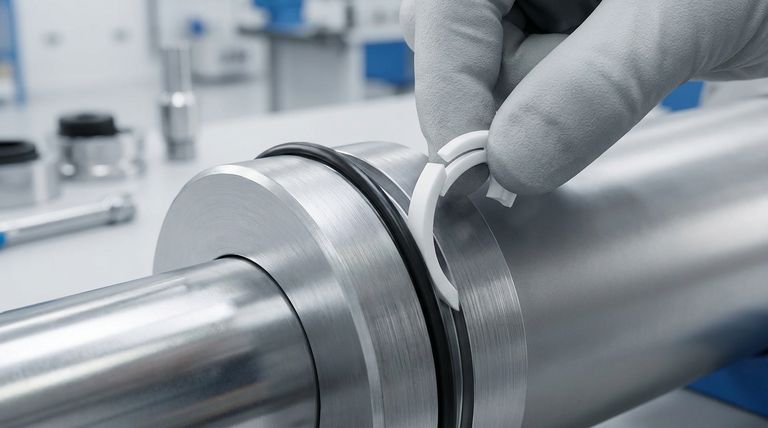
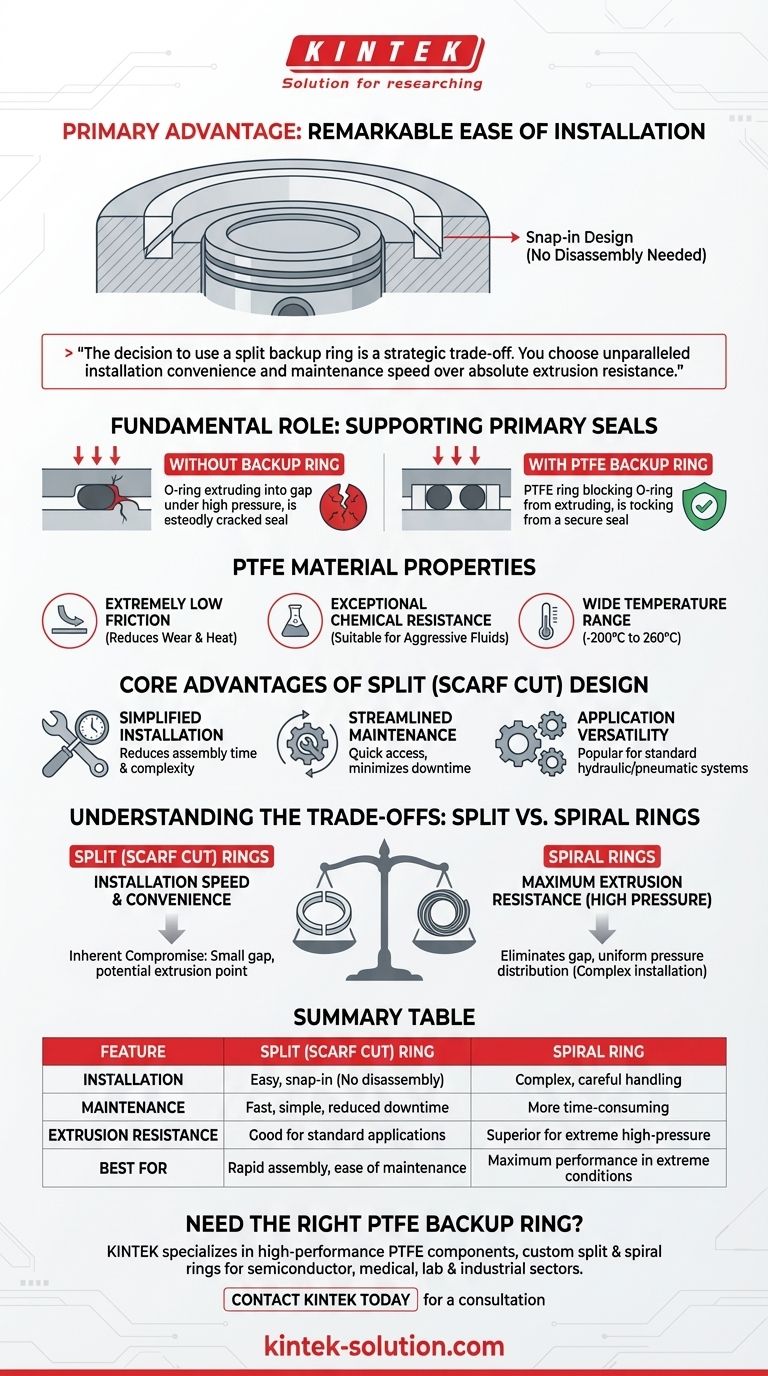
The primary advantage of a split PTFE backup ring is its remarkable ease of installation. The "scarf cut" design allows the ring to be expanded and snapped into a groove without needing to disassemble the surrounding components, significantly simplifying both initial assembly and subsequent maintenance.
The decision to use a split (scarf cut) backup ring is a strategic trade-off. You are choosing unparalleled installation convenience and maintenance speed over the absolute extrusion resistance offered by continuous or spiral rings in the most extreme high-pressure applications.
The Fundamental Role of a PTFE Backup Ring
Before analyzing the split design, it's crucial to understand why backup rings are necessary in the first place. They are support components, not primary seals.
Preventing O-Ring Extrusion
The main purpose of a backup ring is to support a primary seal, typically a rubber O-ring, in high-pressure situations.
Under high pressure, an O-ring can be forced into the small clearance gap between moving parts, a process called extrusion. This damages the O-ring and leads to seal failure.
A harder backup ring, made from a material like PTFE, sits in the groove next to the O-ring and physically blocks this extrusion path, extending the life and pressure rating of the seal.
Leveraging PTFE's Material Properties
PTFE is an ideal material for this function due to its unique combination of properties.
It has an extremely low coefficient of friction, which is critical in dynamic systems like hydraulic cylinders to reduce wear and heat.
Furthermore, PTFE offers exceptional chemical and temperature resistance, making it suitable for aggressive fluids and operating environments ranging from -200°C to 260°C.
The Core Advantages of the Split (Scarf Cut) Design
The specific geometry of the split ring is what provides its key operational benefits. The single diagonal cut allows for flexibility during installation.
Simplified Installation
This is the most significant advantage. A split ring can be easily stretched or compressed to fit over a piston or into a cylinder bore without full system disassembly.
This dramatically reduces assembly time and complexity, a major factor in manufacturing and field repairs.
Streamlined Maintenance and Inspection
The same ease of installation translates directly to maintenance. A worn or damaged seal and backup ring can be accessed and replaced quickly.
This minimizes equipment downtime and lowers the labor costs associated with routine service or unexpected repairs.
Application Versatility
Due to their installation convenience, split rings are a highly versatile and popular choice for a wide range of standard hydraulic and pneumatic systems where extreme pressures are not the primary concern.
Understanding the Trade-offs: Split vs. Spiral Rings
While convenient, the split design is not the optimal choice for every scenario. The cut itself introduces a potential weakness compared to a continuous ring.
The Inherent Compromise
The "split" in a scarf-cut ring creates a small, unavoidable gap. While the diagonal cut minimizes this path, it is still a potential point for extrusion under very high pressures.
For most standard applications, this is not an issue. However, in systems pushing the upper limits of pressure, it becomes a critical design consideration.
When Spiral Rings Excel
Spiral PTFE backup rings are made from a continuous coil. This design eliminates the gap found in split rings.
This provides more uniform pressure distribution and superior resistance to extrusion in the most demanding, high-pressure, and dynamic environments.
The Installation Factor
The superior performance of a spiral ring comes at the cost of installation complexity. They are less forgiving to install and often require more careful handling to avoid damaging the continuous coil.
This makes them less ideal for applications where quick and frequent maintenance is a priority.
Making the Right Choice for Your System
Selecting the correct backup ring requires you to prioritize your system's primary operational need.
- If your primary focus is rapid assembly and ease of maintenance: The split (scarf cut) ring is the clear choice for its simple, tool-free installation.
- If your primary focus is maximum performance in extreme high-pressure or dynamic conditions: A spiral backup ring offers superior extrusion resistance.
- If your primary focus is chemical or temperature resistance: Both split and spiral PTFE rings provide the same excellent material benefits.
Ultimately, choosing the right component is about matching its specific design advantages to the precise demands of your application.
Summary Table:
| Feature | Split (Scarf Cut) Ring | Spiral Ring |
|---|---|---|
| Installation | Easy, snap-in, no disassembly | More complex, requires careful handling |
| Maintenance | Fast and simple, reduces downtime | More time-consuming |
| Extrusion Resistance | Good for standard applications | Superior for extreme high-pressure |
| Best For | Rapid assembly, ease of maintenance | Maximum performance in extreme conditions |
Need the Right PTFE Backup Ring for Your Application?
KINTEK specializes in manufacturing high-performance PTFE components, including custom split and spiral backup rings, seals, liners, and labware. We serve the semiconductor, medical, laboratory, and industrial sectors with precision production from prototypes to high-volume orders.
Our expertise ensures you get the optimal component for your specific pressure, temperature, and chemical resistance requirements, enhancing your system's reliability and efficiency.
Contact KINTEK today for a consultation and let us provide a solution tailored to your needs!
Visual Guide
Related Products
- High Purity PTFE PM2.5 Filter Sample Splitter for Environmental Monitoring Customizable Square Filter Divider for CDC Analysis
- Custom PTFE Constant Pressure Separatory Funnel Corrosion Resistant Low Background Labware for PFA Flasks
- High Purity Virgin PTFE Syringe 20ml Chemical Resistant Liquid Handling for Syringe Pumps and PFA Tubing Integration
- Corrosion Resistant PTFE Separatory Funnel Rack High Temperature Laboratory Round Support Customizable Hole Count Diameter
- Custom PTFE Sleeves and Hollow Rods for Advanced Applications
People Also Ask
- What steps are involved in selecting the proper PTFE filter? A 4-Step Guide to Optimal Filtration
- What sizes and pore options are available for PTFE filters? Choose the Right Filter for Your Application
- Which chemicals are fully compatible with PTFE filters? Discover Unmatched Chemical Resistance
- What temperature resistance do PTFE filters offer? Unmatched Thermal Stability from -200°C to +260°C
- How does the hydrophobicity of PTFE filters benefit their use? Ensure Uninterrupted Gas Flow and Solvent Filtration