The Frustration of the "Perfect" Setup
You’ve designed the perfect experiment. You have a high-precision Teflon (PTFE) microchannel reactor for its legendary chemical resistance, and you’ve connected it to a high-end syringe pump. But when you start the run, something is wrong. The flow pulses. A tiny leak appears at a fitting. Or worse, the reaction results vary wildly from Tuesday to Wednesday, even though the settings are identical.
If your microfluidic data looks like a roller coaster rather than a steady line, you aren't alone. Many researchers spend weeks troubleshooting their pumps, assuming the hardware is failing, only to find that the problem persists across different brands and models.
The Common Struggle: Blaming the Engine
When fluid delivery becomes inconsistent, the natural instinct is to "upgrade the engine." We see labs switching from peristaltic pumps to expensive HPLC systems or buying ultra-fine syringes in an attempt to stabilize the flow.
When that fails, the next step is often "the big squeeze"—tightening fittings and connectors to the point of mechanical stress, hoping to stop the microscopic leaks that plague micro-scale chemistry. These struggles don't just waste time; they lead to project delays, wasted expensive reagents, and a lack of confidence in the scalability of the research.
But what if the problem isn't the pump? What if the struggle is actually a fundamental mismatch between the delivery system and the material of the reactor itself?
The Root Cause: The Physics of "Low Surface Charge"
To solve the mystery of inconsistent flow, we have to look at the interface where the liquid meets the wall.
In traditional glass or silicon microchannels, researchers often use "electro-osmotic flow," where an electric field moves the liquid. However, PTFE and PFA have an incredibly low surface charge. This means they are effectively "invisible" to the electrical forces that move fluids in other materials.
Because of this, fluid movement in a Teflon reactor is almost entirely pressure-driven.
This is the turning point: in a pressure-driven system, the reactor isn't just a container; it is a critical component of the mechanical circuit. Because PTFE is softer and more "slippery" than glass, any tiny imperfection in the CNC machining, any slight mismatch in the fitting threads, or any variation in the tubing’s internal diameter creates a localized pressure drop.
Your pump might be pushing at exactly 10 microliters per minute, but if the internal geometry of your PTFE components isn't perfectly precise, that pressure will dissipate or fluctuate, leading to the "unstable flow" that ruins your data.
The Solution: Engineering for Pressure-Driven Precision
To achieve stable flow, you don't just need a better pump; you need a fluidic path designed specifically for the physics of pressure-driven flow in fluoropolymers. This is where the transition from "standard labware" to "precision-engineered components" becomes vital.
A truly effective solution requires:
- Zero-Dead-Volume Connections: Since you are relying on mechanical pressure, any "dead space" in a fitting acts like a tiny shock absorber, soaking up pressure and causing flow lag.
- High-Tolerance CNC Fabrication: The microchannels themselves must be machined with absolute consistency. Variations in channel depth or width create turbulence that disrupts the laminar flow required for microchemistry.
- Material Purity: Using high-purity PFA for trace analysis labware ensures that no surface contaminants interfere with the fluid dynamics or the chemical integrity of the reaction.
At KINTEK, we don't just manufacture PTFE and PFA products; we engineer the interfaces where your science happens. Our high-precision custom CNC fabrication is designed to meet the rigorous demands of the semiconductor and new energy sectors, ensuring that every valve, fitting, and microchannel liner supports a perfectly stable pressure environment.
Beyond the Fix: Unlocking Scale and Speed
When you stop fighting your fluid delivery system and start working with the material properties of PTFE, the "impossible" becomes routine.
By stabilizing the pressure-driven flow, you unlock the ability to move from microliter-scale prototypes to milliliter-scale industrial production without losing control of your reaction kinetics. You can run longer, automated tests with the confidence that a "set-and-forget" flow rate will actually remain constant overnight. This precision accelerates the transition from the R&D lab to the production line, turning weeks of troubleshooting into hours of productive discovery.
Achieving precision in microfluidics is about more than just a great pump—it’s about the integrity of the entire fluid path. Whether you are dealing with complex electrochemical cells or high-purity trace analysis, the right engineering makes the difference between a failed experiment and a breakthrough.
Ready to stabilize your fluidic systems? Our team of specialists understands the unique challenges of working with high-performance fluoropolymers in demanding research environments. Whether you need a custom-machined prototype or high-volume industrial components, we can help you design a fluid path that works with your science, not against it. Contact Our Experts today to discuss your project requirements.
Related Products
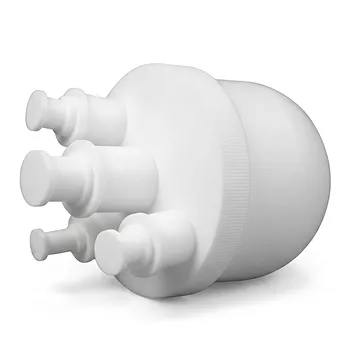
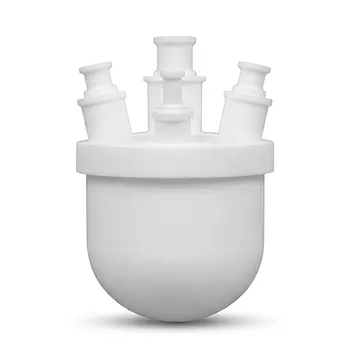
- Customizable Polytetrafluoroethylene PTFE Reactor and Corrosion Resistant Teflon Flask
- Custom PTFE Multilayer Reaction Apparatus High Temperature Corrosion Resistant Threaded Modular Sieve System
- PTFE 10L Reaction Vessel with Stirring Paddle Customizable Corrosion Resistant High Temperature Reactor for Biopharmaceutical and Chemical Processing
- High Performance Customizable PTFE Reaction Vessel and Corrosion Resistant Polytetrafluoroethylene Flask for Chemical Laboratory Use
- Custom PTFE Reaction System with Hose Barb Fittings Corrosion Resistant High Sealing 2L 4L Lab Reactor with Separatory Funnel