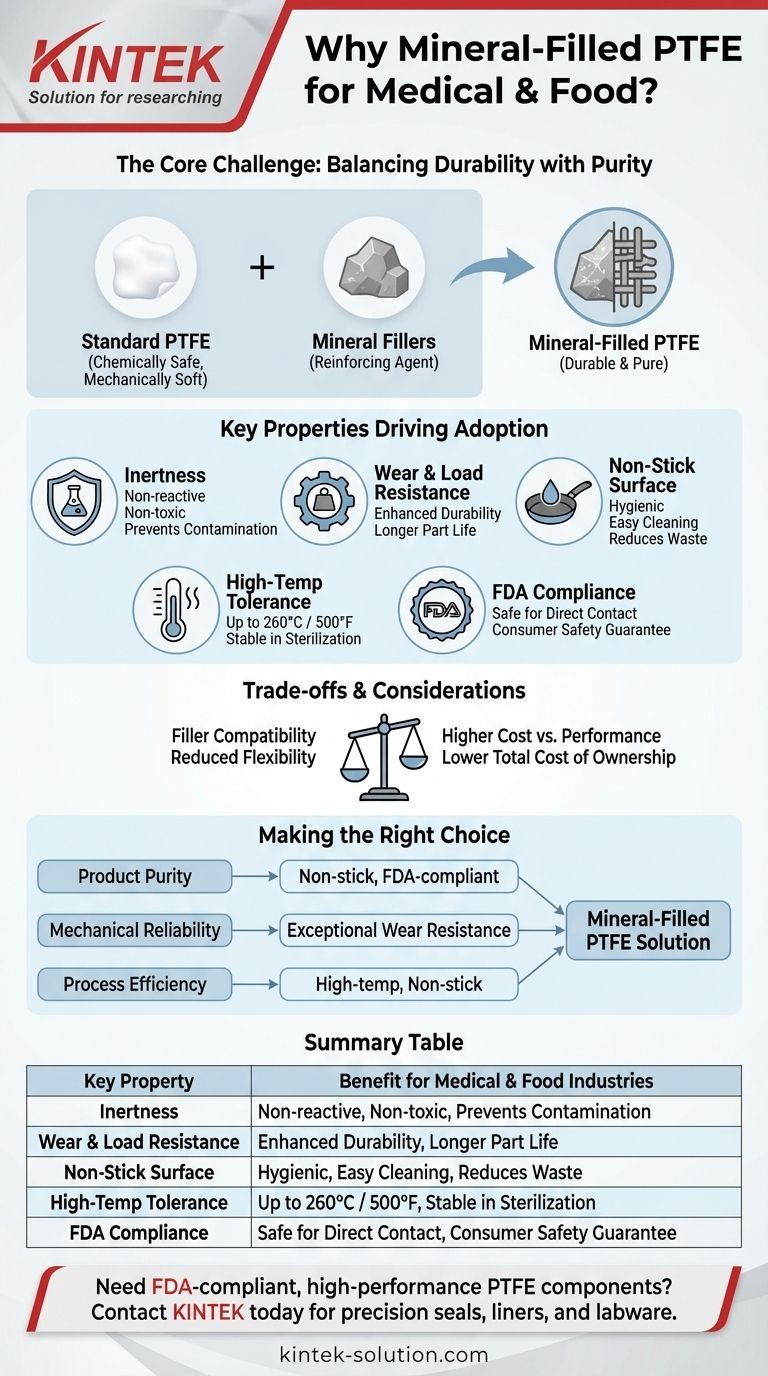
To put it simply, mineral-filled PTFE is used in medical and food industries because it solves a critical engineering challenge: it combines the exceptional mechanical strength and wear resistance needed for industrial machinery with the chemical inertness and non-stick purity required for safe contact with consumable products. This composite material is tough enough for demanding applications like seals and valves yet remains non-toxic, non-reactive, and FDA compliant.
The core problem is that standard PTFE is chemically safe but mechanically soft. By adding mineral fillers, engineers create a reinforced material that is both durable enough for high-wear industrial environments and pure enough for the strictest sanitary regulations.
The Core Challenge: Balancing Durability with Purity
In food and medical processing, materials face a dual mandate. They must withstand intense mechanical stress, high temperatures, and aggressive cleaning regimens while ensuring the absolute purity of the final product.
The Limitation of Standard PTFE
Pure Polytetrafluoroethylene (PTFE) is famous for its non-stick surface and near-universal chemical resistance. However, it is a relatively soft polymer.
In applications involving high pressure or friction—such as gaskets, valve seats, or conveyor belts—unfilled PTFE can deform or wear down quickly, leading to equipment failure and potential contamination.
The Role of Mineral Fillers
Mineral fillers act as a reinforcing agent within the PTFE matrix. Think of it like adding rebar to concrete.
This reinforcement dramatically improves key physical properties like load-bearing capacity and resistance to wear and abrasion. The result is a material that doesn't just survive in an industrial setting, but excels.
Key Properties Driving Adoption in Regulated Industries
The unique combination of properties offered by mineral-filled PTFE makes it an ideal solution for components that come into direct contact with food, pharmaceuticals, and medical products.
Unmatched Chemical Inertness
The material is non-reactive and non-toxic. It does not leach chemicals or react with corrosive fluids, aggressive cleaning agents, or the products themselves.
This ensures that the final product remains free from contamination, maintaining its intended purity and quality.
Superior Wear and Load Resistance
This is the primary benefit of adding mineral fillers. Components like valve seats, seals, and washers made from this material last significantly longer.
This enhanced durability increases operational efficiency, reduces maintenance-related downtime, and boosts overall productivity in processing plants.
A Critical Non-Stick Surface
PTFE's legendary non-stick properties prevent food, powders, and other materials from building up on equipment surfaces.
This quality is crucial for hygiene, as it simplifies cleaning protocols and minimizes the risk of bacterial growth. It also reduces product waste by ensuring an easy release from molds and conveyor belts.
High-Temperature Tolerance
Mineral-filled PTFE can operate at continuous temperatures up to 260°C (500°F).
This allows it to perform reliably in high-temperature processes such as baking, confectionery production, and steam sterilization without degrading or losing its structural integrity.
FDA Compliance and Food Safety
Crucially, specific grades of mineral-filled PTFE are formulated to be FDA compliant.
This certification is a non-negotiable requirement for any material in direct contact with food or medical products, providing a guarantee of its safety for consumer use.
Understanding the Trade-offs
While highly effective, mineral-filled PTFE is a specialized material, and choosing it requires acknowledging certain considerations.
Filler-Specific Compatibility
While the PTFE base is almost universally inert, the specific mineral filler used may have rare chemical vulnerabilities. It is essential to ensure the chosen filler is compatible with all chemicals used in the process, especially aggressive cleaning agents.
Reduced Flexibility
Adding rigid mineral particles can slightly reduce the flexibility of the base PTFE. For applications requiring extreme flexing or very soft, conformable seals, the specific grade and filler percentage must be carefully evaluated.
Cost vs. Performance
Mineral-filled PTFE is a high-performance polymer and is typically more expensive than commodity plastics or standard PTFE. However, its cost is justified by longer part life, reduced machine downtime, and enhanced product safety, leading to a lower total cost of ownership.
Making the Right Choice for Your Application
Selecting the right material is about matching its properties to your most critical operational goal.
- If your primary focus is product purity and hygiene: Mineral-filled PTFE's non-stick, non-reactive, and FDA-compliant nature provides the highest assurance of safety and cleanability.
- If your primary focus is mechanical reliability and uptime: The material's exceptional wear resistance ensures longer life for critical components, directly reducing costly maintenance and production stops.
- If your primary focus is process efficiency: Its performance at high temperatures and non-stick surface combine to reduce waste and enable faster, more consistent production cycles.
Ultimately, choosing mineral-filled PTFE is an investment in a material that refuses to compromise between industrial performance and sanitary safety.
Summary Table:
| Key Property | Benefit for Medical & Food Industries |
|---|---|
| Chemical Inertness | Non-reactive, non-toxic, prevents product contamination |
| Wear & Load Resistance | Enhanced durability for seals, valves, and high-wear parts |
| Non-Stick Surface | Easy cleaning, reduces bacterial growth and product waste |
| High-Temperature Tolerance | Stable performance up to 260°C (500°F) for sterilization and processing |
| FDA Compliance | Certified safe for direct contact with food and medical products |
Need FDA-compliant, high-performance PTFE components for your medical, food, or industrial applications?
KINTEK specializes in precision-manufactured mineral-filled PTFE seals, liners, and labware that deliver unmatched durability and purity. From custom prototypes to high-volume orders, we ensure your components meet strict sanitary standards while withstanding demanding operational environments.
Contact KINTEK today to discuss your project requirements and receive a tailored solution!
Visual Guide
Related Products
- Custom Graphite Filled PTFE Rods for Advanced Industrial Applications
- PTFE Digestion Tubes Teflon Material Chemical Resistant Laboratory Vessels for Trace Metal Analysis
- High Purity PTFE Filter with PFA Valve Connections and Integrated Sieve Plate for Corrosive Fluid Processing
- High Temperature Chemical Resistant 50ml PTFE Syringe Customized Teflon Injector with Threaded Seal for Trace Analysis
- Custom Machined PTFE Conical Sample Cell Corrosion Resistant Triangular Fluoropolymer Container for Trace Analysis
People Also Ask
- What property does graphite filler provide to PTFE? Achieve Superior Self-Lubrication and Low Friction
- How does graphite-filled PTFE perform? A Guide to Superior Self-Lubricating Components
- What are the advantages of Polytetrafluoroethylene (PTFE) with Graphite Fill? Enhance Wear and Friction Performance
- How do graphite fillers enhance PTFE? Achieve Superior Self-Lubrication and Wear Resistance
- How is graphite filler typically used in PTFE? Enhance Wear Resistance & Self-Lubrication