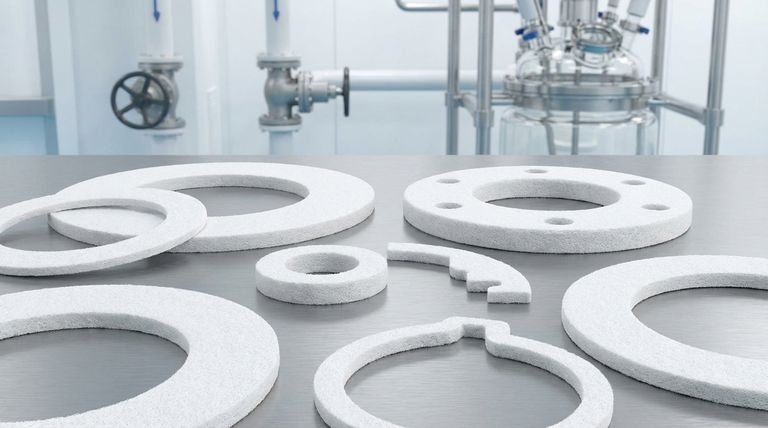
At its core, expanded PTFE (ePTFE) is the sealing material of choice for industries where failure is not an option. It is most commonly used in the chemical processing, petrochemical, pharmaceutical, and food & beverage industries due to its unparalleled chemical resistance and ability to maintain a reliable seal under extreme conditions.
The decision to use an expanded PTFE gasket is driven by the need for a seal that can simultaneously resist aggressive chemicals, withstand a vast range of temperatures, and conform to imperfect surfaces where other materials would fail.
Why Expanded PTFE Is a Premier Sealing Solution
Expanded PTFE is created by rapidly stretching standard PTFE, which alters its molecular structure. This process creates a microporous, fibrous material that is exceptionally strong yet soft and highly conformable.
Unmatched Chemical Resistance
Expanded PTFE inherits the remarkable chemical inertness of standard PTFE. It is virtually immune to attack from the most aggressive chemicals, acids, and caustics across the entire pH range (0-14).
This property makes it indispensable for applications involving corrosive media that would rapidly degrade lesser materials.
Exceptional Temperature and Pressure Stability
ePTFE gaskets can operate effectively in a very wide thermal window, from cryogenic temperatures up to approximately 600°F (315°C).
This stability allows them to maintain a reliable seal in systems that experience significant temperature fluctuations or operate at consistently high pressures, such as in steam lines or chemical reactors.
Purity and Contamination Control
The material is inherently pure and does not leach contaminants. Many grades of ePTFE are FDA-compliant, making them a mandatory choice for industries where product purity is paramount.
This ensures that the gasket itself does not become a source of contamination in sensitive processes like pharmaceutical manufacturing or food processing.
Superior Malleability for Imperfect Surfaces
Perhaps the most significant advantage of the "expanded" form is its softness and conformability. ePTFE gaskets can create a tight seal on flange surfaces that are worn, pitted, or warped.
While a rigid gasket would fail on an imperfect surface, the soft fibers of ePTFE flow into minor imperfections, ensuring a tight, long-lasting seal with lower bolt torque.
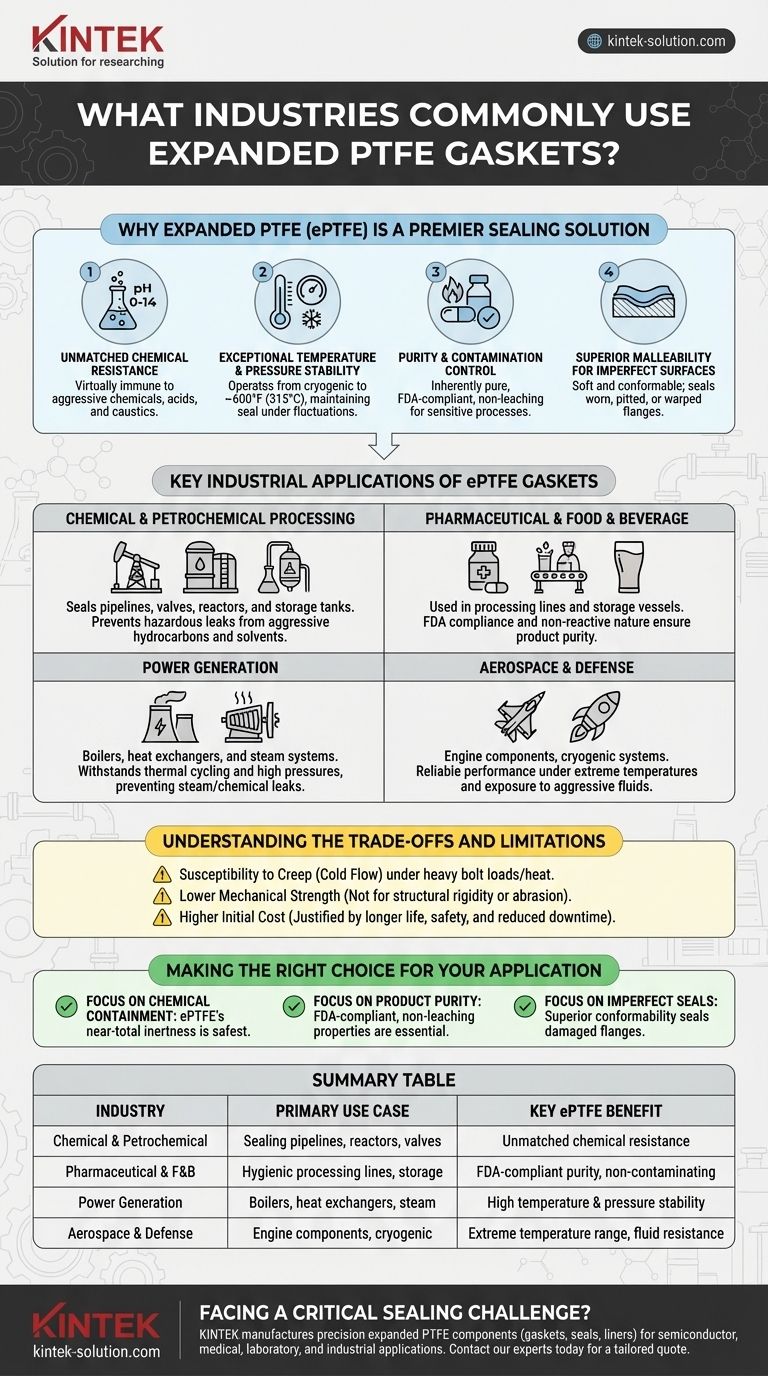
Key Industrial Applications of ePTFE Gaskets
The unique combination of these properties makes ePTFE a problem-solver across several demanding sectors.
Chemical and Petrochemical Processing
In this sector, gaskets are constantly exposed to aggressive hydrocarbons, solvents, and corrosive chemicals.
ePTFE is used to seal pipelines, valves, reactors, and storage tanks, preventing hazardous leaks and ensuring operational safety.
Pharmaceutical and Food & Beverage
Purity is the primary concern here. ePTFE's FDA compliance and non-reactive nature ensure it will not contaminate the product batch.
It is used extensively in processing lines, storage vessels, and equipment where hygienic conditions must be maintained.
Power Generation
Power plants operate under high pressures and temperatures. ePTFE gaskets are used in boilers, heat exchangers, and steam turbine systems.
Their ability to withstand thermal cycling and maintain a seal prevents costly and dangerous steam or chemical leaks.
Aerospace and Defense
These industries require materials that perform reliably under extreme conditions, from engine components exposed to jet fuel to cryogenic systems.
ePTFE's wide operating temperature range and resistance to aggressive fluids make it a critical component for ensuring system integrity.
Understanding the Trade-offs and Limitations
While highly effective, ePTFE is not a universal solution. An objective assessment requires acknowledging its limitations.
Susceptibility to Creep
The primary trade-off for ePTFE's excellent conformability is a higher potential for creep, or "cold flow."
Under heavy, sustained bolt loads, especially at elevated temperatures, the material can slowly deform over time. This can lead to a loss of sealing stress, requiring careful engineering and proper installation torque to mitigate.
Lower Mechanical Strength
ePTFE is a soft material. It is not designed for applications that require structural rigidity or resistance to significant mechanical abrasion.
Higher Initial Cost
Compared to common elastomer or fiber-based gaskets, ePTFE represents a higher upfront material cost.
This cost is typically justified by its longer service life, reduced downtime, and enhanced safety in critical applications.
Making the Right Choice for Your Application
Selecting the correct gasket material is a function of your primary operational goal.
- If your primary focus is containing aggressive chemicals: ePTFE's near-total chemical inertness makes it one of the safest and most reliable choices.
- If your primary focus is ensuring absolute product purity: The FDA-compliant and non-leaching properties of ePTFE are essential for food, beverage, and pharmaceutical applications.
- If your primary focus is sealing old, damaged, or warped flanges: The superior conformability of ePTFE can create a reliable seal where more rigid materials would fail.
Ultimately, choosing an ePTFE gasket is an investment in operational reliability for your most critical sealing challenges.
Summary Table:
| Industry | Primary Use Case | Key ePTFE Benefit |
|---|---|---|
| Chemical & Petrochemical | Sealing pipelines, reactors, valves | Unmatched chemical resistance to aggressive media |
| Pharmaceutical & Food & Beverage | Hygienic processing lines, storage vessels | FDA-compliant purity, non-contaminating |
| Power Generation | Boilers, heat exchangers, steam systems | High temperature & pressure stability |
| Aerospace & Defense | Engine components, cryogenic systems | Extreme temperature range, fluid resistance |
Facing a critical sealing challenge? KINTEK manufactures precision expanded PTFE components (gaskets, seals, liners) for semiconductor, medical, laboratory, and industrial applications. Our custom fabrication—from prototypes to high-volume orders—ensures you get a reliable, application-specific solution that enhances safety and reduces downtime. Contact our experts today to discuss your requirements and receive a tailored quote.
Visual Guide
Related Products
- Customizable High Temperature Resistant Anti Static PTFE Insulating Gaskets Flame Retardant Corrosion Proof Industrial Seals
- Custom PTFE Insulating Gaskets and Corrosion Resistant Fluoropolymer Seals for Industrial Electrical Applications
- Custom PTFE Insulating Gaskets Corrosion Resistant Teflon Seals Tailored Engineering Plastic Components
- Large Scale PTFE Beakers and Flasks for High Temperature Corrosion Resistant Laboratory Applications with Custom CNC Fabrication
- Customizable PTFE Seals Filter Holders for Versatile Applications
People Also Ask
- Why is PTFE an ideal material choice for sealing gaskets, valves, and fluid transfer tubing exposed to extremely aggressive chemicals? Discover Its Superior Chemical Resistance and Reliability
- How is PTFE utilized in seals and gaskets? Leverage Its Chemical & Temperature Resistance
- What are the key properties of PTFE that make it suitable for seals and gaskets? Unlock Superior Sealing Performance
- What are the different types of PTFE gaskets available? Choose the Right Seal for Your Application
- What are the advantages of using PTFE gaskets? Achieve Superior Chemical and Thermal Sealing