To be precise, Polytetrafluoroethylene (PTFE) is a member of the broad chemical family known as per- and poly-fluoroalkyl substances, or PFAS. While this classification is chemically accurate, it is crucial to understand that PTFE is a specific type of PFAS—a fluoropolymer—with properties vastly different from the smaller PFAS compounds that are the focus of most health and environmental concerns.
The critical distinction is not just that PTFE is a PFAS, but that it is a polymer. Its large, stable, and inert molecular structure gives it a safety and performance profile that is fundamentally different from the smaller, more mobile, and more biologically active non-polymer PFAS molecules.

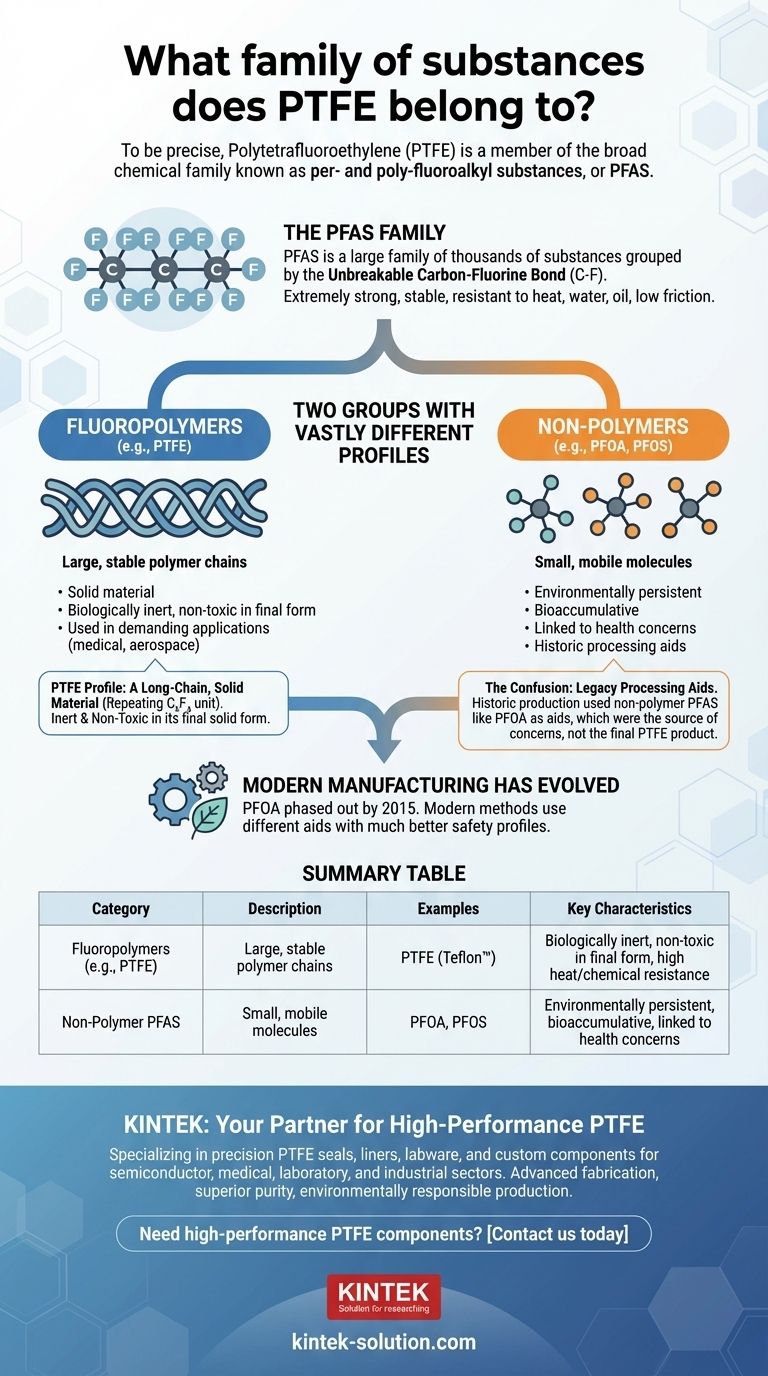
What Defines the PFAS Family?
PFAS is not a single chemical but a large family containing thousands of distinct substances. They are grouped together because of a shared, defining chemical feature.
The Unbreakable Carbon-Fluorine Bond
At the heart of every PFAS molecule is an extremely strong bond between carbon and fluorine atoms. This is one of the strongest single bonds in organic chemistry.
This powerful bond is the source of the desirable properties of PFAS: extreme stability, resistance to heat, water, and oil, and low friction.
Two Groups with Vastly Different Profiles
The PFAS family can be broadly divided into two main categories: polymers and non-polymers. This distinction is essential for understanding risk.
Fluoropolymers, like PTFE, are large, heavy molecules made of long, repeating chains. They are solids, stable, and generally too large to be absorbed by the body.
Non-polymers, like PFOA and PFOS, are much smaller, more mobile molecules. These are the specific PFAS compounds that have been linked to health concerns because they can move through the environment and accumulate in biological systems.
Where PTFE Fits: A Stable Fluoropolymer
PTFE is the original "non-stick" material, best known by the brand name Teflon. Its identity as a fluoropolymer defines its behavior and use.
A Long-Chain, Solid Material
Think of PTFE as a very long, heavy chain. The repeating unit in this chain is C₂F₄. Because of its size and strength, this molecule is a solid that does not readily break down.
Inert and Non-Toxic in Its Final Form
In its finished, solid state (like the coating on a pan), PTFE is considered biologically inert. It does not react with chemicals inside the body and is not absorbed by it.
This stability is why PTFE and other fluoropolymers are trusted in demanding applications, from medical implants and heart patches to critical aerospace components.
Understanding the Source of Confusion
If PTFE itself is so stable, why is it associated with the controversy surrounding PFAS? The answer lies not in the final product, but in the historical manufacturing process.
Legacy Processing Aids
In the past, the manufacturing of PTFE required the use of smaller, non-polymer PFAS molecules as processing aids. The most notable of these was PFOA (Perfluorooctanoic acid).
These smaller molecules were the primary source of environmental contamination and health concerns associated with PTFE production facilities. They were a problematic ingredient, not the final product.
Modern Manufacturing Has Evolved
Recognizing the risks, major global manufacturers began phasing out PFOA in the early 2000s, a process largely completed by 2015 under voluntary global stewardship programs.
Modern production methods now use different processing aids that have a much better safety profile and are not persistent in the same way PFOA was.
How to Apply This Understanding
Making an informed decision requires moving past the simple "PFAS" label and considering the specific substance and its application.
- If your primary focus is consumer product safety: The finished, intact PTFE coating on cookware is considered safe for use. The main risk comes from overheating pans above 500°F (260°C), at which point the polymer can begin to degrade.
- If your primary focus is environmental impact: The significant environmental concerns were linked to legacy manufacturing aids like PFOA, not the stable PTFE polymer itself. Choosing products from reputable manufacturers ensures modern, cleaner production methods were used.
- If your primary focus is material selection: Recognize that while PTFE is technically a PFAS, its risk profile is fundamentally different from non-polymer PFAS. Its properties as a large, inert polymer make it safe and effective for its intended applications.
Ultimately, understanding that "PFAS" includes both stable polymers and problematic non-polymers is the key to navigating this complex topic.
Summary Table:
| Category | Description | Examples | Key Characteristics |
|---|---|---|---|
| Fluoropolymers (e.g., PTFE) | Large, stable polymer chains | PTFE (Teflon™) | Biologically inert, non-toxic in final form, high heat/chemical resistance |
| Non-Polymer PFAS | Small, mobile molecules | PFOA, PFOS | Environmentally persistent, bioaccumulative, linked to health concerns |
Need high-performance PTFE components tailored to your exact requirements?
KINTEK specializes in manufacturing precision PTFE seals, liners, labware, and custom components for the semiconductor, medical, laboratory, and industrial sectors. Our advanced fabrication techniques ensure superior material purity and performance, leveraging modern, environmentally responsible production methods.
We offer custom solutions from prototypes to high-volume orders, delivering the chemical resistance, low friction, and reliability your applications demand.
Contact us today to discuss your project and experience the KINTEK difference!
Visual Guide
Related Products
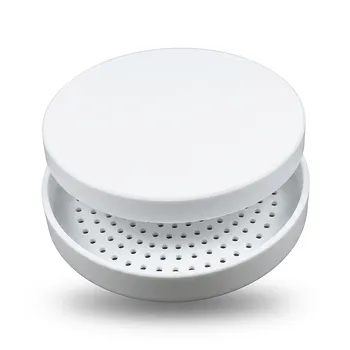
- Custom PTFE Filtration System Acid Resistant High Purity Semiconductor Grade Chemical Processing Filter
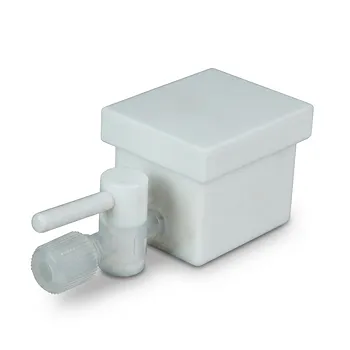
- High Corrosion Resistant PTFE Faucet Polytetrafluoroethylene Valve for Chemical Storage Drums and Fluid Transfer Systems Customizable Industrial Grade
- PTFE PFA Vacuum Filtration System Corrosion Resistant Customizable Shatterproof Laboratory Device
- PTFE Corrosion Resistant Filter with PFA Valve Connections and Integrated Sieve Plate
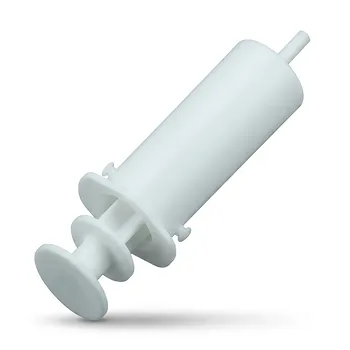
- High Temperature Chemical Resistant 50ml PTFE Syringe Customized Teflon Injector with Threaded Seal for Trace Analysis
People Also Ask
- What makes PTFE filtration systems advantageous for industrial and scientific use? Unmatched Chemical & Thermal Stability
- What sizes and pore options are available for PTFE filters? Choose the Right Filter for Your Application
- What steps are involved in selecting the proper PTFE filter? A 4-Step Guide to Optimal Filtration
- What temperature resistance do PTFE filters offer? Unmatched Thermal Stability from -200°C to +260°C
- How does the hydrophobicity of PTFE filters benefit their use? Ensure Uninterrupted Gas Flow and Solvent Filtration