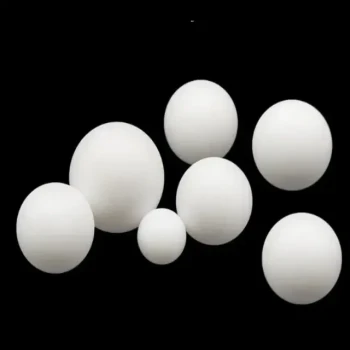
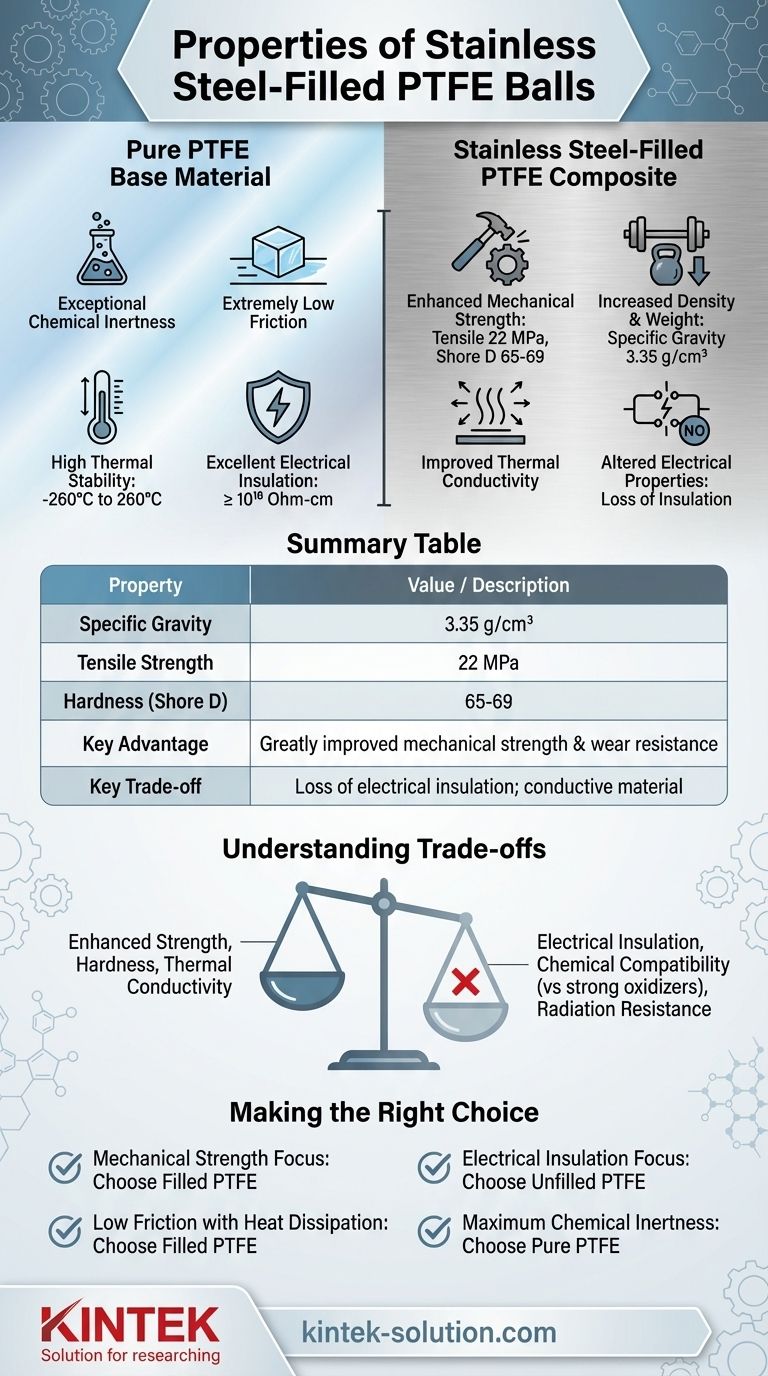
In short, stainless steel-filled PTFE balls are a composite material designed to enhance the mechanical properties of standard Polytetrafluoroethylene (PTFE). They possess a specific gravity of 3.35 g/cm³, a tensile strength of 22 MPa, and a Shore D hardness of 65-69. This filler significantly increases the material's strength, hardness, and density compared to pure PTFE.
By adding stainless steel particles to a PTFE base, you create a material that trades the exceptional electrical insulation of pure PTFE for vastly improved mechanical strength, wear resistance, and thermal conductivity.
Understanding the Base Material: Pure PTFE
To understand the composite, we must first appreciate the properties of its foundation. Pure PTFE is a remarkable polymer known for several key characteristics derived from its strong carbon-fluorine molecular bonds.
Exceptional Chemical Inertness
PTFE is resistant to nearly all chemicals and solvents. This makes it an ideal choice for components that will be exposed to corrosive environments.
Extremely Low Friction
Often known by the trade name Teflon, PTFE has one of the lowest coefficients of friction of any solid. This results in a non-stick, self-lubricating surface ideal for bearings and seals.
High Thermal Stability
Pure PTFE has a very wide operating temperature range, from as low as -260°C up to 260°C. However, it is a poor thermal conductor, meaning it does not dissipate heat well.
Excellent Electrical Insulation
With a volume resistivity of 10¹⁸ Ohm-cm or higher, PTFE is one of the best electrical insulators available.
The Impact of the Stainless Steel Filler
Introducing stainless steel particles into the PTFE matrix fundamentally changes the material's behavior, creating a composite with a new set of advantages and disadvantages.
Enhanced Mechanical Strength
This is the primary reason for the filler. The addition of steel dramatically increases tensile strength (22 MPa) and hardness (65-69 Shore D), making the material far more resistant to wear, deformation, and compression.
Increased Density and Weight
The specific gravity of the composite is 3.35 g/cm³, a significant increase from the 2.2 g/cm³ of pure PTFE. This added weight can be a critical design consideration.
Improved Thermal Conductivity
Metals are excellent thermal conductors. Adding steel particles allows the composite to dissipate heat far more effectively than pure PTFE, making it better for high-speed or high-load applications where friction generates heat.
Altered Electrical Properties
The most significant trade-off is the loss of electrical insulation. The presence of conductive metal particles throughout the material effectively negates PTFE's insulating properties.
Understanding the Trade-offs and Limitations
No material is perfect. Choosing stainless steel-filled PTFE requires acknowledging its specific compromises.
Compromised Electrical Insulation
This material is unsuitable for any application that requires electrical insulation. The steel filler creates a path for electrical current to flow.
Reduced Chemical Compatibility
While still highly resistant, the composite is vulnerable to strong oxidizing agents which can attack the stainless steel filler. Pure PTFE offers broader chemical resistance.
Poor Radiation Resistance
The PTFE base has poor resistance to high-energy radiation, and the steel filler does not mitigate this weakness.
Making the Right Choice for Your Application
Selecting the correct material depends entirely on your primary engineering goal.
- If your primary focus is mechanical strength and wear resistance: The hardness and tensile strength of stainless steel-filled PTFE make it an excellent choice over the unfilled version.
- If your primary focus is electrical insulation: You must use unfilled, virgin PTFE, as the stainless steel filler makes the composite conductive.
- If your primary focus is low friction with heat dissipation: The enhanced thermal conductivity of the steel-filled variant makes it superior for managing friction-generated heat in bearings or seals.
- If your primary focus is maximum chemical inertness: Pure PTFE is the safer choice, especially if the component will be exposed to strong oxidizing agents.
By understanding these distinct properties, you can confidently select the material that precisely matches your engineering requirements.
Summary Table:
| Property | Value / Description |
|---|---|
| Specific Gravity | 3.35 g/cm³ |
| Tensile Strength | 22 MPa |
| Hardness (Shore D) | 65-69 |
| Key Advantage | Greatly improved mechanical strength & wear resistance |
| Key Trade-off | Loss of electrical insulation; conductive material |
Need high-performance PTFE components tailored to your specific requirements?
At KINTEK, we specialize in the precision manufacturing of PTFE components, including advanced composites like stainless steel-filled PTFE. Whether you need the enhanced strength and thermal conductivity of filled PTFE or the supreme chemical resistance of pure PTFE, our expertise ensures your parts meet exact specifications.
We serve the semiconductor, medical, laboratory, and industrial sectors with custom fabrication from prototypes to high-volume orders.
Contact our experts today to discuss your project and discover how our tailored PTFE solutions can enhance your application's performance and reliability.
Visual Guide
Related Products
- Custom PTFE Teflon Balls for Advanced Industrial Applications
- Custom PTFE Ball Mill Grinding Jar 50ml Corrosion Resistant Low Background Lab Milling Vessel
- Custom Graphite Filled PTFE Rods for Advanced Industrial Applications
- High Performance Customizable PTFE Reaction Vessel and Corrosion Resistant Polytetrafluoroethylene Flask for Chemical Laboratory Use
- Large Scale PTFE Beakers and Flasks for High Temperature Corrosion Resistant Laboratory Applications with Custom CNC Fabrication
People Also Ask
- In what applications are PTFE balls highly functional? Ideal for Corrosive, Self-Lubricating Systems
- How do the chemical properties of PTFE balls influence their performance? Unmatched Durability in Harsh Environments
- What materials can PTFE balls be made from? Virgin, Modified, or Filled Compounds for Specific Performance
- What are the available grades of PTFE balls? Choose the Right Grade for Your Application
- What are the key properties of PTFE balls? Unlock Superior Performance for Demanding Applications