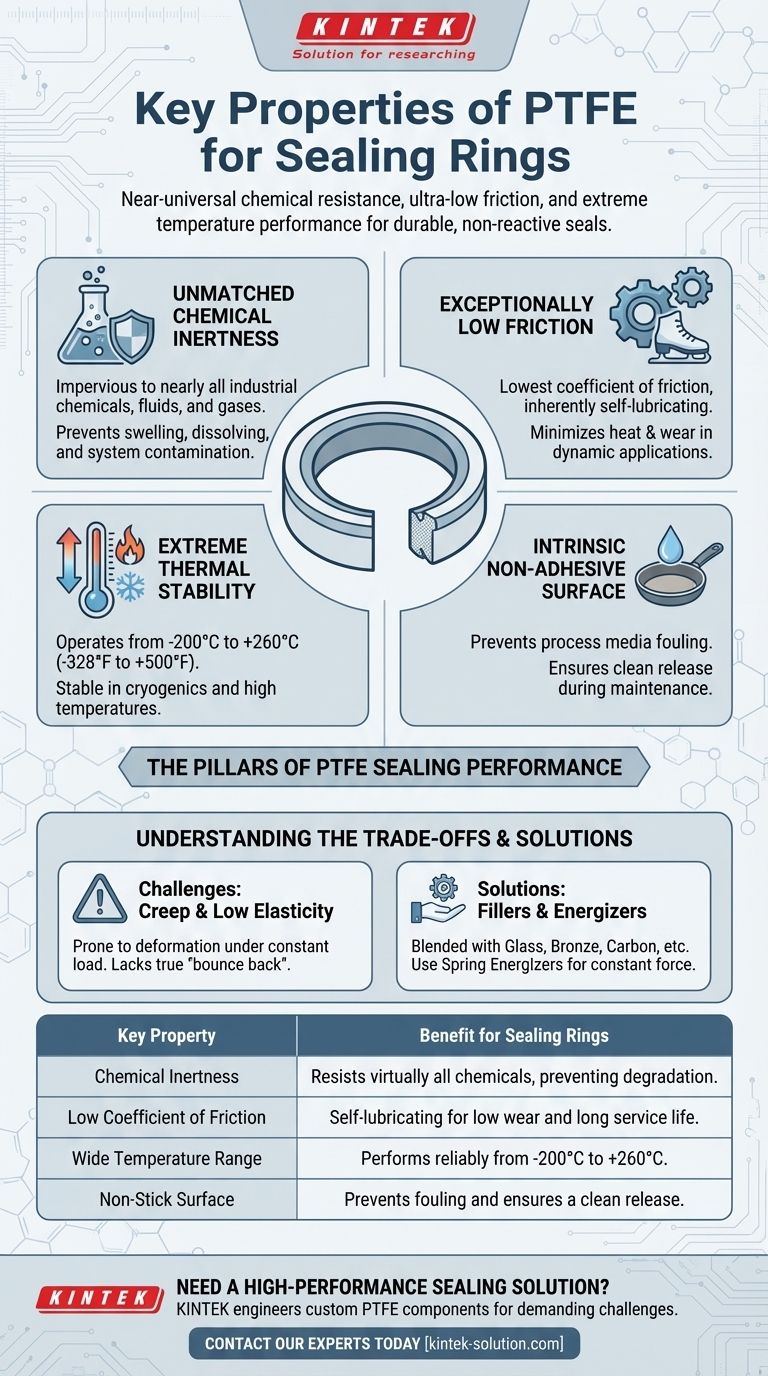
The defining properties of PTFE that make it an exceptional material for sealing rings are its near-universal chemical resistance, an extremely low coefficient of friction, and its ability to perform reliably across a vast temperature range. This unique combination allows it to create a durable, non-reactive seal in environments where most other materials would quickly degrade and fail.
PTFE is chosen for sealing applications not for a single standout feature, but for its rare combination of chemical, thermal, and physical resilience. This makes it a primary problem-solver for the most demanding industrial sealing challenges.

The Pillars of PTFE Sealing Performance
To understand why PTFE is so effective, we must look beyond a simple list of features and analyze how each property contributes to a reliable seal, particularly under aggressive operating conditions.
### Unmatched Chemical Inertness
PTFE is famous for being almost completely inert. It is impervious to nearly all industrial chemicals, fluids, and gases.
This property ensures the sealing ring will not swell, dissolve, or degrade when exposed to corrosive media. This preserves the seal's integrity and prevents contamination of the system. The only common exceptions are molten alkali metals and certain halogenated compounds.
### Exceptionally Low Friction
PTFE has one of the lowest coefficients of friction of any solid material, often compared to wet ice on wet ice. It is inherently self-lubricating.
In dynamic sealing applications, such as in pistons or rotating shafts, this low friction minimizes heat generation and mechanical wear. This translates to a longer service life, lower energy consumption, and smoother, more reliable operation.
### Extreme Thermal Stability
PTFE maintains its critical properties over an exceptionally wide temperature range, typically from -200°C to +260°C (-328°F to +500°F).
This allows it to be used in applications ranging from cryogenics to high-temperature ovens and combustion processes. Unlike elastomeric seals that become brittle at low temperatures or degrade at high temperatures, PTFE remains stable and effective.
### Intrinsic Non-Adhesive Surface
The material is non-stick, meaning other substances do not readily adhere to its surface.
This property is crucial for preventing process media from fouling or clogging the seal. It also ensures a clean release during equipment maintenance, preventing damage to the seal or the surrounding hardware.
Understanding the Trade-offs
While its properties are impressive, PTFE is not without limitations. Acknowledging these trade-offs is key to its proper application.
### The Challenge of Creep (Cold Flow)
Pure PTFE can be prone to "creep," meaning it will slowly deform over time when subjected to a constant compressive load.
This can be a significant issue in static, high-pressure applications, as the seal might lose its initial sealing force. This is why dimensional stability is a critical design consideration.
### Lack of True Elasticity
Unlike rubber or other elastomers, PTFE is not truly elastic. It does not "bounce back" to its original shape with the same force after being compressed.
Because of this, PTFE seals often require a spring energizer (typically a metal spring) inside the seal jacket. The energizer provides a constant outward force, compensating for the material's low elasticity and ensuring a tight seal even under low pressure or due to wear.
### The Role of Fillers
To mitigate weaknesses like creep and improve wear resistance, PTFE is often blended with filler materials.
Common fillers like glass, bronze, carbon, or graphite can significantly enhance the material's stiffness, dimensional stability, and thermal conductivity, tailoring the seal's properties to the specific demands of the application.
Making the Right Choice for Your Application
Selecting the right material requires matching its properties to your primary operational goal.
- If your primary focus is aggressive chemical exposure: PTFE is often the default and safest choice due to its near-total chemical inertness.
- If your primary focus is dynamic sealing with low wear: PTFE's self-lubricating nature makes it ideal for applications with repeated movement, extending the life of the components.
- If your primary focus is extreme temperature resilience: PTFE excels in both cryogenic and high-heat environments where conventional elastomers would immediately fail.
- If your primary focus is static, high-pressure sealing: Be mindful of creep and strongly consider a spring-energized or filled-PTFE design to ensure long-term reliability.
Ultimately, PTFE provides a level of sealing performance in extreme conditions that few other materials can match.
Summary Table:
| Key Property | Benefit for Sealing Rings |
|---|---|
| Chemical Inertness | Resists virtually all industrial chemicals, preventing degradation and contamination. |
| Low Coefficient of Friction | Self-lubricating for low wear and long service life in dynamic applications. |
| Wide Temperature Range | Performs reliably from -200°C to +260°C. |
| Non-Stick Surface | Prevents fouling and ensures a clean release, simplifying maintenance. |
Need a high-performance sealing solution for extreme conditions?
PTFE sealing rings from KINTEK are engineered to solve your most demanding challenges in the semiconductor, medical, laboratory, and industrial sectors. We combine precision manufacturing with deep material expertise to deliver custom PTFE components—from prototypes to high-volume orders—that ensure reliability, longevity, and contamination-free operation.
Contact our experts today to discuss your specific application requirements and receive a tailored solution.
Visual Guide
Related Products
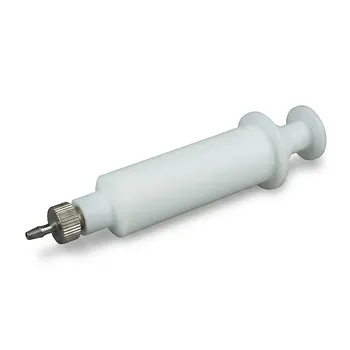
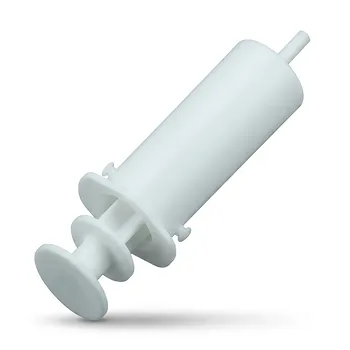
- High Temperature Chemical Resistant 50ml PTFE Syringe Customized Teflon Injector with Threaded Seal for Trace Analysis
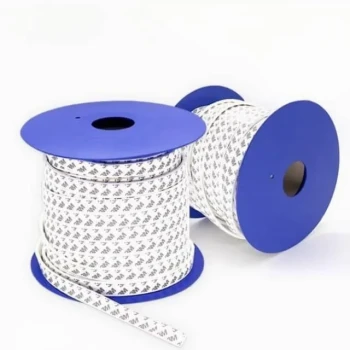
- Custom PTFE Sealing Tapes for Industrial and High Tech Applications
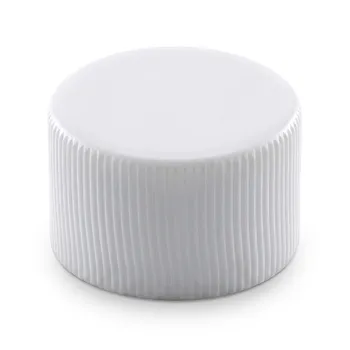
- Custom PTFE Sealing Caps and Corrosion Resistant Low Background Teflon Adapters
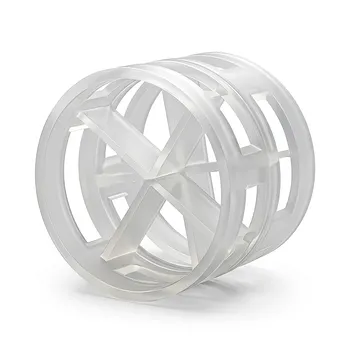
- High Purity PFA PTFE Raschig Rings for Chemical Distillation Tower Packing in Acidic and Alkaline Environments
- Custom PTFE Insulating Gaskets and Corrosion Resistant Fluoropolymer Seals for Industrial Electrical Applications
People Also Ask
- In what medical devices is PTFE commonly used? Essential Components for Safety and Reliability
- Is PTFE approved for food contact applications? Ensuring Food Safety with Compliant PTFE
- What is notable about the coefficient of friction of PTFE? Achieve Unmatched Low-Friction Performance
- How does PTFE's flexibility affect its performance? Unlock Durability and Sealing Power
- Why is PTFE highly resistant to chemicals? Unmatched Inertness for Demanding Applications