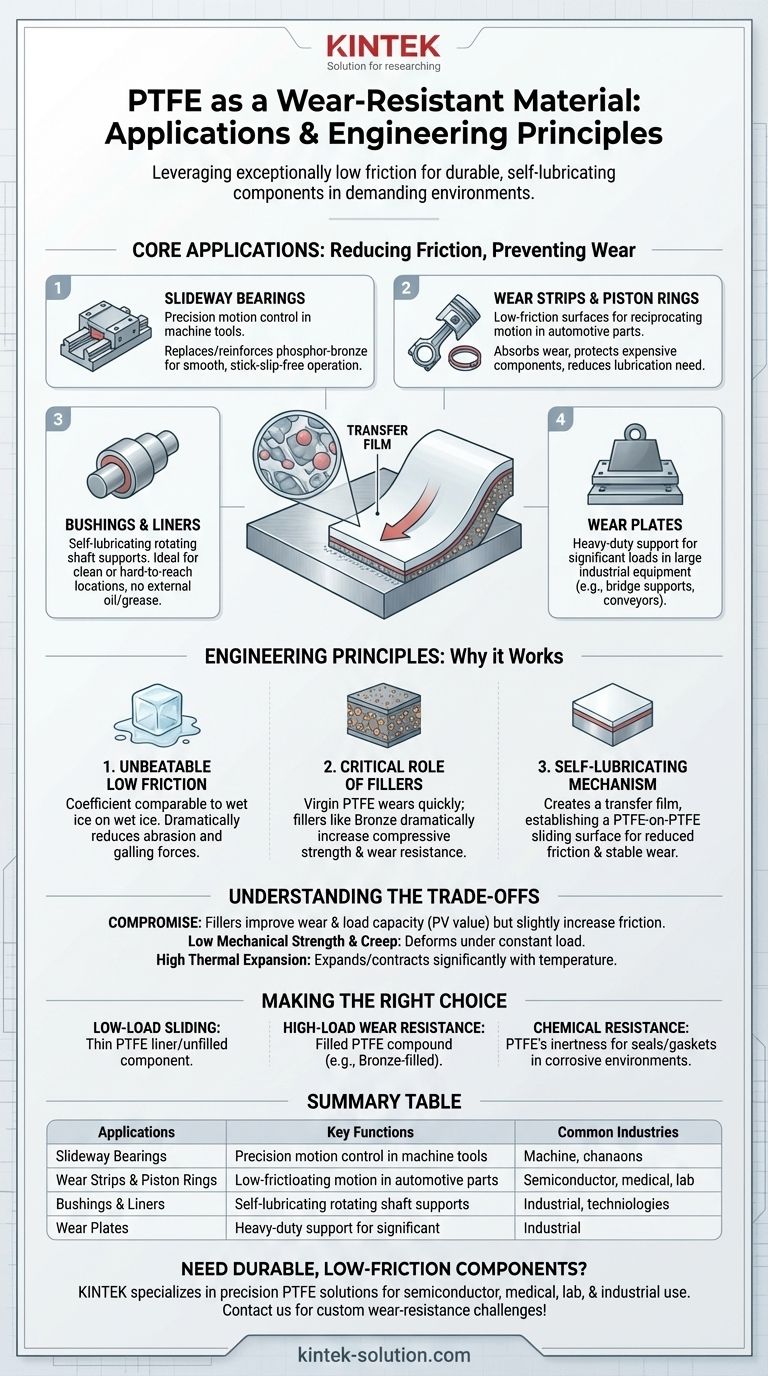
The primary applications of Polytetrafluoroethylene (PTFE) as a wear-resistant material include slideway bearings, wear strips, piston rings, bushings, and wear plates. These components are critical in machinery where reducing friction and preventing wear on metal parts is essential. They leverage PTFE's unique properties to create self-lubricating, durable surfaces in demanding industrial environments.
While famous as a non-stick coating, PTFE’s role as a wear-resistant material is not due to hardness, but to its exceptionally low friction. When reinforced with fillers, it creates high-performance, self-lubricating components that protect and extend the life of critical machinery.
Core Applications in Detail
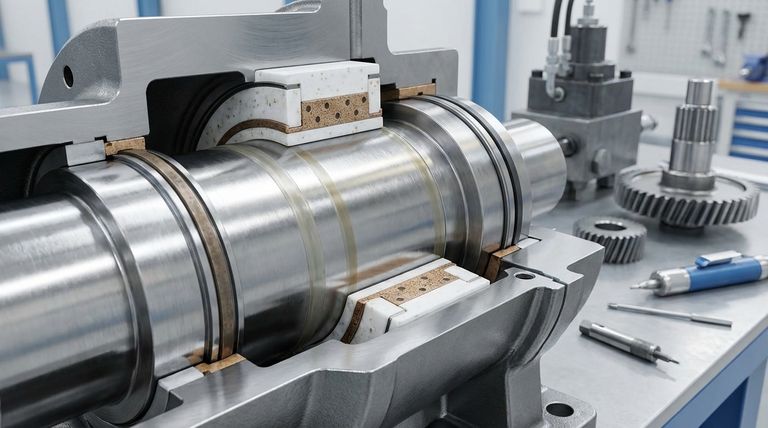
The versatility of PTFE allows it to be shaped into various components that serve as sacrificial, low-friction interfaces between moving metal parts.
Slideway Bearings
In the machine tool industry, filled PTFE slideway bearings are used to replace or reinforce traditional phosphor-bronze guideways.
They provide a smooth, stick-slip-free motion, which is critical for precision machining operations.
Wear Strips & Piston Rings
Wear strips are commonly found in sub-assemblies like shock absorber struts and automotive pistons, providing a low-friction surface for reciprocating motion.
Similarly, PTFE piston rings are fitted onto piston shafts. They absorb wear and prevent damage to the more expensive piston and cylinder components, all while reducing the need for lubrication.
Bushings & Liners
PTFE can be machined into solid bushings for rotating shafts or applied as a thin layer onto metallic bushings.
This creates a self-lubricating bearing that requires no external oil or grease, making it ideal for clean environments or hard-to-reach locations.
Wear Plates
For heavy-duty applications, thick wear plates (often over 10mm) are used in large industrial equipment.
These plates support significant loads while allowing for slow, controlled movement, such as in bridge supports or heavy-duty conveyor systems.
The Engineering Principles Behind PTFE's Effectiveness
Understanding why PTFE is chosen for these applications is key to using it correctly. Its effectiveness stems from a unique combination of properties, especially when it is modified into a composite material.
Unbeatable Low Coefficient of Friction
PTFE has one of the lowest coefficients of friction of any solid material, comparable to wet ice on wet ice. This inherent "slipperiness" is the primary reason it prevents wear—it dramatically reduces the forces that cause abrasion and galling between surfaces.
The Critical Role of Fillers
Pure, or "virgin," PTFE is relatively soft and can wear quickly under high loads. Its performance as a wear material is transformed by adding fillers.
The most common composition for wear resistance is bronze-filled PTFE. Bronze dramatically increases compressive strength and wear resistance. Other fillers like carbon, graphite, and glass fibers are also used to enhance specific properties.
The Self-Lubricating Mechanism
Filled PTFE components create a self-lubricating system through a process called transfer film.
As the component begins to wear, it deposits a microscopic layer of PTFE onto the mating metal surface. Once this film is established, the moving part is sliding on a PTFE-on-PTFE surface, which further reduces friction and stabilizes the wear rate.
Understanding the Trade-offs
No material is perfect. Acknowledging PTFE's limitations is crucial for successful engineering design.
Compromise Between Friction and Wear
Adding fillers like bronze to PTFE significantly improves its wear rate and load-bearing capacity (its PV value).
However, this comes at the cost of a slightly higher coefficient of friction compared to pure PTFE. The trade-off is almost always worthwhile, as the increase in durability far outweighs the minor increase in friction.
Low Mechanical Strength and Creep
Even when filled, PTFE is not as strong as metal. It is susceptible to "creep," which is the tendency to slowly deform over time when under a constant load. This must be accounted for in the design of components, especially in high-pressure applications.
High Thermal Expansion
PTFE expands and contracts with temperature changes more than most metals. Engineers must design components with appropriate clearances to ensure parts do not bind or become loose as operating temperatures fluctuate.
Making the Right Choice for Your Application
Selecting the correct form of PTFE is directly tied to the specific demands of your project.
- If your primary focus is low-friction sliding in a low-load system: A thin PTFE liner or an unfilled component may be sufficient to create a self-lubricating surface.
- If your primary focus is high-load wear resistance in machinery: A filled PTFE compound, such as bronze-filled PTFE, is the definitive choice for its superior strength and durability.
- If your primary focus is chemical resistance in a moving part: PTFE's exceptional chemical inertness makes it ideal for seals, bearings, and gaskets operating in corrosive environments.
Ultimately, selecting the right PTFE formulation transforms a friction and wear problem into a durable, self-lubricating solution.
Summary Table:
| Application | Key Function | Common Industries |
|---|---|---|
| Slideway Bearings | Precision motion control | Machine Tool, Automation |
| Wear Strips & Piston Rings | Reciprocating motion surfaces | Automotive, Aerospace |
| Bushings & Liners | Self-lubricating rotating shafts | Medical, Laboratory |
| Wear Plates | Heavy-load sliding surfaces | Industrial, Construction |
Need durable, low-friction components for your machinery? KINTEK specializes in precision PTFE components (seals, liners, labware, and custom fabrications) for semiconductor, medical, laboratory, and industrial applications. We help you reduce maintenance costs and extend equipment lifespan through custom solutions from prototypes to high-volume orders. Contact our experts today to discuss your specific wear-resistance challenges!
Visual Guide
Related Products
- PTFE Anti Scald Heat Insulation Sleeve Hot Plate Support Feet Laboratory Benchtop Protection Customizable Thermal Barrier
- Custom PTFE Sleeves and Hollow Rods for Advanced Applications
- Customizable PTFE Rods for Advanced Industrial Applications
- Custom PTFE Insulating Gaskets and Corrosion Resistant Fluoropolymer Seals for Industrial Electrical Applications
- Customizable PTFE Seals Filter Holders for Versatile Applications
People Also Ask
- Why is PTFE valuable in automotive and aerospace industries? The Ultimate Material for Extreme Environments
- What are the main ingredients used in the production of PTFE? Unlocking its High-Performance Properties
- Why is PTFE considered non-reactive? The Power of an Unbreakable Molecular Bond
- What is PTFE commonly known as and what are its unique properties? Unlock Unmatched Chemical & Thermal Resistance
- How is PTFE manufactured? Unlocking the Secrets of a High-Performance Polymer