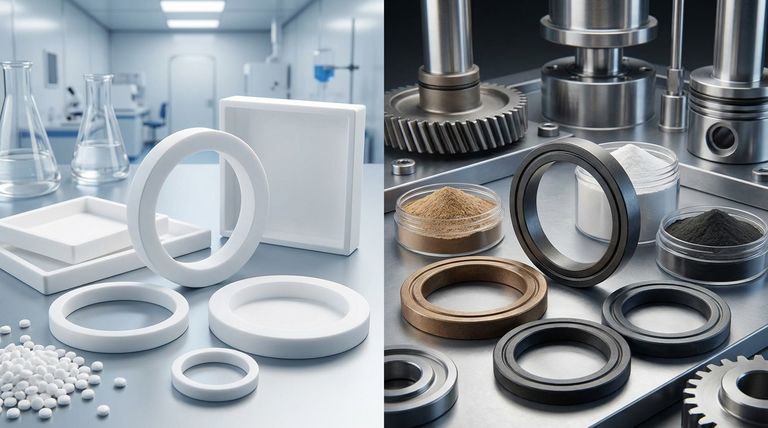
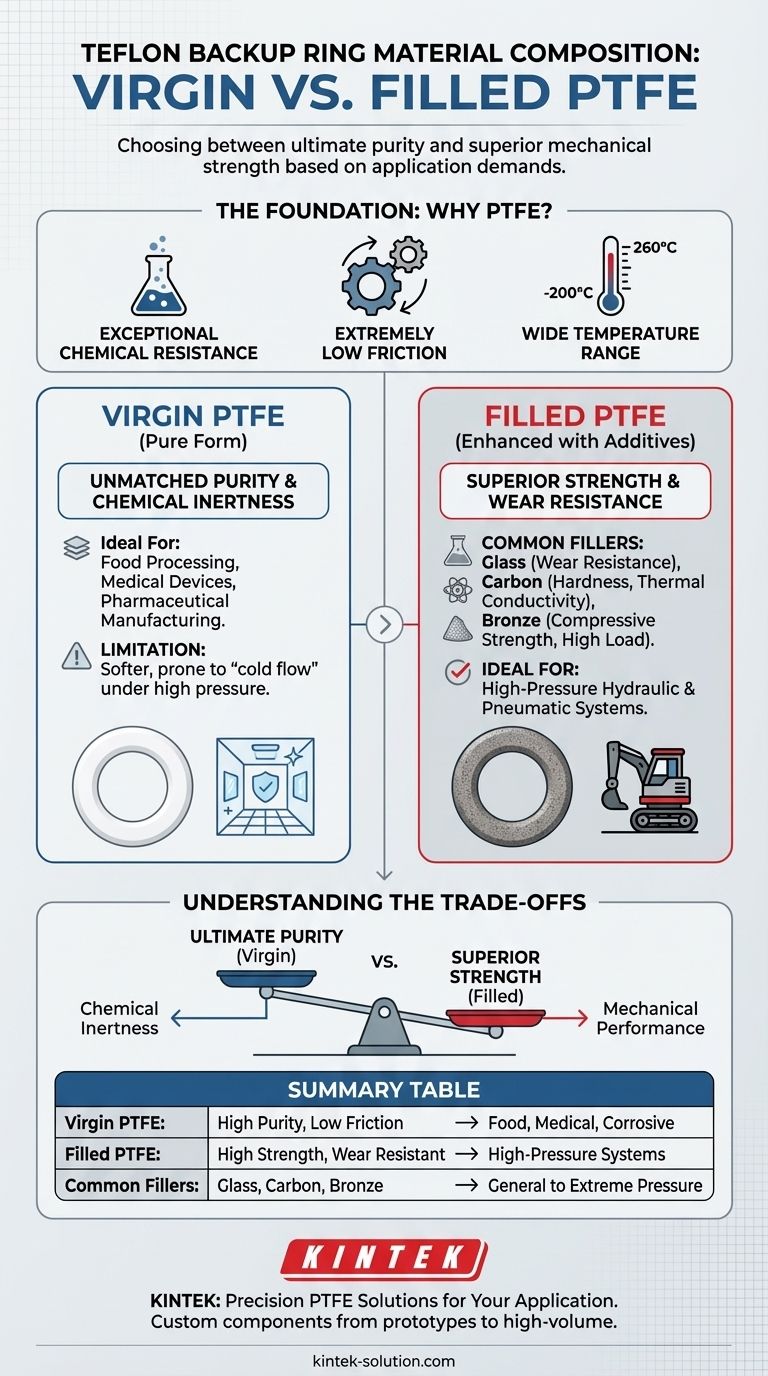
At its core, the material composition of Teflon backup rings varies based on one key distinction: whether the Polytetrafluoroethylene (PTFE) is in its pure form or has been blended with additives. These two categories are known as Virgin PTFE and Filled PTFE. The choice between them is driven entirely by the mechanical and chemical demands of the specific application.
The decision between a pure, virgin PTFE and a mechanically enhanced filled PTFE is a fundamental trade-off. You are essentially choosing between ultimate chemical inertness and superior physical strength.
The Foundation: Why PTFE is the Material of Choice
Before examining the variations, it's crucial to understand why PTFE is the default material for these components. Its inherent properties make it uniquely suited for sealing applications.
Exceptional Chemical Resistance
PTFE is one of the most chemically inert materials known. It resists nearly all industrial chemicals, acids, and solvents, even in highly corrosive or high-temperature environments.
Extremely Low Friction
The material has an exceptionally low coefficient of friction. This self-lubricating, non-stick quality is vital for dynamic applications, reducing wear and ensuring smooth operation.
Wide Temperature Range
PTFE performs reliably across a vast temperature spectrum, typically from -200°C to 260°C (-328°F to 500°F). This allows it to function in environments where many other polymers would fail.
The Two Primary Compositions
The functional differences in Teflon backup rings come from the choice to either use PTFE in its pure state or to enhance it with reinforcing fillers.
Virgin PTFE: The Standard for Purity
This is pure, unadulterated Polytetrafluoroethylene. It contains no additives or fillers.
Its primary advantage is its unmatched chemical resistance and purity. This makes it the only choice for applications where contamination is a critical concern, such as in food processing, medical devices, or pharmaceutical manufacturing.
Filled PTFE: Engineered for Strength
This category involves blending the virgin PTFE base with specific additives to improve its mechanical properties.
These fillers are added to combat PTFE's primary weakness: its tendency to deform or "cold flow" under pressure. Common fillers include:
- Glass: Improves wear resistance and compressive strength.
- Carbon: Increases hardness, load-bearing capability, and thermal conductivity.
- Bronze: Significantly enhances compressive strength and wear resistance, making it ideal for high-pressure hydraulic systems.
Understanding the Trade-offs
Selecting a material is never about finding a "perfect" solution, but about choosing the right set of compromises for your specific problem.
The Limitation of Purity
While chemically superior, virgin PTFE is mechanically softer. In high-pressure applications, it is more susceptible to extrusion into the clearance gap, which is the very problem a backup ring is designed to prevent.
The Compromise of Strength
Adding fillers to create Filled PTFE dramatically improves mechanical strength and wear resistance. However, this enhancement can come at a slight cost.
Fillers can marginally reduce the overall chemical resistance of the compound compared to virgin PTFE. The blend is no longer 100% inert, and the choice of filler must be compatible with the system's media.
Selecting the Right Material for Your Application
Your operational environment and performance goals dictate the correct material choice.
- If your primary focus is chemical purity and non-contamination: Virgin PTFE is the definitive choice for industries like food processing, medical, or pharmaceuticals.
- If your primary focus is high-pressure performance and wear resistance: A Filled PTFE, such as one with carbon or bronze, provides the necessary mechanical strength to prevent extrusion in demanding hydraulic and pneumatic systems.
- If your primary focus is a general-purpose balance of performance and cost: Glass-filled PTFE often provides a good middle ground, enhancing strength and wear resistance effectively.
Ultimately, matching the material composition directly to the application's demands ensures reliability and extends the life of the sealing system.
Summary Table:
| Material Type | Key Characteristics | Ideal For |
|---|---|---|
| Virgin PTFE | Unmatched chemical inertness, high purity, low friction | Food, medical, pharmaceutical, and highly corrosive environments |
| Filled PTFE | Enhanced compressive strength, improved wear resistance | High-pressure hydraulic/pneumatic systems requiring extrusion resistance |
| Common Fillers | Glass: Wear resistance; Carbon: Hardness; Bronze: High load-bearing | General-purpose to extreme-pressure applications |
Need the perfect PTFE backup ring for your specific application?
At KINTEK, we specialize in manufacturing high-performance PTFE components, including custom backup rings for the semiconductor, medical, laboratory, and industrial sectors. Whether you require the ultimate purity of Virgin PTFE or the enhanced strength of a Filled PTFE compound, our precision production and custom fabrication services—from prototypes to high-volume orders—ensure a perfect fit for your system's demands.
Contact our experts today to discuss your requirements and get a solution that delivers reliability and longevity.
Visual Guide
Related Products
- High Purity PFA PTFE Raschig Rings for Chemical Distillation Tower Packing in Acidic and Alkaline Environments
- Customizable PTFE Heat Insulation Plate High Temperature Corrosion Resistant Laboratory Support Layered Multi Tier Stand
- Custom PTFE Acid Resistant Support Rack for PFA Hydrogen Absorption Systems Multi Hole Configurations
- Custom PTFE Corrosion Resistant White Syringe with Threaded Luer Connector Compatibility
- Custom PTFE Constant Pressure Separatory Funnel Corrosion Resistant Low Background Labware for PFA Flasks
People Also Ask
- What properties make PTFE seal rings suitable for food, beverage, and pharma? Ensure Purity & Regulatory Compliance
- What are the key properties of PTFE that make it suitable for sealing rings? Unmatched Chemical & Thermal Resistance
- How does temperature affect the performance and design of PTFE seal rings? Optimize for -200°C to +260°C environments.
- How do PTFE seal rings perform in the high-pressure and corrosive environments of the oil and gas sector? - Guide
- How do fillers such as glass fiber, carbon, bronze, and graphite enhance the performance of PTFE seal rings? Key Benefits