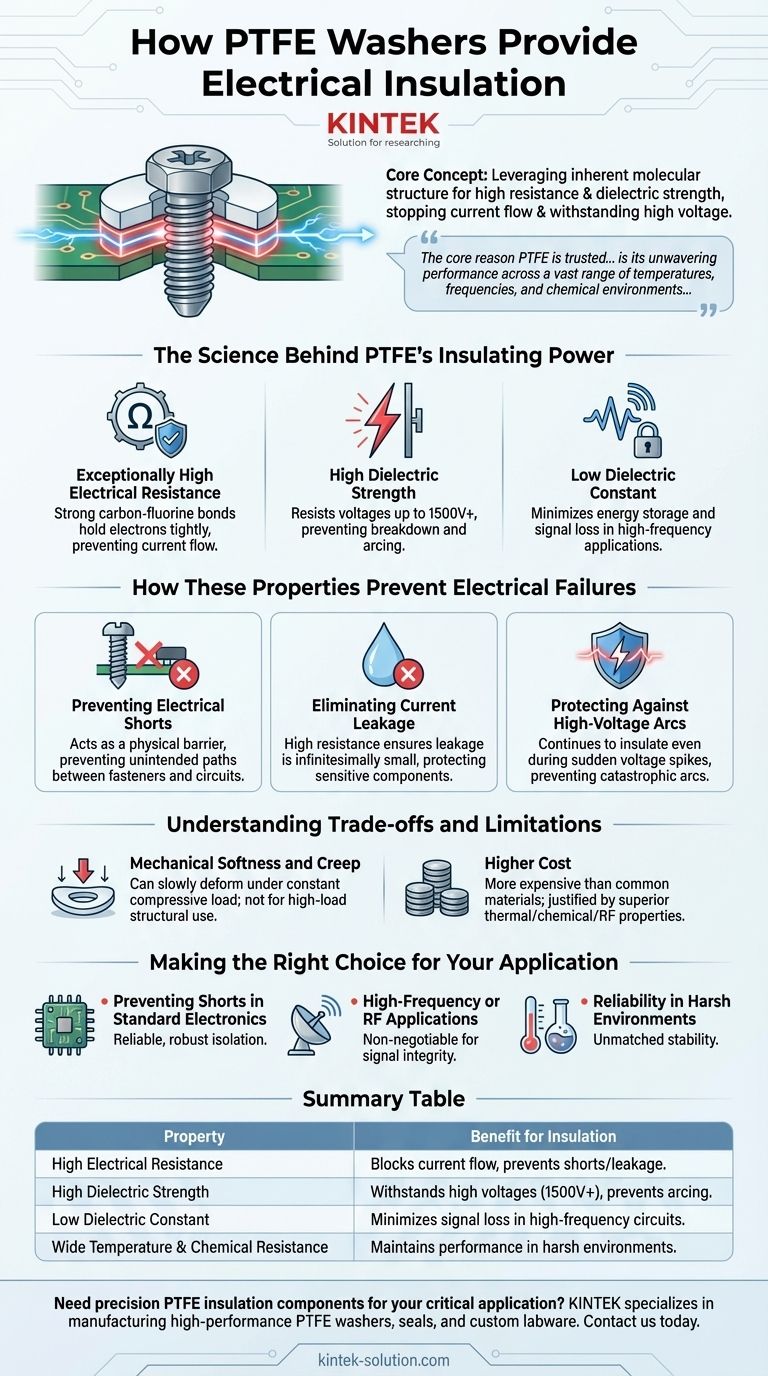
PTFE washers provide electrical insulation by leveraging the material's inherent molecular structure, which creates exceptionally high electrical resistance and dielectric strength. This means Polytetrafluoroethylene (PTFE) not only stops the flow of current under normal conditions but can also withstand very high voltages without breaking down, preventing dangerous electrical shorts and leakage.
The core reason PTFE is trusted for electrical insulation is not just its ability to block current, but its unwavering performance across a vast range of temperatures, frequencies, and chemical environments, ensuring reliable protection for sensitive components where other materials would fail.
The Science Behind PTFE's Insulating Power
To understand why PTFE is such a superior insulator, we must look at its specific electrical properties. These characteristics work together to create a robust barrier against electrical flow and interference.
Exceptionally High Electrical Resistance
Electrical resistance is a measure of how strongly a material opposes the flow of electric current. PTFE possesses an extremely high volume resistivity.
This property is due to its stable molecular structure, built on strong carbon-fluorine bonds, which hold electrons tightly and prevent them from moving freely to conduct electricity.
High Dielectric Strength
Dielectric strength measures a material's ability to act as an insulator under high electrical stress. It defines the maximum voltage a material can withstand before it breaks down and allows current to pass through.
PTFE has a very high dielectric strength, capable of resisting voltages up to 1500 volts or more depending on thickness. This makes it ideal for preventing high-voltage arcing between components.
Low Dielectric Constant
The dielectric constant indicates how much electrical energy a material can store in an electric field. Materials with a low dielectric constant are poor at storing energy.
This is a critical advantage in high-frequency applications, as it minimizes interference (crosstalk) and prevents signal loss in sensitive circuits, preserving the integrity of data and communications.
How These Properties Prevent Electrical Failures
The theoretical properties of PTFE translate directly into practical benefits that ensure the safety and efficiency of electronic systems.
Preventing Electrical Shorts
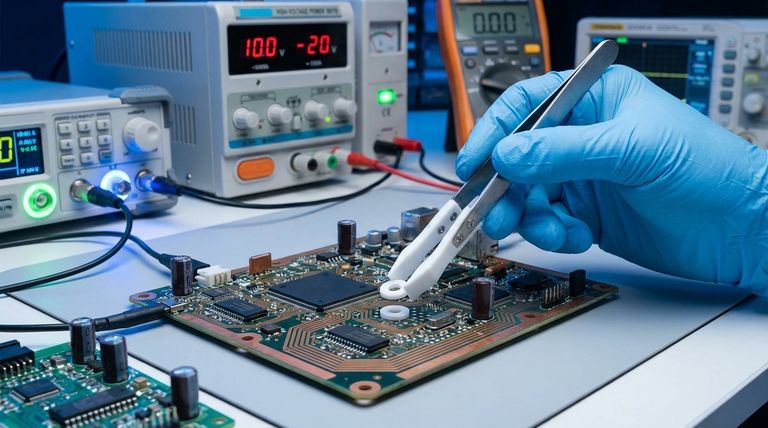
The most common use of a PTFE washer is to act as a physical and electrical barrier.
When placed between a metal screw and a circuit board or chassis, its high resistance prevents the fastener from creating an unintended electrical path, which would cause a short circuit and damage components.
Eliminating Current Leakage
In any electrical system, some minimal current can "leak" through an insulator.
PTFE's high resistance ensures this leakage is infinitesimally small, protecting sensitive components from stray currents and improving the overall efficiency of the device.
Protecting Against High-Voltage Arcs
The material's high dielectric strength is a critical safety feature.
It ensures that even if a sudden voltage spike occurs, the washer will not fail. It will continue to insulate, preventing a catastrophic arc that could destroy the circuitry.
Understanding the Trade-offs and Limitations
While an excellent insulator, PTFE is not the solution for every engineering problem. Understanding its limitations is key to using it effectively.
Mechanical Softness and Creep
PTFE is a relatively soft material. Under a constant compressive load, such as a tightened bolt, it can slowly deform over time in a process known as "creep."
This means it is not suitable for high-load structural applications where maintaining precise dimensions under pressure is critical.
Higher Cost
Compared to other common insulating materials like nylon or certain types of rubber, PTFE is generally more expensive.
Its use is best justified in applications where its superior thermal, chemical, or high-frequency insulating properties are truly necessary.
Making the Right Choice for Your Application
Selecting the right material depends entirely on the specific demands of your project.
- If your primary focus is preventing shorts in standard electronics: PTFE offers an extremely reliable and robust solution for isolating fasteners and components from conductive surfaces.
- If your primary focus is high-frequency or RF applications: PTFE's low dielectric constant is a non-negotiable feature for maintaining signal integrity and minimizing interference.
- If your primary focus is reliability in harsh environments: PTFE's unmatched chemical and thermal stability ensures its insulating properties will not degrade when exposed to extreme conditions.
Ultimately, choosing PTFE is a decision for uncompromising electrical stability in demanding applications.
Summary Table:
| Property | Benefit for Insulation |
|---|---|
| High Electrical Resistance | Blocks current flow, prevents shorts and leakage. |
| High Dielectric Strength | Withstands high voltages (e.g., 1500V+), prevents arcing. |
| Low Dielectric Constant | Minimizes signal loss and interference in high-frequency circuits. |
| Wide Temperature & Chemical Resistance | Maintains performance in harsh environments where other materials fail. |
Need precision PTFE insulation components for your critical application?
KINTEK specializes in manufacturing high-performance PTFE washers, seals, and custom labware for the semiconductor, medical, and industrial sectors. Our components are engineered for superior dielectric strength and reliability in extreme conditions.
Contact us today to discuss your custom fabrication needs—from prototypes to high-volume orders—and ensure your equipment operates with uncompromising safety and efficiency.
Visual Guide
Related Products
- High Purity PTFE Gas Washing Bottle with Sintered Filter Ball Corrosion Resistant Slender Laboratory Scrubber Customizable Height and Width
- Custom PTFE Gas Washing Bottle Corrosion Resistant Low Background Fluoropolymer Gas Absorption Vessel
- PTFE Circular Wafer Carrier 6 Inch Acid Alkali Resistant Semiconductor Cleaning Basket Customizable
- Custom PTFE Gas Washing Bottle Corrosion Resistant Chemical Absorption Vessel with Quarter Inch Tubing Connections
- Custom PTFE Laboratory Cleaning Basket Carrier High Purity Acid Base Resistant Wafer Holder Low Background Contamination Free Chemical Bath Rack
People Also Ask
- How can the susceptibility to creep and cold flow in PTFE washers be addressed? Improve Stability with Filled PTFE or Metal Backing
- What makes PTFE washers suitable for the food industry? Ensure Safety, Hygiene & Durability
- What advantages do PTFE washers offer? Superior Chemical, Thermal, and Low-Friction Performance
- What is a key advantage of PTFE washers in terms of chemical resistance? Unmatched Protection Against Corrosives
- What are the primary applications of PTFE Teflon washers in plumbing? Ensure Leak-Proof Seals in Harsh Environments