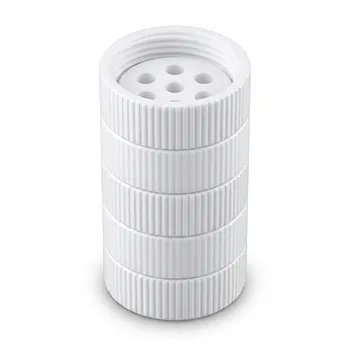
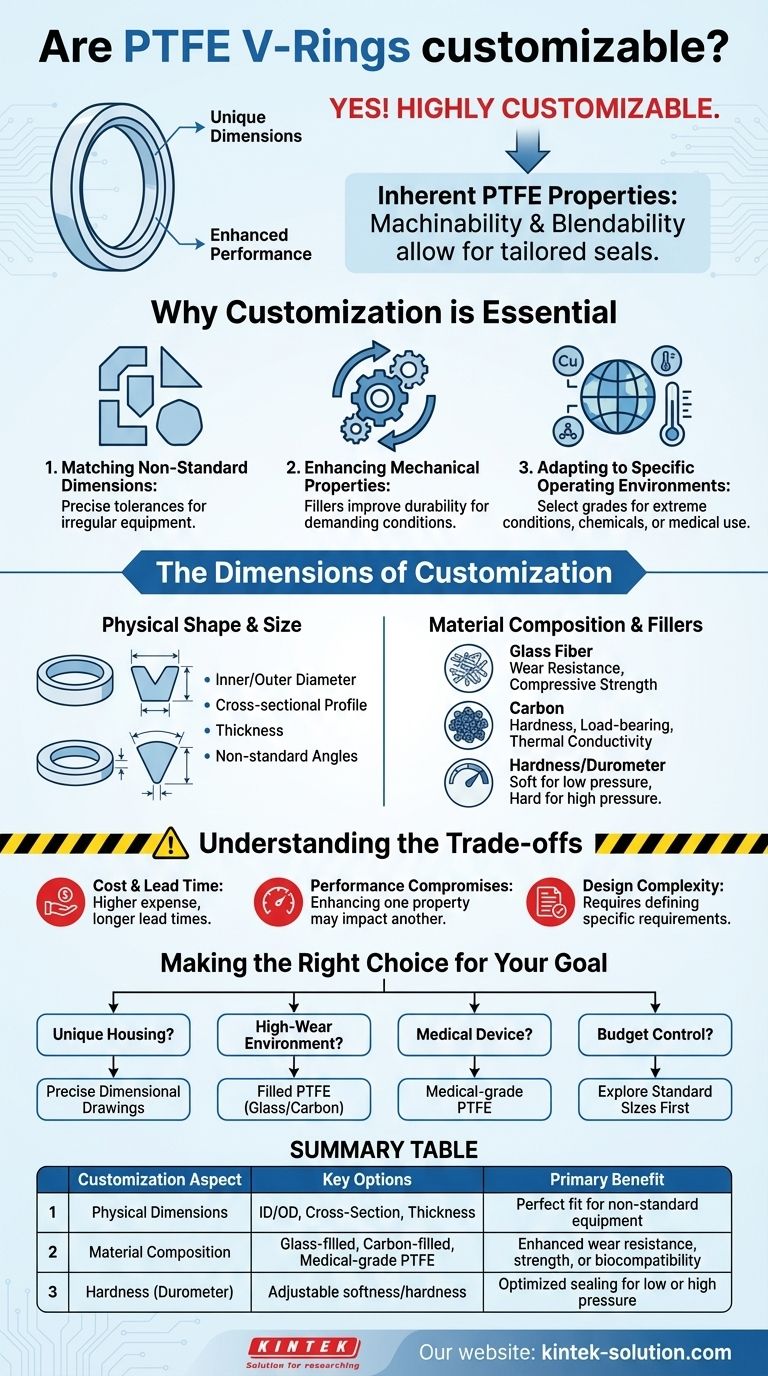
Yes, PTFE V-Rings are highly customizable. The inherent properties of Polytetrafluoroethylene (PTFE), particularly its machinability and its ability to be blended with various fillers, allow for the creation of seals tailored to precise application requirements, from unique dimensions to enhanced performance characteristics.
The key is to understand that customization extends beyond simple size and shape. It involves fundamentally altering the material's composition to achieve specific engineering outcomes, such as increased durability, different hardness, or compatibility with specialized environments.
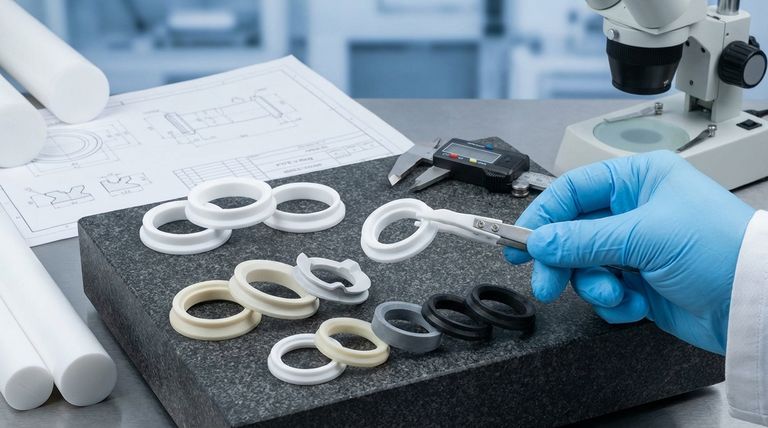
Why Customization is Essential for Sealing Applications
Standard, off-the-shelf components are designed for common applications. However, many industrial, medical, and high-performance systems present unique challenges that demand a tailored solution.
Matching Non-Standard Dimensions
Many designs involve unique housing or shaft dimensions that do not conform to standard sizes. Custom machining allows V-Rings to be manufactured to precise tolerances, ensuring a perfect fit for irregularly shaped or custom-built equipment.
Enhancing Mechanical Properties
Base PTFE is known for its low friction and chemical inertness, but it can be soft. By adding fillers, its mechanical properties can be significantly improved to handle more demanding conditions.
Adapting to Specific Operating Environments
A standard V-Ring may not be suitable for extreme temperatures, aggressive chemicals, or sterile medical applications. Customization allows for the selection of specific PTFE grades and fillers to ensure reliability and safety in these unique contexts.
The Dimensions of Customization
Understanding what can be changed is the first step in specifying the right part. Customization typically falls into two main categories: physical form and material composition.
Physical Shape and Size
This is the most straightforward form of customization. PTFE V-Rings can be machined to virtually any inner diameter, outer diameter, or cross-sectional profile required by the design. This includes creating versions with specific thicknesses or non-standard angles.
Material Composition and Fillers
This is where performance engineering truly begins. Different fillers are blended with the base PTFE resin to enhance specific properties.
Common fillers include glass fiber to increase wear resistance and compressive strength or carbon to improve hardness, load-bearing capability, and thermal conductivity. The percentage and type of filler are customized based on the application's demands.
Hardness and Durometer
The hardness of the final PTFE material can be adjusted. A softer material might provide a better seal in a low-pressure application, while a harder, filled compound would be necessary to prevent extrusion under high pressure.
Understanding the Trade-offs
While customization offers significant advantages, it's crucial to approach it with a clear understanding of the associated trade-offs.
Cost and Lead Time
Custom-machined parts are almost always more expensive than mass-produced, standard components, especially in lower volumes. The process also requires longer lead times for design, tooling (if any), and manufacturing.
Performance Compromises
Enhancing one property with a filler can sometimes impact another. For example, adding glass fiber to improve wear resistance may slightly decrease the material's chemical compatibility against certain aggressive media. It is a balancing act based on the primary need.
Design Complexity
Specifying a custom part requires a deeper technical understanding of the application's requirements. You must be able to clearly define operating pressures, temperatures, media, and desired performance characteristics to the manufacturer.
Making the Right Choice for Your Goal
To specify the correct part, you must first define your most critical requirement.
- If your primary focus is fitting a unique housing: Provide precise dimensional drawings with clear tolerances to ensure an exact fit.
- If your primary focus is durability in a high-wear environment: Specify a V-Ring made from a filled PTFE, such as a glass- or carbon-filled compound.
- If your primary focus is a medical device: Ensure you specify a medical-grade PTFE that meets all necessary regulatory and biocompatibility standards.
- If your primary focus is budget control: Thoroughly investigate all available standard V-Ring sizes and materials before committing to the higher cost of a custom solution.
By leveraging the full scope of PTFE customization, you can move beyond a standard component and engineer a sealing solution that perfectly meets your application's demands.
Summary Table:
| Customization Aspect | Key Options | Primary Benefit |
|---|---|---|
| Physical Dimensions | Inner/Outer Diameter, Cross-Section, Thickness | Perfect fit for non-standard equipment |
| Material Composition | Glass-filled, Carbon-filled, Medical-grade PTFE | Enhanced wear resistance, strength, or biocompatibility |
| Hardness (Durometer) | Adjustable softness or hardness | Optimized sealing for low or high-pressure applications |
Ready to engineer the perfect PTFE V-Ring for your specific needs?
KINTEK specializes in custom fabrication of high-performance PTFE components, including seals, liners, and labware. Whether you need a prototype or a high-volume order for the semiconductor, medical, laboratory, or industrial sectors, our precision manufacturing ensures a perfect seal that meets your exact dimensional, material, and performance requirements.
Contact our experts today to discuss your project and receive a customized solution that enhances your equipment's reliability and efficiency.
Visual Guide
Related Products
- High Purity Laboratory Grade PTFE Syringe Chemical Resistant Fluoropolymer Injector for Trace Analysis
- High Purity PFA PTFE Raschig Rings for Chemical Distillation Tower Packing in Acidic and Alkaline Environments
- Customizable PTFE Reaction Vessel with Electric Stirring Paddle and Buchner Funnel Vacuum Filtration System
- High Corrosion Resistant PTFE Faucet Polytetrafluoroethylene Valve for Chemical Storage Drums and Fluid Transfer Systems Customizable Industrial Grade
- Customizable PTFE Rods for Advanced Industrial Applications
People Also Ask
- In what medical devices is PTFE commonly used? Essential Components for Safety and Reliability
- What are the benefits of PTFE's chemical resistance? Achieve Unmatched Reliability in Corrosive Environments
- What chemicals is PTFE resistant to? Discover Its Near-Universal Chemical Inertness
- What chemical endgroups and off-gases are produced during the molecular weight reduction of PTFE fluoropolymers, and what safety measures are required?
- How do surfactants like APFO impact TFE polymerization, and why are alternatives essential?