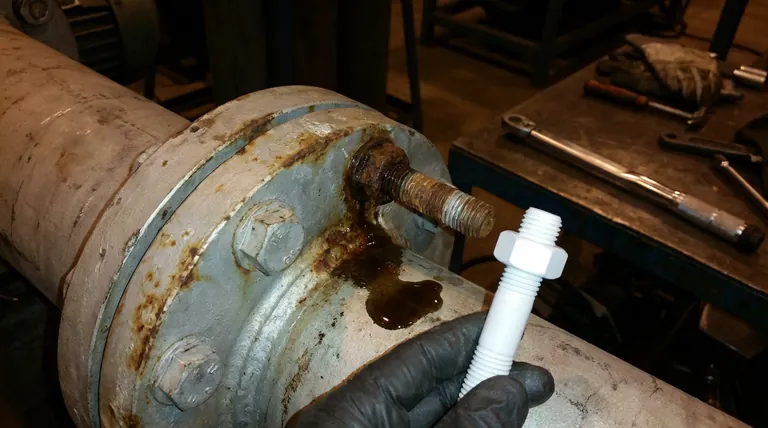
It’s a scenario that keeps maintenance managers and engineers up at night. A critical flange connection on a high-pressure line has been meticulously assembled. Your team used high-grade bolts and tightened them with a calibrated torque wrench to the exact specification in the manual. Everything looks perfect.
A week later, you get the call. There's a leak. Or worse, the vibration from a nearby pump has caused the joint to loosen. How is this possible?
The Frustrating Cycle of "Solutions" That Don't Solve Anything
When a critical joint fails, the response is usually predictable. First, you dispatch a team to re-torque the bolts. This might stop the leak for a little while, but the problem often returns.
So, you escalate. Maybe you switch to a stronger, more expensive material like stainless steel. Or perhaps you try a different anti-seize lubricant, creating a messy, inconsistent application process. You might even blame the gasket, replacing it with a more expensive model.
Despite these efforts, the root problem persists. The consequences are more than just frustrating; they are costly:
- Unscheduled Downtime: Every hour your process is offline to fix a "simple" joint is an hour of lost production and revenue.
- Wasted Resources: You burn through expensive fasteners, custom gaskets, and valuable man-hours chasing a problem that won't stay fixed.
- Safety and Environmental Risks: In chemical, oil and gas, or high-purity applications, a failed joint isn't an inconvenience—it's a potential safety incident or a source of costly contamination.
These "solutions" all fail for the same reason: they are attempts to treat a symptom, not the underlying disease. The strength of the bolt is almost never the issue.
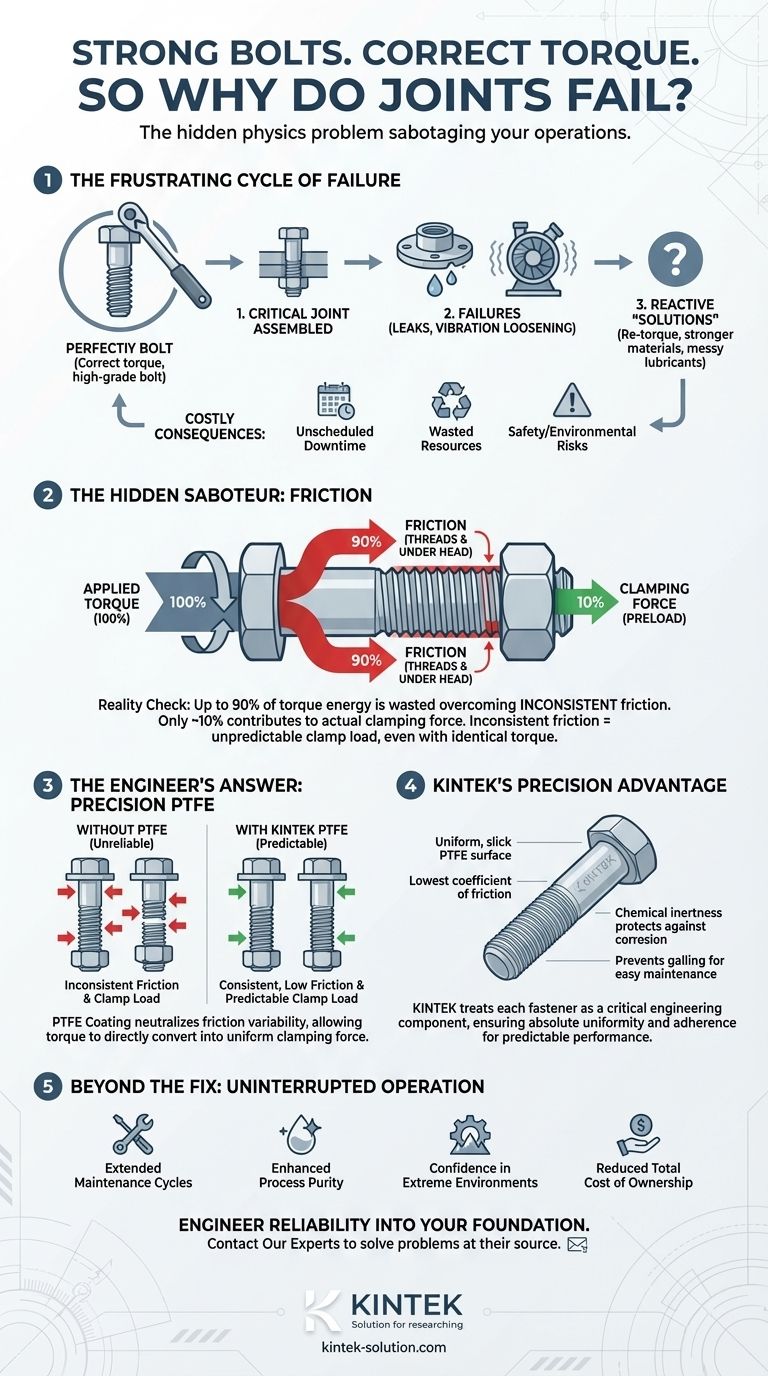
The Hidden Saboteur: Where 90% of Your Torque Really Goes
The core of the problem lies in a fundamental physical principle that is often overlooked. When you apply torque to a bolt, where do you think that energy goes? Common sense suggests it goes into stretching the bolt, creating the clamping force (known as "preload") that holds the joint together.
The reality is shocking: in a typical, unlubricated steel bolt, as much as 90% of your torque energy is consumed simply to overcome friction—about 50% in the threads and 40% under the bolt head.
Only the remaining 10% of your effort actually contributes to the clamping force.
This is the hidden saboteur. The amount of friction is not only massive, but it's also wildly inconsistent. It varies based on surface finish, the presence of dirt or rust, and even humidity. This means that even when you apply the exact same torque to two identical bolts, the resulting clamping force can differ dramatically. One bolt might achieve the target tension, while the one next to it might have only 50% of the required clamp load.
This uneven pressure is what creates microscopic gaps in the joint, inviting leaks, loosening under vibration, and ultimately, failure. This is why stronger bolts don't help—they face the same unpredictable friction. It’s why messy, inconsistent lubricants are a poor substitute for true control. You aren't fighting a strength problem; you're fighting a physics problem.
The Engineer's Answer: Turning Friction from an Enemy into an Ally
To truly solve this problem, you don't need a stronger bolt. You need to control the friction. The ideal solution would be a method that makes the coefficient of friction extremely low and, crucially, perfectly consistent from bolt to bolt.
This is precisely the engineering principle behind using a precision-applied Polytetrafluoroethylene (PTFE) coating.
A high-quality PTFE coating, commonly known by the brand name Teflon®, does more than just provide its famous corrosion resistance. It fundamentally changes the physics of the joint.
- It Neutralizes Unpredictable Friction: PTFE has one of the lowest coefficients of friction of any solid. By creating a uniform, slick surface on the threads and head, it dramatically reduces the energy lost to friction. This allows your applied torque to be converted directly and predictably into clamping force. The result? Every bolt achieves the correct preload, creating a secure, evenly compressed joint.
- It Forms an Impenetrable Barrier: The chemical inertness of PTFE protects the underlying bolt metal from the aggressive acids, solvents, or saltwater that would otherwise cause corrosion and seizure, ensuring long-term integrity.
- It Simplifies Maintenance: The non-stick properties of PTFE prevent galling and seizure, a common headache with stainless steel fasteners. Disassembly for maintenance becomes fast and clean, often allowing the fasteners to be reused and dramatically reducing downtime.
KINTEK's Precision PTFE: A Tool Built on Physics
A PTFE coating is only as good as its application. At KINTEK, we aren't just coating parts; we are manufacturing precision components. We understand that for a PTFE-coated fastener to solve the core friction problem, the coating must be applied with absolute uniformity and adherence. As specialists in custom PTFE fabrication for demanding industries like semiconductor and medical, we treat each fastener as a critical engineering component, ensuring it delivers the predictable performance your application demands.
Beyond the Fix: Designing for Uninterrupted Operation
Once you eliminate unpredictable friction, you move beyond the reactive cycle of fixing leaks. You start engineering reliability into the very foundation of your equipment. For our clients, this has unlocked new possibilities:
- Extended Maintenance Cycles: With joints that are verifiably secure and protected from corrosion, you can extend the time between scheduled shutdowns, boosting overall productivity.
- Enhanced Process Purity: In semiconductor or lab environments, a fully-sealed, chemically inert system prevents contamination that could ruin entire production batches.
- Confidence in Extreme Environments: Engineers designing offshore platforms or chemical reactors can now specify joints with a known, reliable clamping force, confident that they will perform for years without failure.
- Reduced Total Cost of Ownership: The initial investment in a precision-coated fastener is quickly returned through eliminated downtime, reusable hardware, and the prevention of catastrophic failures.
The right fastener isn't just a piece of hardware; it's a strategic decision to prioritize reliability and operational excellence. By addressing the hidden physics of joint failure, you are not just solving a technical problem—you are building a more robust, predictable, and profitable operation. If you are tired of chasing the same problems, let's discuss how to solve them at their source.
Whether you're battling corrosion in a wastewater plant or ensuring joint integrity in a high-vibration industrial setting, our team can help you apply these principles to your unique project. Contact Our Experts to discuss your specific application and build reliability into your design from the ground up.
Visual Guide