Your Digestion Run Just Failed—But the Acid Wasn’t the Problem
You’ve carefully prepared your samples, added the concentrated nitric and hydrofluoric acids, and programmed the microwave digestion system. Halfway through the cycle, the pressure drops or, worse, an alarm sounds. Upon opening the cavity, you find a warped liner, a compromised seal, and potentially thousands of dollars in corrosive damage to your instrument.
If your laboratory frequently deals with difficult inorganic or organic matrices—such as soil, ores, or polymers—you’ve likely experienced the frustration of inconsistent seals and prematurely "worn out" liners. It’s a common bottleneck that turns a routine preparation step into a high-stakes gamble with your equipment and your data.
The Cost of "Standard" Performance
When digestion liners fail or leak, the immediate reaction is often to blame the temperature settings or the age of the vessel. Many labs attempt to mitigate these failures by:
- Lowering the digestion temperature (which leads to incomplete digestion and poor analytical results).
- Increasing the frequency of liner replacements, which spikes consumable costs.
- Investing in complex, multi-part vessel assemblies that are difficult to clean.
The negative consequences are more than just technical; they are financial. Project deadlines slip as samples are re-run. Costs soar as expensive PTFE components are discarded every few weeks. Most critically, the "memory effect"—where traces of a previous sample hide in the pores of the material—compromises the integrity of ultra-trace analysis, leading to unreliable data that can derail entire research programs.
The Root Cause: Why Standard PTFE "Bows" Under Pressure
To understand why standard PTFE often falls short, we have to look at its behavior on a molecular level. Standard PTFE is a remarkable material for its chemical inertness, but it has a "fatal flaw" in high-pressure environments: Cold Flow (Creep).
Even well below its melting point, PTFE behaves like a very slow-moving liquid when subjected to heat and load. In a microwave digestion vessel, the combination of temperatures exceeding 200°C and pressures over 50 bar causes standard PTFE to physically deform. This deformation—or "creep"—leads to:
- Seal Failure: As the liner wall thins or the rim deforms, the vessel can no longer maintain the pressure required for the reaction.
- Increased Permeability: Standard PTFE has a relatively high porosity. Under pressure, acid vapors and sample ions can migrate into the material. This not only weakens the liner but also leads to cross-contamination between different sample runs.
The "common solutions" fail because they attempt to fix the vessel's geometry without addressing these fundamental material limitations.
The Solution: TFM—Engineering the Flow Out of the Material
The transition from standard PTFE to TFM (a modified PTFE) isn't just a minor upgrade; it is a fundamental shift in material science designed specifically for the extremes of the modern lab.
By incorporating a small amount of perfluoropropyl vinyl ether (PPVE) into the polymer chain, TFM achieves a denser, more rigid molecular structure. Our TFM-based digestion liners address the root causes of failure through three critical improvements:
- Substantially Reduced Creep: TFM maintains its shape under high pressure and temperature far better than standard PTFE. This means the critical sealing surfaces stay intact run after run, preventing leaks and protecting your microwave.
- Lower Porosity and Gas Permeability: The denser structure of TFM significantly reduces the "memory effect." It is less likely to absorb sample components or acid vapors, ensuring that your ultra-trace analysis remains pure and your cleaning cycles are more effective.
- Enhanced Mechanical Strength: Because TFM-PTFE is tougher at elevated temperatures, the liners can withstand more aggressive digestion protocols, allowing you to process tougher matrices that standard PTFE simply cannot handle.
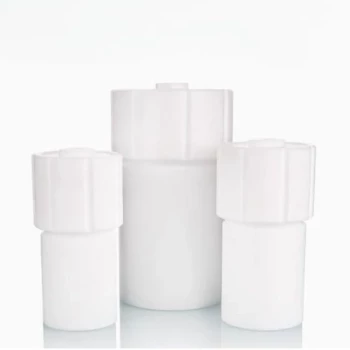
At KINTEK, we don't just provide the material; we apply high-precision CNC fabrication to ensure that every TFM liner meets exact tolerances. A better material is only effective if the fit is perfect, ensuring a gastight seal that protects your investment.
Beyond the Fix: Unlocking New Analytical Potentials
When the "hidden struggle" of liner deformation is removed, your laboratory moves from a defensive posture to an offensive one. By switching to high-precision TFM liners, you unlock the ability to:
- Digestion of Extreme Matrices: Confidently process refractory oxides and complex polymers that require higher temperatures and pressures.
- Accelerate Throughput: Reduced cross-contamination and more durable hardware mean less downtime for cleaning and fewer interrupted runs.
- Achieve Ultra-Trace Precision: With lower permeability, you can push the limits of your detection levels without fear of background noise from previous samples.
Solving the material challenge of the digestion liner is the first step toward a more efficient, reliable, and high-performing laboratory environment.
Whether you are struggling with frequent vessel failures or looking to optimize your trace analysis workflow, our team is ready to help you transition to higher-performance materials tailored to your specific microwave system. Let's work together to ensure your labware is as robust as your research. Contact Our Experts to discuss your custom TFM requirements today.
Related Products
- 5ml High Pressure PTFE Digestion Vessel for Geological Mineral Analysis Corrosion Resistant Polytetrafluoroethylene TFM Digestion Inner Liner
- High Purity TFM Microwave Digestion Vessels PTFE Acid Evaporation Liners Domestic GT-400 Equivalent Laboratory Reaction Containers
- Custom TFM Reaction Vessel with Stainless Steel Jacket and PTFE Inner Cup for High Corrosion Resistance
- High Purity PTFE Microwave Digestion Vessel Replacement Liner for Acid Sample Preparation and Trace Analysis
- Custom High Purity TFM Microwave Digestion Vessel 100ml Capacity Compatible Replacement Liner for Professional Analytical Instruments