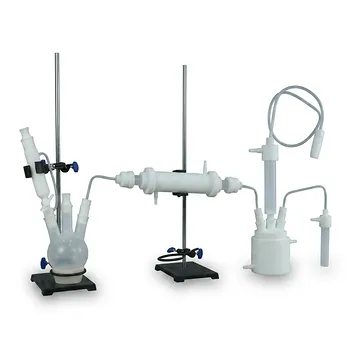
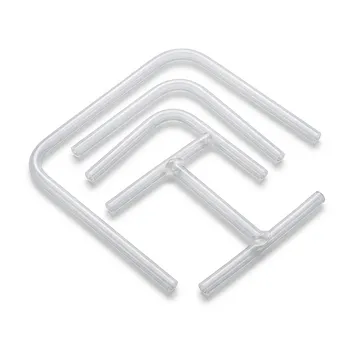
The High Cost of Thermal Frustration
Have you ever walked into the lab to find a critical distillation process halted because a condenser tube couldn't handle the heat? Or perhaps you’ve dealt with the opposite nightmare: a cryogenic cooling line that became brittle and shattered under pressure?
In sectors like semiconductor manufacturing and new energy research, thermal cycling isn't just a variable—it’s a constant. When your equipment fails at the thermal margins, it isn't just a technical glitch; it’s a business crisis. Every hour of downtime translates to lost revenue, delayed R&D milestones, and the potential for expensive batch contamination.
The Conventional Struggle: Why "Standard" Materials Fall Short
When faced with extreme temperature swings, many engineers feel trapped between a rock and a hard place.
Traditionally, the "go-to" solutions have been glass or specialty metal alloys. However, these come with significant trade-offs:
- Glass is excellent for purity but is notoriously vulnerable to thermal shock. One rapid transition from steam to coolant, and the resulting crack can ruin a week’s worth of work.
- Metals, while durable, often succumb to corrosion when exposed to the aggressive reagents used in trace analysis or chemical synthesis.
- Common Polymers often seem like a good middle ground, until they reach their "glass transition" temperature and become brittle, or worse, reach their flow point and begin to deform, leading to leaks and process failure.
Many teams attempt to manage these risks by over-engineering their systems with complex heat exchangers or by slowing down their processes to "nurse" the equipment. These aren't solutions; they are expensive compromises.
The Science of Stability: Why PTFE Doesn't "Give Up"
The reason most materials fail at extreme temperatures is molecular. In most plastics, heat provides enough energy to break the molecular chains (chain scission) or allow them to slide past each other, causing the material to melt and flow.
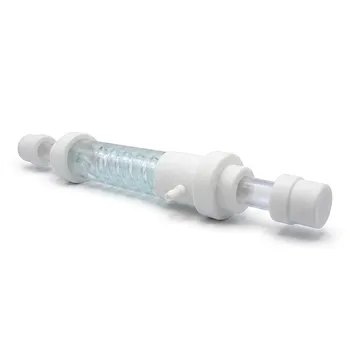
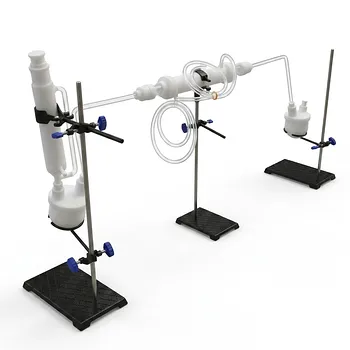
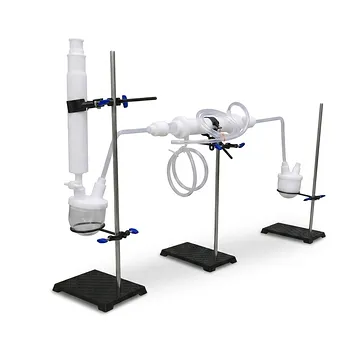
PTFE (Polytetrafluoroethylene) operates on a different set of rules. To understand why PTFE condenser tubes can operate continuously from -268°C up to 260°C, we have to look at the "hidden" physics of the material:
1. The Carbon-Fluorine Shield
The bond between carbon and fluorine is one of the strongest in organic chemistry. This high bond strength prevents the molecular chains from breaking down even when subjected to intense thermal energy. While other materials degrade, PTFE remains chemically intact.
2. The "No-Flow" Phenomenon
Perhaps the most misunderstood aspect of PTFE is its melting behavior. While PTFE has a crystalline melting point of 327°C, it does not "melt" in the way a wax candle does. Due to an exceptionally high melt viscosity (between 10^10 and 10^12 Pa·s), PTFE transitions into a stable, gel-like state rather than a liquid. It maintains its shape and dimensional stability even as it approaches its upper limits.
3. Cryogenic Resilience
On the cold end of the spectrum, PTFE remains functional at temperatures as low as -268°C (nearly absolute zero). Unlike many materials that become as fragile as eggshells when frozen, PTFE retains enough physical property stability to handle industrial cooling duties without catastrophic failure.
The Right Tool for the Thermal Edge
Understanding the science is the first step; applying it is the second. At KINTEK, we don't just provide "plastic tubes." We manufacture high-precision PTFE and PFA components designed specifically to harness these unique thermal properties.
Our PTFE condenser tubes and fluid transfer components are engineered to be the "silent workhorses" of your lab. Because we specialize in custom CNC fabrication, we ensure that every fitting, valve, and tube is manufactured to tolerances that account for thermal expansion.
When you choose a KINTEK PTFE solution, you are choosing a tool that was designed with the understanding that 260°C isn't just a number on a datasheet—it’s a high-stakes environment where equipment must not fail.
Unlocking New Potential in Your Research
When you solve the problem of thermal instability, you do more than just "fix a leak." You open the door to process intensification.
Imagine being able to:
- Accelerate Chemical Synthesis: Run reactions at higher temperatures with total confidence in your hardware.
- Ensure Ultra-Pure Trace Analysis: Use PFA and PTFE labware that won't leach contaminants, even under rigorous thermal cleaning cycles.
- Simplify System Design: Replace fragile glass-and-metal hybrids with a unified, high-purity fluoropolymer fluid path.
By removing the "thermal ceiling" from your equipment, you allow your team to focus on the science, not the hardware.
Whether you are scaling up a semiconductor etching process or developing the next generation of high-energy battery electrolytes, your equipment should be an enabler, not a bottleneck. At KINTEK, we specialize in turning the unique properties of PTFE and PFA into tailored solutions for the world’s most demanding research environments. If you are struggling with component failure or need a custom-fabricated solution for your thermal challenges, our engineering team is ready to help.
Contact Our Experts to discuss your specific project requirements and discover how precision-engineered PTFE can stabilize your most critical processes.
Related Products
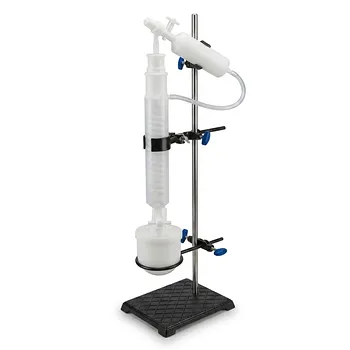
- Custom PTFE Condenser Tube 100ml Serpentine and Straight Fluoropolymer Laboratory Heat Exchanger with Flask Adapters
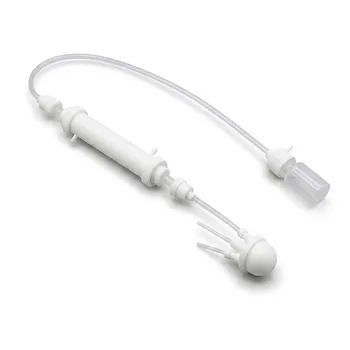
- Custom PTFE Condenser Tube Hydrofluoric Acid Resistant Reflux Device Constant Pressure Separatory Funnel
- Custom PTFE Condenser Tube Reflux Reaction Condensation Purification Device Semiconductor Chemical Lab Equipment
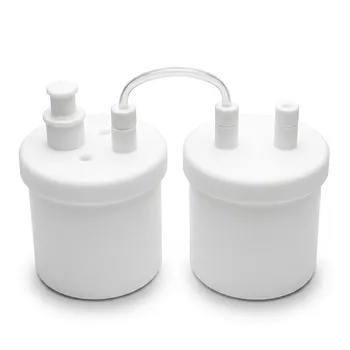
- Custom PTFE Condensation Device Reflux Condenser Tube Fluoropolymer Heat Exchanger Chemical Resistant Laboratory Apparatus
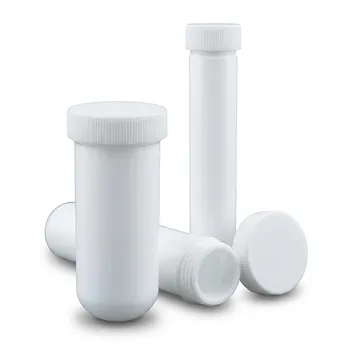
- High Purity PTFE Digestion Tubes and Custom Centrifuge Tubes 100ml for Trace Analysis and Chemical Digestion
Related Articles
- Why Trace Contamination Still Haunts Your Yields—And the Overlooked Role of Condenser Surface Integrity
- The "Efficiency Drift" Problem: Why Your Heat Exchangers Fail and How PTFE Stops the Cycle
- The Hidden Risks of Medical Fluid Transfer: Why Standard Tubing Fails and How to Solve the Purity Puzzle
- Why Your PTFE Tubing Shouldn't Be "Melted": Understanding the Power of Paste Extrusion
- Why Your High-Purity Fluid Systems Keep Failing: The Hidden Culprit in Your Connectors