At its core, PTFE paste extrusion is the specialized manufacturing process used to create high-performance, flexible, and thin-walled products that are impossible to make with other methods. It is primarily used for producing high-specification wire insulation, durable chemical transfer hoses and pipe liners, and critical tubing for the aerospace, automotive, and medical industries.
The crucial insight is that paste extrusion is not just a shaping process; it's a structural engineering process. It uniquely transforms PTFE fine powder into a strong, fibrillated material, enabling the creation of products that demand extreme flexibility, chemical inertness, and reliability under harsh conditions.
Why Paste Extrusion is Essential for High-Performance PTFE
Standard extrusion methods that involve melting a material and forcing it through a die don't work well for PTFE. Paste extrusion is a multi-step, lower-temperature process designed specifically to overcome PTFE's unique material properties.
The Role of Lubricant
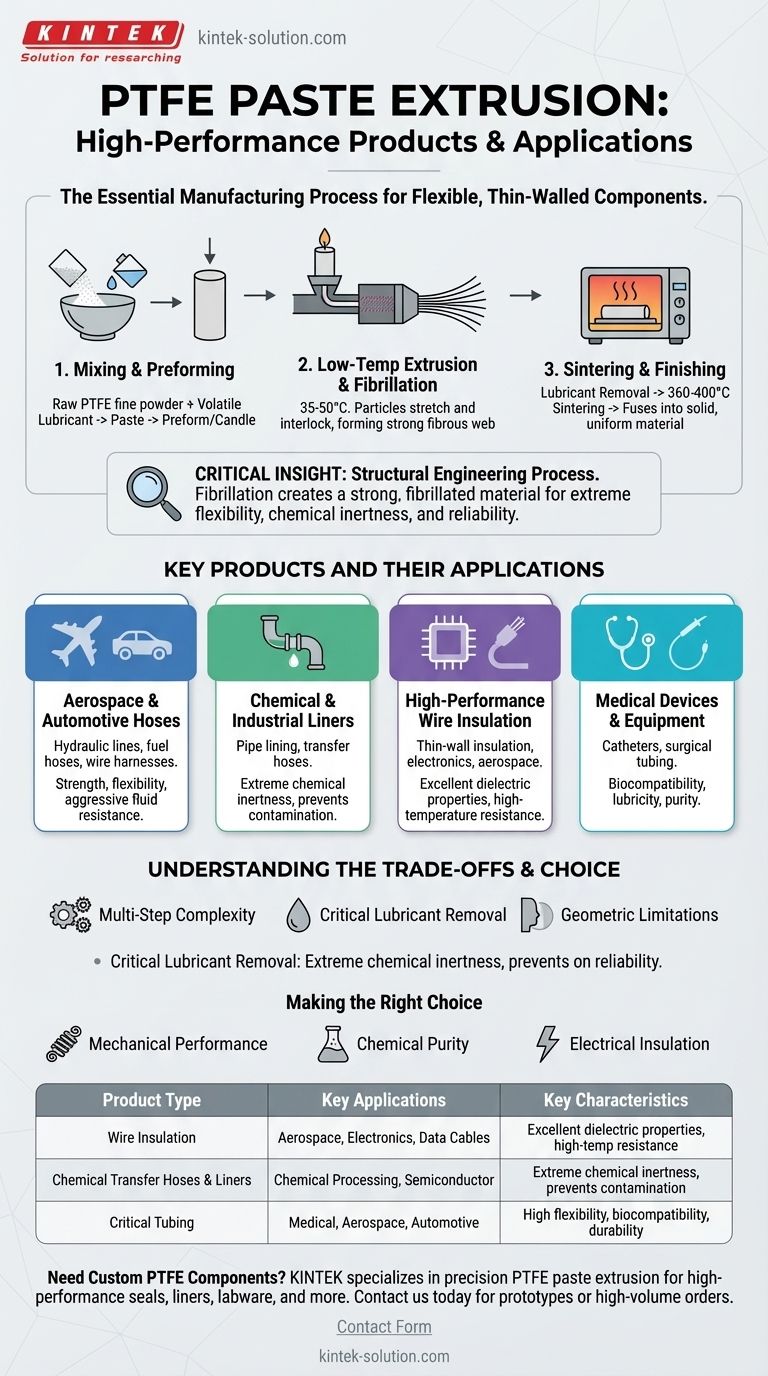
Raw PTFE fine powder does not flow like a typical plastic. To make it processable, it is mixed with a volatile lubricant, such as mineral spirits, to form a workable paste or dough.
This paste is then compressed into a solid cylinder called a "preform" or "candle," which is loaded into the extruder.
Creating Strength Through Fibrillation
The material is extruded at a relatively low temperature, between 35-50°C. The mechanical pressure forces the PTFE particles to stretch and interlock, forming a strong, fibrous web-like structure.
This process, known as fibrillation, is what gives the final product its exceptional mechanical strength and flexibility.
The Critical Sintering Step
After extrusion, the product is heated to carefully dry off and remove the lubricant.
Finally, it is sintered at high temperatures (360-400°C). This fuses the PTFE particles into a solid, uniform, and air-free finished product with the material's signature properties fully realized.
Key Products and Their Applications
The unique characteristics imparted by paste extrusion make it the only choice for a range of demanding applications where failure is not an option.
Aerospace and Automotive Hoses
The combination of strength, flexibility, and resistance to aggressive fluids makes these products ideal for hydraulic lines, fuel hoses, and wire harnesses in aircraft and high-performance vehicles.
Chemical and Industrial Liners
Paste-extruded PTFE is used to line pipes and create transfer hoses for handling highly corrosive chemicals and solvents. Its chemical inertness prevents contamination and ensures process purity.
High-Performance Wire Insulation
Due to its excellent dielectric properties and high-temperature resistance, paste-extruded PTFE is used as a thin-wall insulation for critical wiring in electronics, aerospace, and data cables.
Medical Devices and Equipment
The biocompatibility and lubricity of PTFE make it suitable for catheters, surgical tubing, and other medical components where purity and performance are paramount.
Understanding the Trade-offs
While powerful, paste extrusion is a more complex and deliberate process than other polymer manufacturing methods.
Multi-Step Process Complexity
The need for precise mixing, preforming, lubricant removal, and sintering makes the process more involved and slower than simple melt extrusion.
Critical Lubricant Removal
The quality of the final product depends entirely on the complete and uniform removal of the lubricant. Any residual solvent can create imperfections or points of failure.
Geometric Limitations
This method is best suited for producing continuous profiles like tubing, liners, and wire coatings. It is not used for creating complex, molded 3D shapes.
Making the Right Choice for Your Application
Selecting a paste-extruded product is a decision driven by the operational demands of your environment.
- If your primary focus is mechanical performance under stress: Choose paste-extruded products for applications requiring high flexibility, vibration resistance, and durability, such as aerospace hydraulic hoses.
- If your primary focus is chemical purity and inertness: This process is ideal for creating liners and tubing for semiconductor fabrication or aggressive chemical processing where contamination is not an option.
- If your primary focus is electrical insulation: For high-frequency or high-temperature wiring, the thin, uniform walls and superior dielectric strength of paste-extruded PTFE are unmatched.
Ultimately, PTFE paste extrusion is the definitive solution when you need to leverage the material's unique properties in a flexible, thin-walled form factor.
Summary Table:
| Product Type | Key Applications | Key Characteristics |
|---|---|---|
| Wire Insulation | Aerospace, Electronics, Data Cables | Excellent dielectric properties, high-temperature resistance |
| Chemical Transfer Hoses & Liners | Chemical Processing, Semiconductor | Extreme chemical inertness, prevents contamination |
| Critical Tubing | Medical, Aerospace, Automotive | High flexibility, biocompatibility, durability under stress |
Need a custom PTFE component that demands extreme flexibility, chemical inertness, or superior electrical insulation?
At KINTEK, we specialize in precision PTFE paste extrusion, manufacturing high-performance seals, liners, labware, and custom components for the semiconductor, medical, laboratory, and industrial sectors. We handle everything from prototypes to high-volume orders, ensuring your product meets the strictest specifications.
Contact us today to discuss your project and see how our expertise can bring reliability and performance to your most demanding applications.
Visual Guide
Related Products
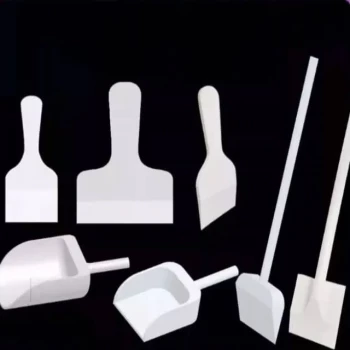
- Customizable PTFE Scrapers and Shovels for Demanding Applications
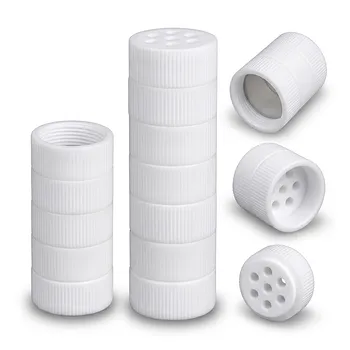
- Corrosion Resistant PTFE Multi Layer Sieve with Threaded Connections for Bio Chemical Laboratory Extraction and Customizable Mesh Size
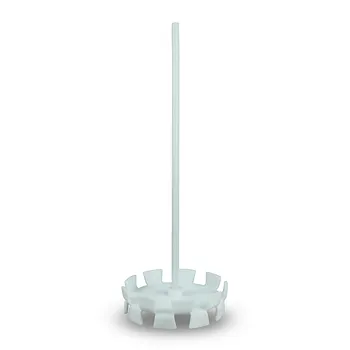
- Corrosion Resistant PTFE Dispersing Disc and High Temperature Propeller Stirring Paddle for Laboratory Chemical Mixing
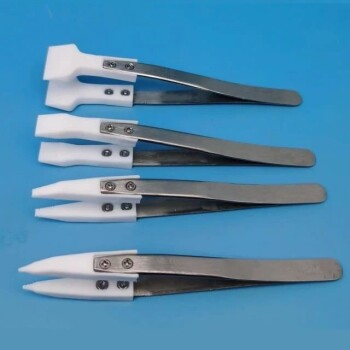
- Custom PTFE Parts Manufacturer for Teflon Parts and PTFE Tweezers
- High Purity PTFE Wide Mouth Extraction Bottle Large Capacity Reaction Vessel for Rotary Agitators
People Also Ask
- Why are PTFE shovels considered cost-effective? Maximize ROI with Superior Durability
- What are the key properties that make PTFE shovels ideal for laboratory use? Ensure Sample Integrity with Chemically Inert Tools
- What are the advantages of PTFE shovels in terms of chemical resistance? Unmatched Inertness for Handling Corrosives
- How does the durability of PTFE shovels compare to plastic shovels? Discover the Superior Choice for Harsh Conditions
- What are some specific applications of PTFE shovels in the laboratory? Ensure Sample Purity and Safety